Key Takeaways:
What is CFD Software?
Computational Fluid Dynamics (CFD) software is used to simulate and analyze the behavior of fluids (liquids and gases) and heat transfer within or around engineering components. It helps engineers evaluate fluid flow, pressure, temperature, turbulence, and aerodynamic performance before manufacturing.
Popular CFD Software:
- ANSYS Fluent – Advanced fluid flow, heat transfer, and turbulence simulation.
- ANSYS CFX – High-performance CFD for turbomachinery and industrial applications.
- STAR-CCM+ – Multiphysics simulation for automotive, aerospace, and marine engineering.
- OpenFOAM – Open-source CFD software for custom fluid flow simulations.
- COMSOL Multiphysics – Coupled fluid, thermal, structural, and electromagnetic analysis.
- SolidWorks Flow Simulation – Integrated CFD for SolidWorks CAD models.
- Autodesk CFD – Fluid flow and thermal analysis for product design optimization.
- SimScale – Cloud-based CFD and FEA simulation platform.
Applications of CFD Software:
CFD software is widely used in the automotive, aerospace, mechanical, chemical, civil, HVAC, marine, biomedical, and energy industries for aerodynamic analysis, cooling system design, heat transfer, combustion analysis, ventilation studies, and fluid flow optimization.
Advantages of CFD Software:
CFD software reduces the need for physical prototypes, improves product performance, predicts flow behavior accurately, identifies design issues early, shortens development time, lowers testing costs, and enhances product reliability.
In this article:
CFD Software
Introduction
Computational Fluid Dynamics (CFD) software is a specialized computer application used to simulate and analyze the behavior of fluids (liquids and gases) and their interaction with solid surfaces. It uses advanced numerical methods to solve the governing equations of fluid flow, heat transfer, and related physical phenomena. CFD software enables engineers to predict fluid behavior under various operating conditions without relying solely on expensive physical experiments or prototypes.
Modern CFD software plays a crucial role in engineering design by helping engineers optimize product performance, improve energy efficiency, reduce development costs, and accelerate product development. It is widely used in mechanical, aerospace, automotive, civil, chemical, marine, biomedical, electronics, and energy engineering.
What is CFD Software?
CFD software is a simulation tool that uses the principles of fluid mechanics, thermodynamics, and numerical analysis to model and solve complex fluid flow and heat transfer problems. The software divides the fluid domain into a mesh of small computational cells and solves mathematical equations to determine variables such as velocity, pressure, temperature, and turbulence.
CFD software allows engineers to:
- Analyze fluid flow patterns
- Study heat transfer
- Evaluate pressure distribution
- Predict aerodynamic performance
- Simulate cooling systems
- Optimize fluid system designs
- Reduce physical testing
- Improve product reliability
Popular CFD Software
Several commercial and open-source CFD software packages are available, each offering unique capabilities.
1. ANSYS Fluent
ANSYS Fluent is one of the world’s most widely used CFD software packages.
Features
- Advanced turbulence models
- Heat transfer analysis
- Combustion simulation
- Multiphase flow
- Species transport
- Dynamic mesh
- High-performance computing support
Applications
- Aerospace
- Automotive
- Energy systems
- HVAC
- Chemical processing
2. ANSYS CFX
ANSYS CFX is designed for high-accuracy fluid flow simulations involving rotating machinery.
Features
- Turbomachinery analysis
- Heat transfer
- Rotating equipment simulation
- Multiphase flow
- Compressible flow
Applications
- Pumps
- Compressors
- Turbines
- Fans
3. Siemens Simcenter STAR-CCM+
STAR-CCM+ is an integrated CFD platform used for complex engineering simulations.
Features
- Fluid flow
- Heat transfer
- Multiphase flow
- Particle tracking
- Combustion
- Aerodynamics
Applications
- Automotive
- Aerospace
- Marine
- Energy
4. COMSOL Multiphysics
COMSOL combines CFD with other physics simulations.
Features
- Fluid flow
- Heat transfer
- Structural interaction
- Electromagnetics
- Chemical transport
Applications
- Research
- Biomedical engineering
- Electronics
- Chemical engineering
5. SolidWorks Flow Simulation
Integrated directly into SolidWorks CAD software.
Features
- Internal and external flow analysis
- Thermal analysis
- HVAC simulation
- Electronic cooling
- Parametric studies
Applications
- Mechanical product design
- Consumer products
- Industrial equipment
6. Autodesk CFD
Autodesk CFD focuses on design optimization.
Features
- Fluid flow
- Heat transfer
- Pressure analysis
- Airflow simulation
- Thermal comfort analysis
Applications
- Building design
- Mechanical systems
- Electronics cooling
7. Altair AcuSolve
AcuSolve is a general-purpose CFD solver.
Features
- Turbulent flow
- Heat transfer
- Multiphase flow
- Fluid-structure interaction
Applications
- Automotive
- Industrial equipment
- Aerospace
8. FLOW-3D
FLOW-3D specializes in free-surface flow simulations.
Features
- Free-surface flow
- Casting simulation
- Hydraulic analysis
- Wave simulation
Applications
- Water engineering
- Casting
- Environmental engineering
9. SimScale
A cloud-based simulation platform.
Features
- Browser-based simulation
- CFD
- FEA
- Thermal analysis
- Collaboration tools
Applications
- Startups
- Education
- Product design
10. OpenFOAM (Open Source)
One of the most popular open-source CFD software packages.
Features
- Customizable solver
- Turbulence models
- Multiphase flow
- Heat transfer
- Combustion
Applications
- Research
- Academia
- Industrial simulations
11. SU2 (Open Source)
SU2 is widely used for aerodynamic optimization.
Features
- Compressible flow
- Shape optimization
- Heat transfer
- Aerodynamics
12. Code_Saturne (Open Source)
Developed for industrial CFD applications.
Features
- Turbulent flow
- Thermal analysis
- Combustion
- Environmental simulations
Applications of CFD Software
CFD software is applied across many engineering fields.
Mechanical Engineering
- Heat exchangers
- Pumps
- Compressors
- HVAC systems
- Valves
- Cooling systems
Aerospace Engineering
- Aircraft aerodynamics
- Jet engines
- Rockets
- UAVs
- Wing optimization
Automotive Engineering
- Vehicle aerodynamics
- Engine cooling
- Radiators
- Air intake systems
- Exhaust systems
Civil Engineering
- Wind engineering
- Building ventilation
- Tunnel airflow
- Smoke management
Chemical Engineering
- Reactors
- Mixing tanks
- Distillation columns
- Process equipment
Marine Engineering
- Ship hulls
- Propellers
- Offshore structures
- Underwater vehicles
Biomedical Engineering
- Blood flow analysis
- Artificial heart valves
- Respiratory airflow
- Medical devices
Electronics
- CPU cooling
- Heat sinks
- Battery thermal management
- Electronic packaging
Energy Industry
- Wind turbines
- Boilers
- Gas turbines
- Nuclear reactors
- Solar thermal systems
Advantages of CFD Software
1. Reduces Development Costs
Virtual simulations reduce the need for expensive physical prototypes and experimental testing.
2. Saves Time
Engineers can evaluate multiple design concepts quickly, shortening the product development cycle.
3. Improves Product Performance
CFD helps optimize fluid flow, cooling, aerodynamics, and heat transfer.
4. Enhances Safety
Potential issues such as overheating, pressure buildup, or poor ventilation can be identified before manufacturing.
5. Visualizes Complex Flow Patterns
Engineers can view velocity vectors, pressure contours, temperature fields, and streamlines that are difficult to measure experimentally.
6. Supports Complex Geometries
CFD software can analyze intricate components and systems with high accuracy.
7. Optimizes Energy Efficiency
Improves the performance of pumps, turbines, HVAC systems, and heat exchangers while reducing energy consumption.
8. Accelerates Product Development
Virtual testing speeds up design validation and reduces time-to-market.
9. Enables Design Optimization
Engineers can compare multiple design alternatives and identify the most efficient solution.
10. Facilitates Multiphysics Simulation
Many CFD packages integrate with structural, thermal, electromagnetic, and chemical simulations for comprehensive product analysis.
Key Features of CFD Software
- CAD model import and integration
- Automatic and manual mesh generation
- Advanced turbulence models
- Heat transfer analysis
- Multiphase flow simulation
- Combustion modeling
- Fluid-structure interaction (FSI)
- Parallel computing and GPU support (in some packages)
- High-quality visualization tools
- Automated report generation
Comparison of Popular CFD Software
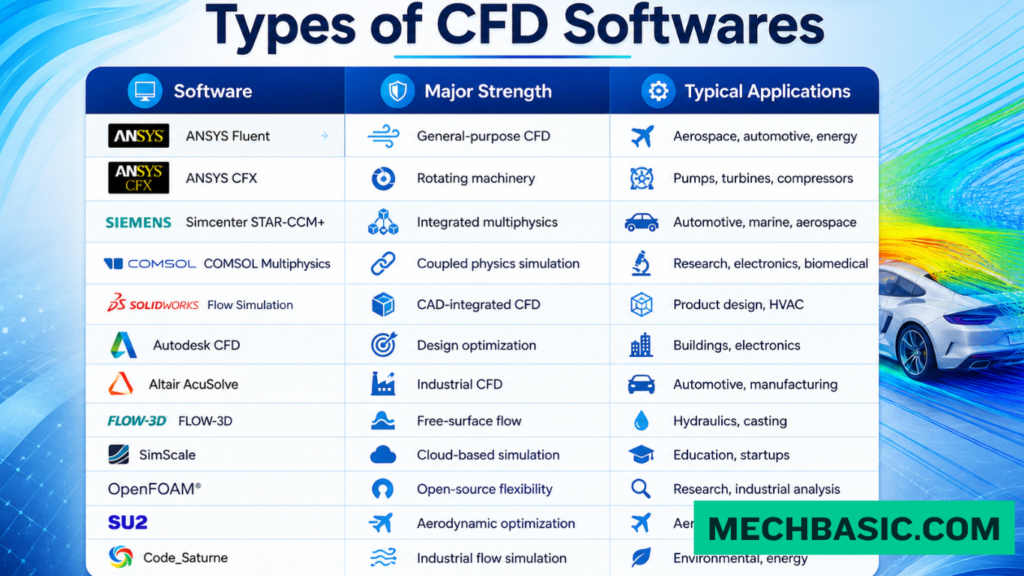
| Software | Major Strength | Typical Applications |
|---|---|---|
| ANSYS Fluent | General-purpose CFD | Aerospace, automotive, energy |
| ANSYS CFX | Rotating machinery | Pumps, turbines, compressors |
| Simcenter STAR-CCM+ | Integrated multiphysics | Automotive, marine, aerospace |
| COMSOL Multiphysics | Coupled physics simulation | Research, electronics, biomedical |
| SolidWorks Flow Simulation | CAD-integrated CFD | Product design, HVAC |
| Autodesk CFD | Design optimization | Buildings, electronics |
| Altair AcuSolve | Industrial CFD | Automotive, manufacturing |
| FLOW-3D | Free-surface flow | Hydraulics, casting |
| SimScale | Cloud-based simulation | Education, startups |
| OpenFOAM | Open-source flexibility | Research, industrial analysis |
| SU2 | Aerodynamic optimization | Aerospace |
| Code_Saturne | Industrial flow simulation | Environmental, energy |
Best Practices for Using CFD Software
- Build clean and simplified CAD models.
- Generate a high-quality mesh with boundary-layer refinement.
- Use accurate fluid properties.
- Apply realistic inlet, outlet, and wall boundary conditions.
- Choose appropriate turbulence and physical models.
- Monitor convergence and residuals.
- Perform mesh independence studies.
- Validate simulation results using experiments or analytical calculations.
- Document assumptions and simulation settings.
Frequently Asked Questions (FAQs)
1. What is CFD software?
CFD software is a computer application used to simulate fluid flow, heat transfer, and related physical phenomena by solving the governing equations of fluid mechanics numerically.
2. Why is CFD software important?
It enables engineers to optimize designs, improve performance, reduce prototype costs, shorten development time, and analyze complex fluid systems before manufacturing.
3. Which industries use CFD software?
CFD software is widely used in aerospace, automotive, mechanical, civil, marine, biomedical, electronics, chemical, and energy industries.
4. What are the most popular CFD software packages?
Popular CFD software includes ANSYS Fluent, ANSYS CFX, Simcenter STAR-CCM+, COMSOL Multiphysics, SolidWorks Flow Simulation, Autodesk CFD, OpenFOAM, and SimScale.
5. Can CFD software simulate heat transfer?
Yes. Most CFD software can analyze conduction, convection, radiation, thermal management, and cooling performance.
6. What is meshing in CFD?
Meshing divides the fluid domain into small computational cells, allowing the governing equations to be solved numerically. Good mesh quality is essential for accurate results.
7. Can CFD software replace physical testing?
CFD significantly reduces the need for physical prototypes and testing, but experimental validation remains important, especially for critical or safety-related applications.
8. Is CFD software suitable for beginners?
Some software, such as SolidWorks Flow Simulation and SimScale, is beginner-friendly, while advanced tools like ANSYS Fluent, STAR-CCM+, and OpenFOAM require greater expertise.
9. What factors affect CFD simulation accuracy?
Accuracy depends on geometry quality, mesh density, boundary conditions, turbulence models, fluid properties, solver settings, and validation against experimental data.
10. Can CFD software integrate with CAD software?
Yes. Many CFD tools integrate directly with CAD platforms such as SolidWorks, Autodesk Inventor, CATIA, Siemens NX, and Creo, enabling efficient design and simulation workflows.
Conclusion
CFD software is an indispensable tool in modern engineering, allowing engineers to simulate and optimize fluid flow, heat transfer, and related physical processes before manufacturing. By providing detailed insights into velocity, pressure, temperature, turbulence, and aerodynamic performance, CFD software helps reduce development costs, improve product quality, enhance safety, and accelerate innovation. From commercial solutions such as ANSYS Fluent, Simcenter STAR-CCM+, and COMSOL Multiphysics to open-source platforms like OpenFOAM, CFD software supports a wide range of industries and applications. When combined with accurate modeling, quality meshing, and proper validation, CFD software enables the development of efficient, reliable, and high-performance engineering products.
Ansys Fluent: Industry-leading CFD solver for advanced fluid mechanics, aerodynamics, multiphase flows, and combustion.
Latest articles:
Flatness-GD&T | GD&T Tutorials

ANSI vs ISO Standards-Key Differences you need to know
Straightness-GD&T | GD&T Tutorials
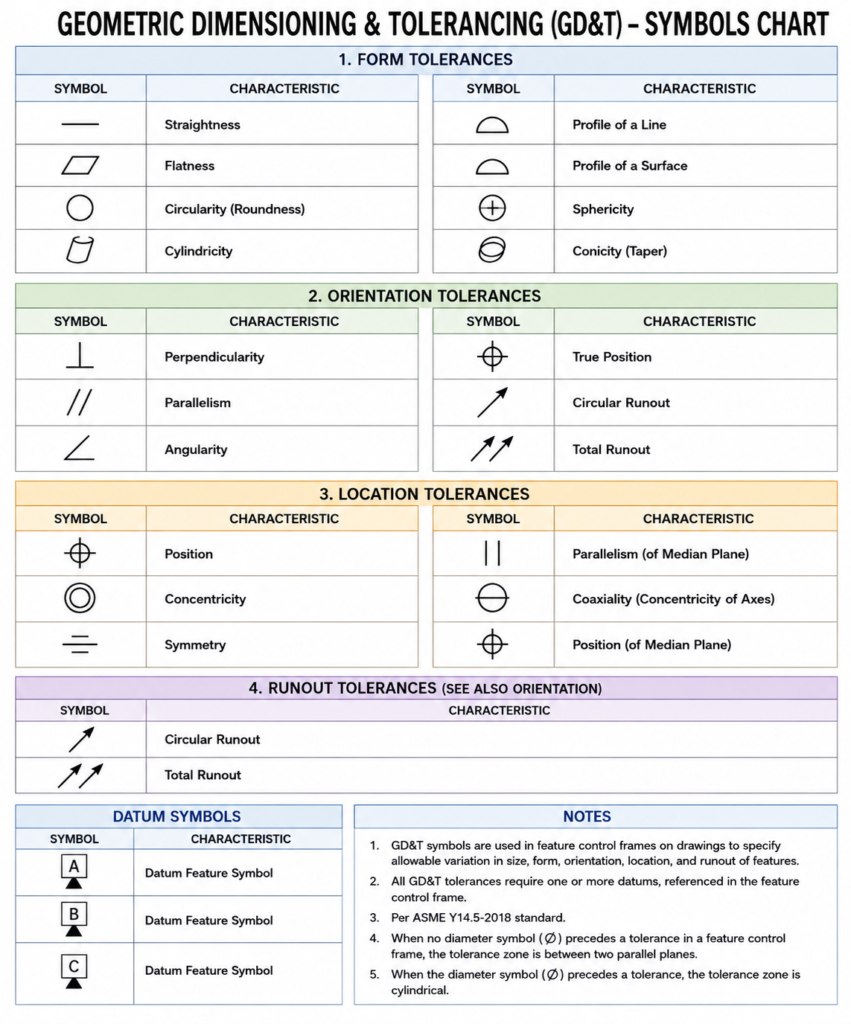
GD&T Symbols chart- Free download | GD&T
Geometric Dimensioning and Tolerancing (GD&T) is a standardized system used in engineering drawings to define…
GD&T Symbols, Basics and full form
Can I convert a DXF to STL?
Can I convert a DXF to STL? Can I Convert a DXF to STL? Yes,…
Categories: