Key Takeaways:
What is ANSYS CFD?
ANSYS CFD is a simulation software used to analyze fluid flow, heat transfer, and related physical phenomena using Computational Fluid Dynamics (CFD). It enables engineers to predict the performance of products under real-world operating conditions, reducing the need for physical testing and improving design efficiency.
Features of ANSYS CFD:
ANSYS CFD provides tools for fluid flow analysis, heat transfer, turbulence modeling, multiphase flow, combustion simulation, aerodynamic analysis, conjugate heat transfer, and particle tracking. It also supports advanced meshing, post-processing, and design optimization.
Applications of ANSYS CFD:
ANSYS CFD is widely used in the automotive, aerospace, mechanical, chemical, energy, HVAC, marine, and biomedical industries for aerodynamic design, engine cooling, HVAC systems, pumps, turbines, heat exchangers, combustion systems, and electronic cooling.
Advantages of ANSYS CFD:
ANSYS CFD improves design accuracy, reduces development time, minimizes the need for physical prototypes, optimizes fluid and thermal performance, lowers testing costs, and enhances product reliability and efficiency.
Types of Analysis in ANSYS CFD:
- Fluid Flow Analysis – Studies the movement of liquids and gases.
- Heat Transfer Analysis – Evaluates temperature distribution and thermal performance.
- Turbulence Analysis – Simulates complex turbulent flow behavior.
- Multiphase Flow Analysis – Models interactions between different fluid phases.
- Combustion Analysis – Simulates fuel combustion and flame behavior.
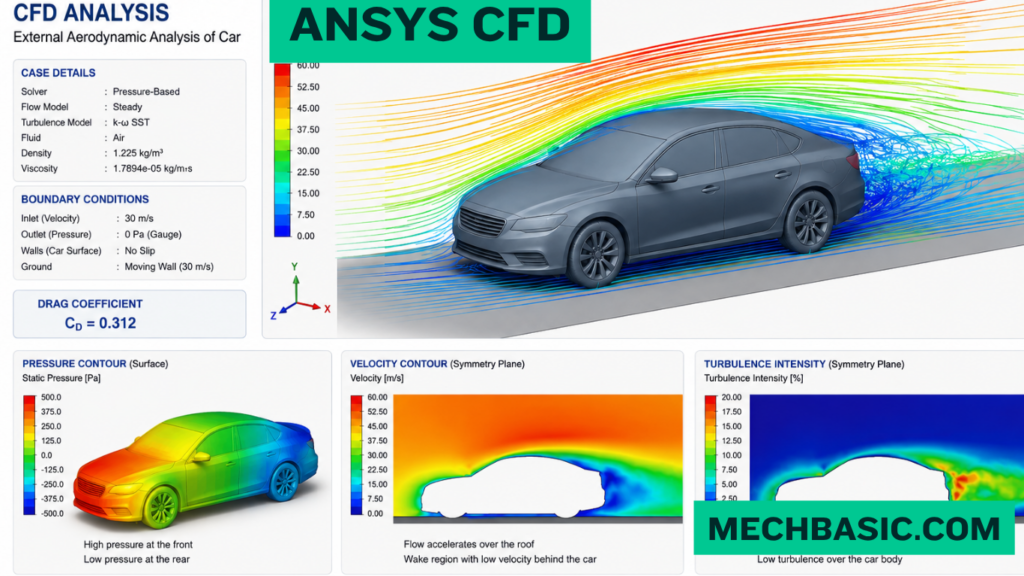
- Aerodynamic Analysis – Evaluates drag, lift, and airflow around objects.
- Conjugate Heat Transfer (CHT) – Analyzes heat transfer between solids and fluids.
- Particle Tracking Analysis – Simulates the motion of particles within fluid flow.
In this article:
ANSYS CFD
Introduction
ANSYS CFD (Computational Fluid Dynamics) is a comprehensive simulation solution developed by ANSYS, Inc. that enables engineers to analyze and predict the behavior of fluids (liquids and gases), heat transfer, turbulence, combustion, and fluid-structure interactions. By using advanced numerical methods to solve the governing equations of fluid flow, ANSYS CFD helps engineers optimize designs, improve product performance, reduce development costs, and minimize the need for physical prototypes.
ANSYS CFD is widely recognized as one of the most powerful CFD platforms available and is extensively used in aerospace, automotive, mechanical, chemical, civil, marine, biomedical, electronics, and energy industries. Its two primary CFD solvers are ANSYS Fluent and ANSYS CFX, each designed for specific types of engineering applications.
What is ANSYS CFD?
ANSYS CFD is a simulation platform that uses Computational Fluid Dynamics (CFD) techniques to model and analyze fluid flow, heat transfer, turbulence, combustion, and related physical phenomena. It enables engineers to create virtual prototypes of products and evaluate their performance under real-world operating conditions before manufacturing.
ANSYS CFD solves the Continuity Equation, Navier–Stokes Equations, and the Energy Equation using advanced numerical methods such as the Finite Volume Method (FVM).
ANSYS CFD helps engineers analyze:
- Fluid flow patterns
- Pressure distribution
- Velocity distribution
- Temperature distribution
- Heat transfer
- Turbulence
- Aerodynamic performance
- Multiphase flow
- Combustion
- Fluid-structure interaction (FSI)
Ansys Fluent Official Page: Overview of Fluent capabilities, HPC scaling, and industry case studies.
Features of ANSYS CFD
ANSYS CFD offers a broad range of advanced simulation capabilities.
1. Advanced Fluid Flow Simulation
Simulates internal and external flows involving:
- Liquids
- Gases
- Compressible flow
- Incompressible flow
Applications include pipes, ducts, pumps, aircraft, and vehicles.
2. Heat Transfer Analysis
Supports all major modes of heat transfer:
- Conduction
- Convection
- Radiation
Applications include:
- Heat exchangers
- Electronics cooling
- Engine cooling
- HVAC systems
3. Turbulence Modeling
ANSYS CFD provides several turbulence models, including:
- k-ε (k-epsilon)
- k-ω (k-omega)
- SST (Shear Stress Transport)
- Reynolds Stress Model (RSM)
- Large Eddy Simulation (LES)
- Detached Eddy Simulation (DES)
- Direct Numerical Simulation (DNS, limited by computational resources)
These models enable accurate simulation of both simple and highly turbulent flows.
4. Multiphase Flow Simulation
Analyzes systems containing more than one phase.
Examples include:
- Air–water flow
- Oil–water separation
- Gas–solid flow
- Bubble dynamics
- Slurry transport
5. Combustion Modeling
Simulates combustion processes in:
- Gas turbines
- Internal combustion engines
- Boilers
- Industrial furnaces
It supports species transport, chemical reactions, and pollutant prediction.
6. Rotating Machinery Simulation
ANSYS CFD accurately models rotating components such as:
- Pumps
- Compressors
- Fans
- Turbines
- Propellers
7. Fluid-Structure Interaction (FSI)
Couples CFD with structural analysis to study interactions between flowing fluids and deformable structures.
Examples:
- Wind acting on bridges
- Blood flow through arteries
- Flexible aircraft wings
8. Dynamic Mesh
Allows simulation of moving or deforming geometries.
Applications include:
- Valve motion
- Piston movement
- Rotating machinery
- Mixing equipment
9. High-Performance Computing (HPC)
Supports parallel processing on multicore CPUs and computing clusters, enabling efficient simulation of large and complex models.
10. Powerful Post-Processing
Visualizes simulation results through:
- Velocity vectors
- Pressure contours
- Temperature contours
- Streamlines
- Particle tracking
- Animations
- 3D flow visualization
Applications of ANSYS CFD
ANSYS CFD is used in a wide range of engineering disciplines.
Aerospace Engineering
- Aircraft aerodynamics
- Jet engines
- Rockets
- UAVs
- Wing optimization
Automotive Engineering
- Vehicle aerodynamics
- Engine cooling
- Battery thermal management
- Exhaust systems
- Cabin airflow
Mechanical Engineering
- Pumps
- Compressors
- Heat exchangers
- HVAC systems
- Valves
- Cooling systems
Civil Engineering
- Wind loading on buildings
- Tunnel ventilation
- Smoke movement
- Urban airflow studies
Chemical Engineering
- Chemical reactors
- Mixing tanks
- Distillation columns
- Process equipment
Marine Engineering
- Ship hull optimization
- Marine propellers
- Offshore structures
- Underwater vehicles
Biomedical Engineering
- Blood flow analysis
- Artificial heart valves
- Drug delivery systems
- Respiratory airflow
Electronics Cooling
- CPU cooling
- Heat sinks
- Battery packs
- Electronic enclosures
Energy Industry
- Wind turbines
- Gas turbines
- Boilers
- Nuclear reactors
- Solar thermal systems
Advantages of ANSYS CFD
1. High Simulation Accuracy
Advanced numerical methods and validated physical models provide reliable predictions for complex fluid and thermal systems.
2. Reduces Development Costs
Virtual testing minimizes the need for multiple physical prototypes and expensive experimental testing.
3. Shortens Product Development Time
Engineers can evaluate and optimize multiple design alternatives quickly, accelerating the product development process.
4. Improves Product Performance
ANSYS CFD helps optimize aerodynamics, heat transfer, fluid flow, and energy efficiency.
5. Handles Complex Physics
It can simulate:
- Turbulence
- Combustion
- Multiphase flow
- Compressible flow
- Fluid-structure interaction
- Rotating machinery
6. Excellent Visualization
Detailed contour plots, streamlines, vectors, and animations make it easier to understand and communicate simulation results.
7. Scalable for Large Problems
Support for high-performance computing enables efficient simulation of industrial-scale models.
8. Integrates with ANSYS Ecosystem
ANSYS CFD works seamlessly with other ANSYS products for structural, thermal, electromagnetic, and multiphysics simulations.
9. Supports Design Optimization
Engineers can perform parametric studies and automated optimization to improve product performance.
10. Widely Accepted in Industry
ANSYS CFD is trusted across industries for product development, certification support, and research due to its extensive validation and robust capabilities.
Types of Analysis in ANSYS CFD
ANSYS CFD supports numerous analysis types depending on the engineering application.
1. Steady-State Flow Analysis
Analyzes fluid flow under constant operating conditions where variables do not change with time.
Applications:
- Pipe flow
- Heat exchangers
- Ventilation systems
2. Transient Flow Analysis
Simulates fluid behavior that changes over time.
Applications:
- Valve opening and closing
- Pulsating flow
- Pump start-up
- Wave propagation
3. Thermal Analysis
Evaluates heat transfer through:
- Conduction
- Convection
- Radiation
Applications:
- Electronic cooling
- Engine cooling
- Heat exchangers
4. Turbulence Analysis
Models turbulent flow using various turbulence models.
Applications:
- Aircraft aerodynamics
- Wind engineering
- Mixing equipment
5. Multiphase Flow Analysis
Simulates interactions between multiple fluid or particulate phases.
Applications:
- Oil and gas pipelines
- Bubble columns
- Slurry transport
6. Combustion Analysis
Studies combustion processes, flame propagation, emissions, and fuel efficiency.
Applications:
- Gas turbines
- Boilers
- Internal combustion engines
7. Compressible Flow Analysis
Analyzes high-speed gas flows where density changes significantly.
Applications:
- Supersonic aircraft
- Rocket nozzles
- Gas turbines
8. Fluid-Structure Interaction (FSI)
Examines the interaction between fluid flow and structural deformation.
Applications:
- Flexible structures
- Biomedical devices
- Offshore platforms
9. Rotating Machinery Analysis
Evaluates the performance of rotating components.
Applications:
- Pumps
- Fans
- Compressors
- Turbines
10. Species Transport Analysis
Simulates the mixing and transport of chemical species.
Applications:
- Combustion systems
- Chemical reactors
- Pollution control
Best Practices for ANSYS CFD
- Use clean and simplified CAD geometry.
- Generate a high-quality mesh with boundary-layer refinement.
- Select the appropriate turbulence and physical models.
- Apply realistic boundary conditions.
- Perform mesh independence studies.
- Monitor residuals and convergence.
- Validate simulation results using experimental or analytical data.
- Document assumptions and engineering decisions.
Summary Table
| Aspect | Description |
|---|---|
| Software | ANSYS CFD (Fluent and CFX) |
| Developer | ANSYS, Inc. |
| Method | Computational Fluid Dynamics (Finite Volume Method) |
| Main Applications | Fluid flow, heat transfer, turbulence, combustion, multiphase flow |
| Common Outputs | Velocity, pressure, temperature, turbulence, drag, lift, heat flux |
| Primary Users | Mechanical, aerospace, automotive, chemical, civil, marine, biomedical, and energy engineers |
Frequently Asked Questions (FAQs)
1. What is ANSYS CFD?
ANSYS CFD is a simulation platform that uses Computational Fluid Dynamics to analyze fluid flow, heat transfer, turbulence, and related physical phenomena in engineering systems.
2. What is the difference between ANSYS Fluent and ANSYS CFX?
- ANSYS Fluent is a versatile general-purpose CFD solver suitable for a wide range of fluid flow and heat transfer applications.
- ANSYS CFX is optimized for high-accuracy simulations involving rotating machinery such as pumps, turbines, compressors, and fans.
3. What industries use ANSYS CFD?
ANSYS CFD is widely used in aerospace, automotive, mechanical, chemical, civil, marine, biomedical, electronics, and energy industries.
4. What types of analyses can ANSYS CFD perform?
It supports steady-state, transient, thermal, turbulence, multiphase, combustion, compressible flow, rotating machinery, fluid-structure interaction, and species transport analyses.
5. What are the main advantages of ANSYS CFD?
Its key advantages include high simulation accuracy, advanced physics models, powerful visualization, reduced development costs, faster product development, and seamless integration with other ANSYS tools.
6. Can ANSYS CFD simulate heat transfer?
Yes. It can model conduction, convection, and radiation, making it suitable for cooling systems, heat exchangers, electronic devices, and thermal management applications.
7. Does ANSYS CFD support high-performance computing?
Yes. ANSYS CFD supports parallel processing and distributed computing, enabling efficient simulation of large and computationally intensive models.
8. Can ANSYS CFD replace experimental testing?
ANSYS CFD significantly reduces the need for physical testing and prototypes, but experimental validation remains essential for critical engineering applications and certification.
9. What factors affect the accuracy of ANSYS CFD simulations?
Accuracy depends on mesh quality, geometry, material properties, boundary conditions, turbulence model selection, solver settings, and validation against experimental or analytical results.
10. Is ANSYS CFD suitable for beginners?
ANSYS CFD offers user-friendly interfaces and extensive documentation, but mastering advanced simulation techniques requires a solid understanding of fluid mechanics, heat transfer, and numerical methods.
Conclusion
ANSYS CFD is one of the most advanced and widely used Computational Fluid Dynamics platforms available for engineering simulation. By accurately modeling fluid flow, heat transfer, turbulence, combustion, and fluid-structure interactions, it enables engineers to optimize designs, improve performance, reduce development costs, and accelerate innovation. Whether using ANSYS Fluent for general-purpose CFD or ANSYS CFX for rotating machinery applications, engineers across industries rely on ANSYS CFD to solve complex fluid dynamics challenges with confidence. Its comprehensive physics models, powerful visualization tools, scalability, and integration with the ANSYS ecosystem make it an indispensable solution for modern engineering analysis and product development.
Latest articles:

Best Budget Workstation Laptops for SolidWorks and Heavy 3D Assembly Modeling
Best Budget Workstation Laptops for SolidWorks and Heavy 3D Assembly Modeling Overview What Does SOLIDWORKS…

SolidWorks Standard vs Professional vs Premium: Full Feature Comparison
SolidWorks Standard vs Professional vs Premium: Full Feature Comparison Overview: SOLIDWORKS Package Overview SOLIDWORKS comes…

SolidWorks 2026 License Cost: Perpetual vs Subscription Pricing Breakdown
SolidWorks 2026 License Cost: Perpetual vs Subscription Pricing Breakdown Overview: SOLIDWORKS 2026 License Options SOLIDWORKS…

Flatness-GD&T | GD&T Tutorials
ANSI vs ISO Standards-Key Differences you need to know
Straightness-GD&T | GD&T Tutorials
Categories: