Key Takeaways:
What is CFD Engineering?
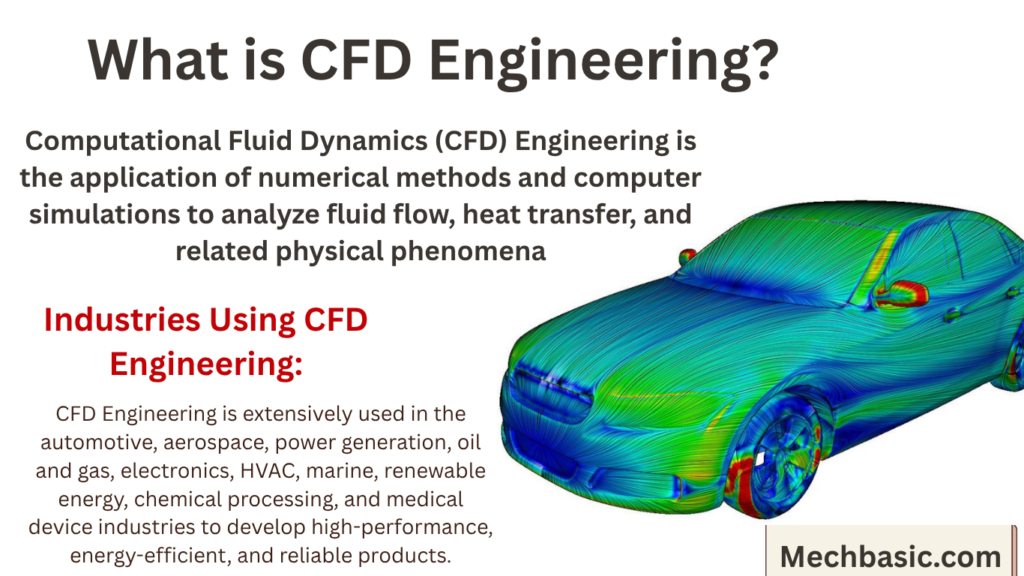
Computational Fluid Dynamics (CFD) Engineering is the application of numerical methods and computer simulations to analyze fluid flow, heat transfer, and related physical phenomena. It enables engineers to predict the performance of products and systems under real-world conditions, reducing the need for costly physical testing.
Importance of CFD Engineering:
CFD Engineering helps improve product performance, optimize fluid flow, reduce development costs, minimize physical prototypes, shorten design cycles, and enhance safety and reliability.
Applications of CFD Engineering:
CFD Engineering is widely used in the automotive, aerospace, mechanical, chemical, civil, energy, HVAC, marine, biomedical, and manufacturing industries for aerodynamic analysis, cooling system design, combustion studies, ventilation analysis, and thermal management.
Engineering Analysis Using CFD:
CFD Engineering is used to perform fluid flow analysis, heat transfer analysis, turbulence modeling, pressure distribution analysis, aerodynamic analysis, combustion simulation, multiphase flow analysis, and thermal optimization to improve engineering designs.
Benefits of CFD Engineering:
CFD Engineering improves design accuracy, increases product efficiency, reduces development time, lowers testing and manufacturing costs, identifies design issues early, and supports innovation through virtual simulation.
Industries Using CFD Engineering:
CFD Engineering is extensively used in the automotive, aerospace, power generation, oil and gas, electronics, HVAC, marine, renewable energy, chemical processing, and medical device industries to develop high-performance, energy-efficient, and reliable products.
In this article:
- What is CFD Engineering?
- CFD Engineering (Computational Fluid Dynamics Engineering)
- What is CFD Engineering?
- Importance of CFD Engineering
- Applications of CFD Engineering
- Engineering Analysis Using CFD
- Benefits of CFD Engineering
- Industries Using CFD Engineering
- Best Practices in CFD Engineering
- Summary Table
- Frequently Asked Questions (FAQs)
- Conclusion
CFD Engineering (Computational Fluid Dynamics Engineering)
Computational Fluid Dynamics (CFD) Engineering is a specialized branch of engineering that applies fluid mechanics, thermodynamics, heat transfer, mathematics, and numerical methods to analyze and simulate the behavior of fluids (liquids and gases) using computer-based simulation tools. CFD Engineering enables engineers to predict how fluids flow, transfer heat, mix, and interact with solid surfaces under different operating conditions.
Instead of relying solely on costly physical experiments, CFD Engineering allows engineers to create virtual models of products and systems, helping optimize designs, improve efficiency, enhance safety, and reduce development costs. It has become an indispensable part of modern engineering in industries such as aerospace, automotive, mechanical, civil, chemical, marine, biomedical, electronics, and energy.
What is CFD Engineering?
CFD Engineering is the application of Computational Fluid Dynamics (CFD) principles to solve engineering problems involving fluid flow and heat transfer. Engineers use CFD software to simulate real-world conditions and predict system performance before manufacturing or construction.
CFD Engineering is based on solving the governing equations of fluid flow, including:
- Continuity Equation (Mass Conservation)
- Navier–Stokes Equations (Momentum Conservation)
- Energy Equation (Heat Transfer)
Using numerical methods such as the Finite Volume Method (FVM), CFD Engineering helps analyze:
- Fluid flow
- Pressure distribution
- Velocity distribution
- Heat transfer
- Turbulence
- Aerodynamics
- Hydrodynamics
- Combustion
- Multiphase flow
- Fluid-structure interaction (FSI)
Importance of CFD Engineering
CFD Engineering has transformed the engineering design process by enabling accurate virtual testing and optimization.
1. Improves Design Accuracy
CFD predicts fluid behavior with high precision, allowing engineers to identify performance issues early and refine designs before production.
2. Reduces Development Costs
Virtual simulations reduce the need for multiple physical prototypes, saving material, testing, and manufacturing costs.
3. Accelerates Product Development
Design alternatives can be evaluated quickly, shortening the product development cycle and reducing time-to-market.
4. Enhances Product Performance
CFD helps optimize:
- Aerodynamics
- Cooling systems
- Heat exchangers
- Fluid transport
- Energy efficiency
5. Improves Safety
Engineers can identify and address issues such as overheating, excessive pressure, poor ventilation, and unstable flow conditions before implementation.
6. Supports Sustainable Engineering
CFD enables the design of energy-efficient products and systems, reducing energy consumption, emissions, and material waste.
7. Solves Complex Engineering Problems
CFD can simulate complex geometries, turbulent flows, rotating machinery, and coupled thermal-fluid interactions that are difficult to analyze experimentally.
Applications of CFD Engineering
CFD Engineering is widely used across many engineering disciplines.
Mechanical Engineering
- Heat exchangers
- Pumps
- Compressors
- Valves
- HVAC systems
- Industrial cooling
Aerospace Engineering
- Aircraft aerodynamics
- Jet engines
- Rocket propulsion
- UAV performance
- Wing optimization
Automotive Engineering
- Vehicle aerodynamics
- Engine cooling
- Battery thermal management
- Cabin airflow
- Exhaust systems
Civil Engineering
- Wind effects on buildings
- Tunnel ventilation
- Smoke management
- Urban airflow analysis
Chemical Engineering
- Chemical reactors
- Mixing tanks
- Distillation columns
- Process optimization
Marine Engineering
- Ship hull optimization
- Propeller design
- Offshore structures
- Underwater vehicles
Biomedical Engineering
- Blood flow simulation
- Artificial heart valves
- Respiratory airflow
- Drug delivery systems
Electronics Engineering
- CPU cooling
- Heat sink optimization
- Battery cooling
- Electronic enclosure ventilation
Energy Engineering
- Wind turbines
- Gas turbines
- Boilers
- Nuclear reactors
- Solar thermal systems
Engineering Analysis Using CFD
CFD Engineering supports a wide range of engineering analyses.
1. Fluid Flow Analysis
Simulates the movement of liquids and gases through or around components.
Examples:
- Water flow in pipelines
- Airflow around vehicles
- Fuel flow in engines
2. Heat Transfer Analysis
Evaluates:
- Conduction
- Convection
- Radiation
Applications:
- Electronic cooling
- Heat exchangers
- Engine thermal management
3. Aerodynamic Analysis
Determines:
- Drag coefficient
- Lift coefficient
- Flow separation
- Pressure distribution
Applications:
- Aircraft
- Cars
- Wind turbines
4. Turbulence Analysis
Predicts complex turbulent flow using advanced turbulence models.
Applications:
- Mixing equipment
- HVAC systems
- Industrial ducts
5. Multiphase Flow Analysis
Analyzes interactions between multiple phases such as:
- Liquid–gas
- Gas–solid
- Liquid–liquid
6. Combustion Analysis
Studies fuel combustion, flame propagation, emissions, and thermal efficiency.
Applications:
- Internal combustion engines
- Gas turbines
- Industrial furnaces
7. Fluid-Structure Interaction (FSI)
Examines how fluid forces affect structural deformation.
Applications:
- Aircraft wings
- Bridges
- Biomedical implants
8. Rotating Machinery Analysis
Evaluates:
- Pumps
- Compressors
- Fans
- Turbines
- Propellers
Benefits of CFD Engineering
1. Improved Product Quality
CFD identifies design weaknesses before manufacturing, resulting in safer and more reliable products.
2. Cost Savings
Virtual testing reduces prototype fabrication, laboratory testing, and redesign costs.
3. Faster Innovation
Engineers can quickly evaluate multiple design concepts and optimize them using simulation.
4. Enhanced Performance
CFD improves aerodynamic efficiency, cooling effectiveness, and overall system performance.
5. Better Decision-Making
Detailed simulation results support informed engineering decisions throughout product development.
6. Increased Safety
Potential failures related to fluid flow or thermal performance can be identified and corrected early.
7. Reduced Environmental Impact
CFD contributes to lower emissions, improved fuel efficiency, and optimized energy consumption.
8. Supports Digital Engineering
CFD integrates with CAD, FEA, optimization tools, and digital twin technologies to create advanced engineering workflows.
Industries Using CFD Engineering
CFD Engineering is essential in many industries.
Aerospace Industry
- Aircraft manufacturers
- Space exploration
- Defense systems
Applications:
- Aerodynamics
- Propulsion
- Thermal management
Automotive Industry
- Passenger vehicles
- Electric vehicles (EVs)
- Motorsports
Applications:
- Aerodynamics
- Battery cooling
- Engine airflow
Mechanical Manufacturing
- Industrial machinery
- Pumps
- Compressors
- Heat exchangers
Energy Industry
- Wind energy
- Gas turbines
- Nuclear power
- Renewable energy systems
Marine Industry
- Shipbuilding
- Offshore oil and gas
- Naval engineering
Chemical and Process Industry
- Process equipment
- Reactors
- Mixing systems
- Pipeline design
Electronics Industry
- Semiconductor cooling
- Data centers
- Consumer electronics
- Battery systems
Biomedical Industry
- Cardiovascular devices
- Medical implants
- Respiratory systems
Civil Engineering
- Smart buildings
- Tunnel ventilation
- Urban wind studies
- Environmental engineering
Research and Development
- Universities
- Government laboratories
- Industrial R&D centers
- National research institutes
Best Practices in CFD Engineering
- Develop clean and simplified CAD models.
- Generate high-quality meshes with appropriate refinement.
- Use accurate material properties and fluid data.
- Apply realistic boundary and operating conditions.
- Select suitable turbulence and physical models.
- Perform mesh independence studies.
- Validate simulation results using experiments or analytical calculations.
- Interpret results using engineering judgment and document assumptions.
Summary Table
| Aspect | Description |
|---|---|
| Field | Computational Fluid Dynamics Engineering |
| Purpose | Simulate and optimize fluid flow and heat transfer |
| Core Principles | Fluid mechanics, thermodynamics, numerical methods |
| Common Analyses | Flow, thermal, turbulence, combustion, multiphase, FSI |
| Typical Software | ANSYS Fluent, ANSYS CFX, STAR-CCM+, OpenFOAM, COMSOL |
| Major Industries | Aerospace, automotive, energy, marine, electronics, biomedical |
Frequently Asked Questions (FAQs)
1. What is CFD Engineering?
CFD Engineering is the application of Computational Fluid Dynamics to analyze and optimize fluid flow, heat transfer, and related physical processes using numerical simulation techniques.
2. Why is CFD Engineering important?
It enables engineers to improve design accuracy, reduce development costs, accelerate product development, enhance safety, and optimize product performance before physical manufacturing.
3. Which industries use CFD Engineering?
CFD Engineering is widely used in aerospace, automotive, mechanical, civil, marine, biomedical, electronics, chemical, and energy industries.
4. What types of engineering analyses are performed using CFD?
Common analyses include fluid flow, heat transfer, aerodynamics, turbulence, combustion, multiphase flow, fluid-structure interaction, and rotating machinery performance.
5. What software is commonly used in CFD Engineering?
Popular CFD software includes ANSYS Fluent, ANSYS CFX, Siemens Simcenter STAR-CCM+, OpenFOAM, COMSOL Multiphysics, SolidWorks Flow Simulation, and Autodesk CFD.
6. Can CFD Engineering replace physical testing?
CFD significantly reduces the need for physical prototypes and experiments, but validation through physical testing is still recommended for critical engineering applications.
7. What skills are required for CFD Engineering?
A strong background in fluid mechanics, heat transfer, thermodynamics, numerical methods, CAD modeling, meshing, simulation software, and data interpretation is essential.
8. How does CFD Engineering support sustainable design?
CFD helps optimize energy consumption, improve fuel efficiency, reduce emissions, and minimize material waste, contributing to environmentally sustainable engineering solutions.
9. What factors influence the accuracy of CFD simulations?
Simulation accuracy depends on geometry quality, mesh refinement, boundary conditions, material properties, turbulence model selection, solver settings, and proper validation.
10. What is the future of CFD Engineering?
The future of CFD Engineering includes greater integration with artificial intelligence (AI), machine learning (ML), cloud computing, high-performance computing (HPC), and digital twin technology, enabling faster, more accurate, and highly automated engineering simulations.
Conclusion
CFD Engineering has become a cornerstone of modern engineering by enabling the accurate simulation and optimization of fluid flow, heat transfer, and related physical processes before physical prototypes are built. It empowers engineers to design safer, more efficient, and higher-performing products while reducing costs, development time, and environmental impact. With applications across aerospace, automotive, mechanical, civil, marine, biomedical, chemical, electronics, and energy industries, CFD Engineering continues to drive innovation and support advanced product development. As emerging technologies such as AI, cloud computing, and digital twins evolve, the role of CFD Engineering will become even more significant in shaping the future of engineering design and analysis.
Ansys Fluent & CFX: Industry-standard CFD software suite for aerodynamics, combustion, heat transfer, and multiphase flow.
Latest articles:

Flatness-GD&T | GD&T Tutorials

ANSI vs ISO Standards-Key Differences you need to know
Straightness-GD&T | GD&T Tutorials
GD&T Symbols chart- Free download | GD&T
Geometric Dimensioning and Tolerancing (GD&T) is a standardized system used in engineering drawings to define…

GD&T Symbols, Basics and full form
Can I convert a DXF to STL?
Can I convert a DXF to STL? Can I Convert a DXF to STL? Yes,…
Categories: