
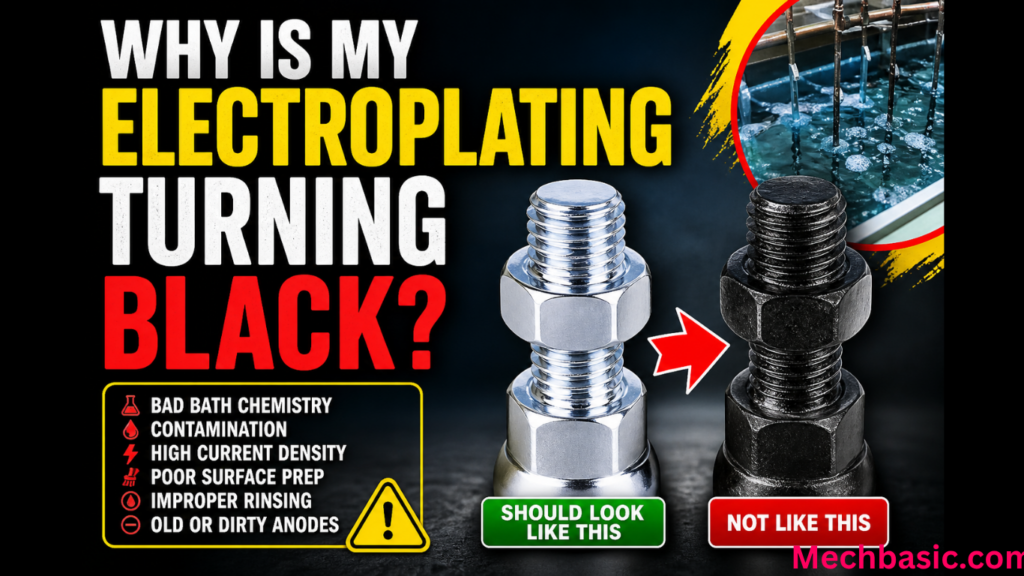
Electroplating may turn black due to excessive current, contaminated plating solution, or poor surface cleaning before plating.
Improper bath chemistry, oxidation, or overheating can also cause dark or burnt deposits on the metal surface.
Maintaining correct operating conditions and using a clean plating bath helps prevent blackening problems.
In this article:
- What “Black Electroplating” Usually Means
- 1. Excessive Current Density (Most Common Cause)
- 2. Low Metal Ion Concentration
- 3. Poor Surface Cleaning
- 4. Bath Contamination
- 5. Incorrect pH
- 6. Poor Agitation
- 7. Anode Problems
- 8. Oxidation of the Deposit
- 9. Excessive Brightener/Additives
- 10. Hydrogen Evolution
- 11. Improper Water Quality
- 12. Incorrect Temperature
- 13. Poor Electrical Contact
- 14. Passive Oxide Formation on Aluminum
- 15. Overheating of the Part
- Most Common Real-World Causes
- Quick Troubleshooting Checklist
- Professional Troubleshooting Tool
- Summary
- 1. Excessive Current Density (Most Common Cause)
Electroplating turning black is a very common problem and usually indicates that the metal deposit is:
- burning,
- oxidizing,
- contaminated,
- chemically unstable,
- or depositing incorrectly.
The exact cause depends on:
- the metal being plated,
- bath chemistry,
- current density,
- contamination,
- and surface preparation.
Black deposits can range from:
- thin dark stains
to - powdery soot-like coatings
to - burned brittle deposits.
What “Black Electroplating” Usually Means
A black appearance typically indicates one or more of these:
| Cause Type | What Happens |
|---|---|
| Excess current | Burned deposit |
| Oxidation | Metal oxide formation |
| Contamination | Impure deposition |
| Poor chemistry | Unstable crystal growth |
| Poor cleaning | Carbon/oil residues |
| Low metal concentration | Starved deposition |
| Wrong pH | Hydroxide formation |
| Poor agitation | Ion depletion |
| Anode problems | Sludge contamination |
1. Excessive Current Density (Most Common Cause)
The Problem
Too much current is applied.
Electroplating follows:
Faraday’s laws of electrolysis
If current is too high:
- metal deposits too rapidly,
- crystal growth becomes uncontrolled.
What Happens
Instead of smooth metallic crystals:
- coarse,
- burnt,
- powdery,
- dark deposits form.
This is often called:
- “burning”
Symptoms
| Symptom | Description |
|---|---|
| Black edges | High-current regions |
| Powdery surface | Poor crystal bonding |
| Brittle coating | Internal stress |
| Rough texture | Rapid deposition |
Why Edges Turn Black First
Electric field concentration is strongest at:
- corners,
- edges,
- sharp points.
Current density becomes excessive there.
Prevention
Reduce:
- voltage,
- amperage,
- current density.
Improve:
- part spacing,
- shielding,
- agitation.
2. Low Metal Ion Concentration
The Problem
Not enough metal ions in solution.
Example:
Nickel sulfate
concentration becomes too low.
What Happens
The surface becomes ion-starved.
Current continues flowing, causing:
- hydrogen evolution,
- burnt deposits,
- black appearance.
Symptoms
- dark plating
- poor coverage
- edge burning
- roughness
Prevention
Regular bath analysis:
- titration,
- conductivity testing,
- Hull cell testing.
3. Poor Surface Cleaning
The Problem
Oil, grease, oxide, or polishing compound remains on the part.
What Happens
Contamination interferes with:
Atomic bonding
The deposit forms unevenly and may trap carbonized residues.
Symptoms
- dark spots
- streaks
- patchy black areas
- blistering
Prevention
Proper:
- degreasing,
- alkaline cleaning,
- acid activation,
- rinsing.
Common cleaners:
- Sodium hydroxide
4. Bath Contamination
The Problem
Foreign metals or impurities enter bath.
Common Contaminants
| Contaminant | Source |
|---|---|
| Iron | Corroding equipment |
| Copper | Drag-in |
| Organics | Oils/additives |
| Particles | Sludge/dust |
| Chlorides | Water contamination |
Effects
Contaminants disrupt crystal growth causing:
- blackness,
- roughness,
- pitting,
- dull deposits.
Organic Contamination
Broken-down brighteners can create:
- dark smut,
- carbon deposits,
- haze.
Prevention
Use:
- filtration,
- activated carbon treatment,
- deionized water.
5. Incorrect pH
The Problem
Bath pH drifts outside operating range.
High pH Effects
Metal hydroxides may precipitate.
These precipitates appear:
- dark,
- cloudy,
- rough.
Low pH Effects
Excess hydrogen evolution causes:
- burning,
- blackening,
- brittleness.
Prevention
Continuous pH monitoring.
6. Poor Agitation
The Problem
Solution movement is insufficient.
What Happens
Metal ions near the surface become depleted.
Localized ion starvation causes:
- burning,
- blackness,
- rough deposits.
Common in
- deep recesses,
- high-current areas,
- large flat surfaces.
Prevention
Use:
- air agitation,
- pump circulation,
- cathode movement.
7. Anode Problems
The Problem
Anodes become:
- passivated,
- corroded,
- dirty,
- improperly connected.
Effects
- unstable metal concentration,
- sludge formation,
- contamination.
Example
Poor chromium plating anodes using:
Chromic acid
may generate sludge causing dark deposits.
Prevention
- clean anodes,
- proper anode bags,
- correct anode area.
8. Oxidation of the Deposit
Some metals oxidize rapidly.
Example: Copper
Fresh copper may oxidize into:
- dark brown,
- black oxides.
Copper oxidation:
2Cu + O_2 \rightarrow 2CuO
Copper oxide appears black.
Nickel Oxidation
Poor rinsing or drying can oxidize nickel surfaces.
Prevention
- immediate rinsing,
- proper drying,
- protective post-treatment.
9. Excessive Brightener/Additives
The Problem
Too much additive in bath.
Brighteners improve appearance, but excess causes:
- stress,
- decomposition,
- dark deposits.
Symptoms
- hazy black coating
- brittle plating
- cloudy finish
Prevention
Careful additive control.
10. Hydrogen Evolution
The Problem
Too much current or low metal concentration causes hydrogen gas formation.
Cathode reaction:
2H^+ + 2e^- \rightarrow H_2
Effects
Hydrogen bubbles create:
- pits,
- black spots,
- roughness.
Prevention
- lower current density,
- improve agitation,
- proper wetting agents.
11. Improper Water Quality
Hard water or contaminated rinse water introduces:
- chlorides,
- calcium,
- magnesium,
- particulates.
This may create:
- stains,
- black smut,
- cloudy plating.
Prevention
Use:
- deionized water,
- reverse osmosis water.
12. Incorrect Temperature
Too Hot
Causes:
- additive breakdown,
- unstable deposition,
- dark deposits.
Too Cold
Causes:
- poor conductivity,
- dull black appearance.
Prevention
Maintain specified operating temperature.
13. Poor Electrical Contact
Weak rack contact causes:
- intermittent current,
- arcing,
- localized burning.
Symptoms
- black patches
- uneven plating
- edge discoloration
Prevention
Clean and tighten contacts regularly.
14. Passive Oxide Formation on Aluminum
Aluminum rapidly forms oxide:
Passivation
Without proper activation:
- plating becomes patchy,
- dark,
- non-adherent.
Prevention
Use:
- zincate pretreatment,
- proper activation.
15. Overheating of the Part
Small parts or sharp edges may overheat electrically.
This causes:
- local burning,
- black crust,
- brittle deposits.
Diagnosing Black Electroplating
| Appearance | Likely Cause |
|---|---|
| Black edges | Excess current |
| Powdery black | Burned deposit |
| Black spots | Contamination |
| Uniform dark coating | Wrong chemistry |
| Black after rinsing | Oxidation |
| Black recesses | Poor agitation |
| Streaky blackness | Poor cleaning |
Metal-Specific Blackening Causes
| Metal | Common Black Cause |
|---|---|
| Nickel | Burning/high current |
| Copper | Oxidation |
| Zinc | Contamination |
| Chromium | Wrong temperature/current |
| Silver | Sulfide tarnish |
| Gold | Severe contamination |
Most Common Real-World Causes
In practical plating shops, black deposits are most often caused by:
- excessive current density
- poor cleaning
- contaminated bath
- low metal concentration
- poor agitation
- incorrect pH
Quick Troubleshooting Checklist
Check:
- current density
- voltage
- bath pH
- metal concentration
- agitation
- temperature
- contamination
- rinsing quality
- cleaning quality
- anode condition
Professional Troubleshooting Tool
Many plating shops use:
Hull cell test
This quickly reveals:
- burning,
- contamination,
- pH problems,
- additive imbalance.
Summary
Electroplating usually turns black because of:
- excessive current density,
- contamination,
- oxidation,
- poor cleaning,
- low metal concentration,
- improper pH,
- or inadequate agitation.
The most common cause is “burning,” where metal deposits too rapidly and forms a rough dark unstable coating instead of a smooth metallic layer.
High-quality plating requires tight control of:
- chemistry,
- current,
- cleanliness,
- temperature,
- and solution movement.
Other courses:





