
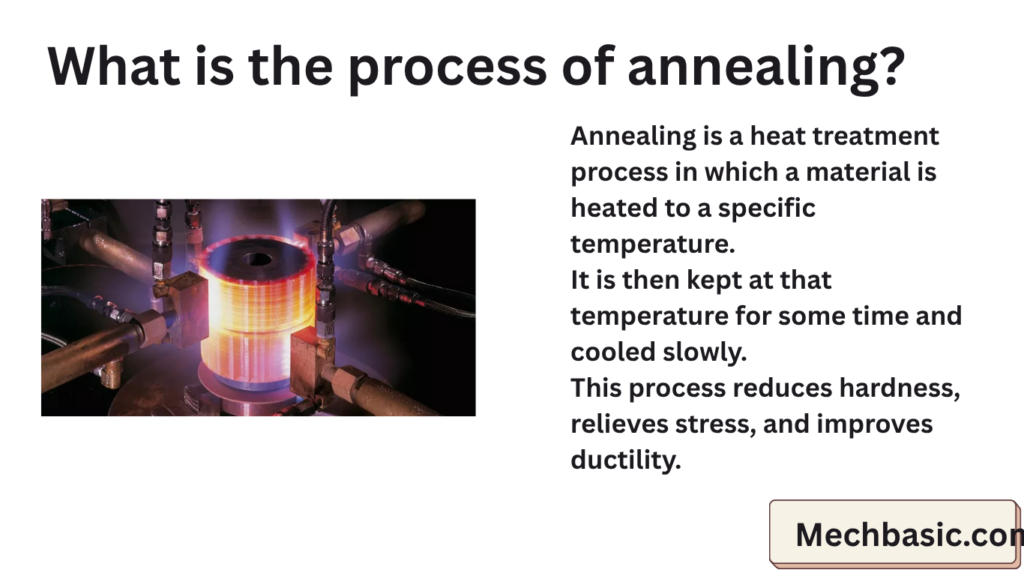
Annealing is a heat treatment process in which a material is heated to a specific temperature.
It is then kept at that temperature for some time and cooled slowly.
This process reduces hardness, relieves stress, and improves ductility.
In this article:
Annealing is a heat treatment process in which a material (usually metal, but sometimes glass or polymers) is heated to a specific temperature, held there for a certain time, and then cooled slowly. The purpose is to reduce hardness, relieve internal stresses, improve ductility, and refine the internal structure of the material.
Process of Annealing
The annealing process generally consists of three main stages:
- Heating
- Soaking (holding)
- Slow cooling
1. Heating stage
In the first stage, the metal is heated gradually to a predetermined temperature.
The temperature depends on:
- Type of metal
- Carbon content
- Desired properties
- Heat treatment purpose
For steel, heating is usually done above the critical temperature range.
Objectives of heating
- Increase atomic movement
- Prepare the metal structure for transformation
- Remove effects of previous processing
Important considerations
- Heating should be uniform
- Excessively rapid heating may create thermal stresses
- Correct furnace temperature must be maintained
Example:
Low-carbon steel and high-carbon steel require different heating temperatures.
2. Soaking (holding) stage
Once the required temperature is reached, the material is kept at that temperature for a certain period.
This period is called soaking time.
Purpose of soaking
- Ensure uniform temperature throughout the material
- Allow complete structural changes
- Relieve internal stresses
- Enable recrystallization
Factors affecting soaking time
- Thickness of material
- Shape and size
- Material composition
- Furnace type
If soaking time is too short:
- Internal structure may not change completely
If too long:
- Grain growth may occur
3. Slow cooling stage
After soaking, the material is cooled very slowly, usually inside the furnace.
Cooling rate is carefully controlled.
Purpose of slow cooling
- Prevent stress formation
- Produce soft microstructures
- Improve machinability
- Avoid cracking
Typical cooling methods:
- Furnace cooling
- Insulated chamber cooling
- Ash or sand cooling (for some applications)
Slow cooling distinguishes annealing from many other heat treatment processes.
Structural changes during annealing
During annealing, several metallurgical changes may occur:
Recovery
- Internal stresses decrease
- Crystal defects reduce
Recrystallization
- New strain-free grains form
Grain growth
- Grain size may increase if held too long
These changes improve the material properties.
Types of annealing
Common forms include:
- Full annealing
- Process annealing
- Stress relief annealing
- Recrystallization annealing
- Spheroidizing annealing
- Isothermal annealing
Each serves a different purpose.
Advantages of annealing
- Reduces hardness
- Improves ductility
- Removes residual stresses
- Improves machinability
- Enhances formability
- Refines structure
Applications of annealing
Annealing is widely used in:
- Steel manufacturing
- Sheet metal production
- Wire drawing
- Forged parts
- Automobile components
- Machine parts
Examples:
- Annealing copper wires to make them flexible
- Annealing steel before machining
Flow diagram of annealing process
Metal → Heating → Soaking → Slow cooling → Improved properties
Conclusion
The annealing process involves controlled heating, holding, and slow cooling of a material to alter its internal structure and properties. It is mainly used to soften metals, reduce stresses, improve ductility, and prepare materials for further manufacturing operations.
Other courses:





