
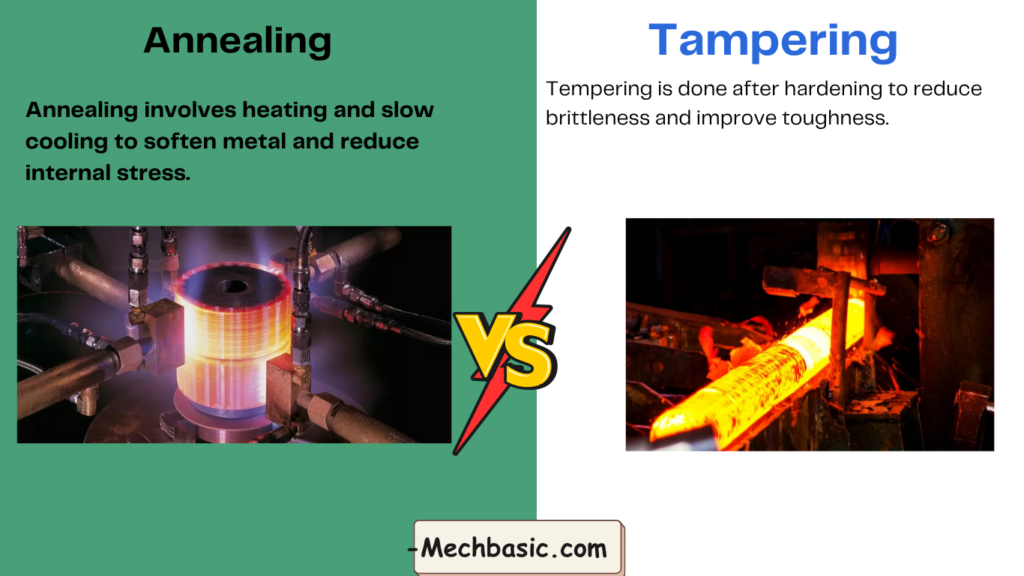
Annealing softens metal and relieves internal stresses by slow cooling after heating.
Tempering is done after hardening to reduce brittleness and improve toughness.
Annealing increases ductility, while tempering balances hardness and strength.
In this article:
You likely mean Annealing vs Tempering (not tampering). Both are heat treatment processes, but they have different purposes, temperatures, and effects on material properties.
Annealing vs Tempering
| Feature | Annealing | Tempering |
|---|---|---|
| Definition | Heat treatment process used to soften a material and relieve internal stresses | Heat treatment performed after hardening to reduce brittleness and improve toughness |
| Main objective | Increase ductility and reduce hardness | Reduce brittleness while retaining useful hardness |
| Heating temperature | Heated to a suitable temperature, often above the critical temperature | Heated below the critical temperature |
| Cooling method | Very slow cooling, usually inside the furnace | Cooled in air, oil, or other controlled methods |
| Material condition before process | Can be applied to untreated or worked material | Usually performed after hardening/quenching |
| Effect on hardness | Decreases hardness significantly | Slightly decreases hardness from the hardened state |
| Effect on ductility | Greatly increases ductility | Improves toughness and some ductility |
| Effect on internal stress | Relieves residual stresses | Relieves stresses caused by hardening |
| Microstructural change | Produces softer and more stable structures | Converts brittle hardened structure into tougher structure |
| Strength | Usually lowers strength | Retains much of the strength while increasing toughness |
| Brittleness | Reduces brittleness indirectly by softening | Specifically reduces brittleness of hardened steel |
| Main applications | Sheet metal, wires, forgings, machining preparation | Springs, cutting tools, gears, automotive parts |
1. Annealing:
Annealing is done to make metals softer and easier to work with.
Process steps
- Heat metal to a specified temperature
- Hold at that temperature (soaking)
- Cool very slowly in the furnace
Main purposes
- Reduce hardness
- Improve ductility
- Remove internal stresses
- Improve machinability
- Refine grain structure
Effects on material
- Softer material
- Easier shaping and forming
- Better machinability
Example:
Steel sheets are annealed before deep drawing operations.
2. Tempering:
Tempering is carried out after hardening.
After quenching, steel becomes very hard but brittle. Tempering modifies those properties.
Process steps
- Harden steel first
- Reheat below critical temperature
- Hold for a certain time
- Cool under controlled conditions
Main purposes
- Reduce brittleness
- Improve toughness
- Relieve quenching stresses
- Retain useful hardness
Effects on material
- Tougher structure
- Less chance of cracking
- Better impact resistance
Example:
Hardened cutting tools are tempered for practical use.
Summary
Imagine a steel knife:
- Annealing: makes it softer and easier to shape or machine.
- Hardening: makes it very hard but brittle.
- Tempering: reduces brittleness and makes it usable without breaking easily.
Conclusion:
Annealing softens metal for easier processing, while tempering toughens hardened metal by reducing brittleness.
Other courses:





