
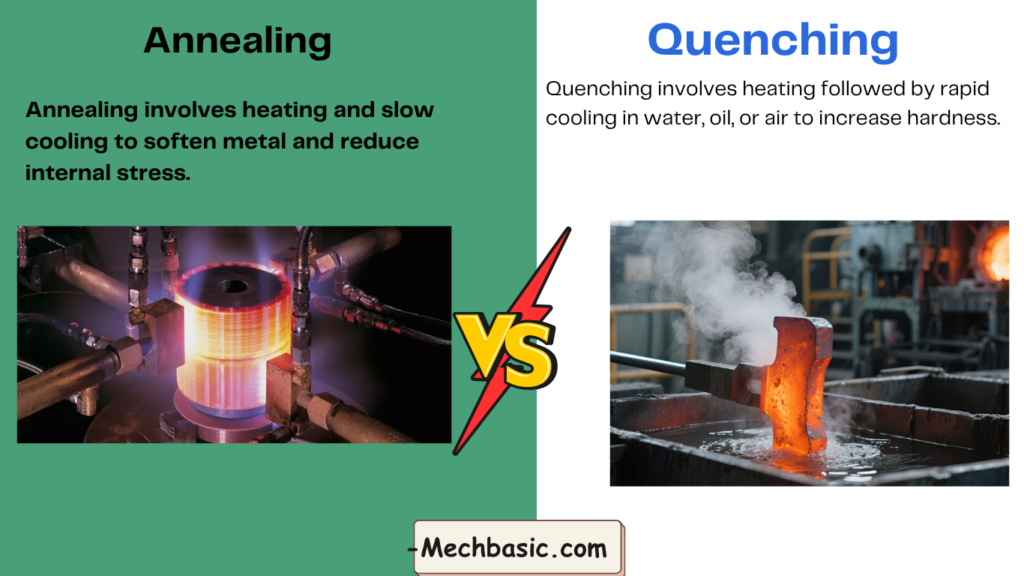
Annealing involves heating and slow cooling to soften metal and reduce internal stress.
Quenching involves heating followed by rapid cooling in water, oil, or air to increase hardness.
Annealing improves ductility, while quenching increases strength and hardness.
In this article:
Annealing and quenching are both heat treatment processes, but they produce almost opposite effects on a material. Annealing generally makes a material softer and more ductile, while quenching makes it harder and stronger by rapidly cooling it.
Annealing vs Quenching
| Feature | Annealing | Quenching |
|---|---|---|
| Definition | Heat treatment process used to soften material and relieve stresses | Rapid cooling process used to increase hardness and strength |
| Main purpose | Reduce hardness and improve ductility | Increase hardness and wear resistance |
| Heating temperature | Heated to a specified temperature, often above critical temperature | Heated above critical temperature before cooling |
| Holding stage | Material is soaked at temperature | Material is soaked before rapid cooling |
| Cooling method | Very slow cooling, usually inside the furnace | Rapid cooling in a quenching medium |
| Cooling rate | Slow | Very fast |
| Common cooling media | Furnace cooling | Water, oil, brine, air, polymers |
| Hardness | Decreases | Increases significantly |
| Ductility | Increases | Decreases |
| Toughness | Usually improves through stress relief and softer structure | May decrease because material can become brittle |
| Internal stress | Removes or reduces internal stresses | Can create residual stresses |
| Grain structure | Produces softer, more stable structure | Forms hard structures such as martensite in steel |
| Distortion risk | Low | Higher |
| Cracking risk | Low | Higher due to thermal shock |
| Machinability | Improves | Usually decreases |
| Wear resistance | Lower than hardened state | High wear resistance |
| Applications | Sheet metal, wires, forgings | Cutting tools, gears, dies |
Annealing:
Annealing softens the material and prepares it for further processing.
Process steps
- Heat metal to the required temperature
- Hold at that temperature
- Cool slowly inside the furnace
Objectives
- Reduce hardness
- Relieve internal stress
- Improve ductility
- Improve machinability
- Refine grain structure
Effects
- Softer material
- Easier shaping and machining
- Reduced residual stresses
Example:
Copper wire is annealed to make it flexible.
Quenching:
Quenching involves very rapid cooling after heating.
Process steps
- Heat metal above critical temperature
- Hold for uniform temperature
- Rapidly cool in a quenching medium
Common quenching media
- Water
- Oil
- Brine
- Air
- Polymer solutions
Objectives
- Increase hardness
- Improve strength
- Improve wear resistance
Effects
- Very hard surface
- High strength
- Increased brittleness
- Residual stresses may develop
Example:
Steel cutting tools are quenched to achieve high hardness.
Advantages of annealing
- Improves ductility
- Reduces hardness
- Reduces stress
- Better machinability
- Lower cracking risk
Advantages of quenching
- High hardness
- Better wear resistance
- Increased strength
- Suitable for tools and machine parts
Disadvantages comparison
Annealing
- Lower strength
- Longer processing time
- Furnace cooling takes time
Quenching
- Can create cracks
- Distortion may occur
- Material may become brittle
Practical example
Consider a steel gear:
- Annealing: makes the gear easier to machine and shape.
- Quenching: makes the gear surface hard and wear resistant.
Often, quenching is followed by tempering to reduce brittleness.
Summary:
Annealing uses slow cooling to soften and relieve stress, whereas quenching uses rapid cooling to harden and strengthen the material.
Other courses:





