
Annealing uses slow cooling to soften metal and reduce internal stress.
Quenching uses rapid cooling after heating to make metal harder and stronger.
Annealing improves ductility, while quenching increases hardness.
In this article:
What is electroplating?
Electroplating is a process of coating the surface of an object with a thin layer of another metal by using electric current. It is mainly used to improve the object’s appearance, corrosion resistance, hardness, wear resistance, and conductivity.
In simple words, electroplating transfers a metal coating from a solution onto another material through electrolysis.
Definition
Electroplating can be defined as:
The process of depositing a thin layer of one metal onto the surface of another material using an electric current and an electrolyte solution.
Principle of electroplating
Electroplating works on the principle of electrolysis.
When electric current passes through an electrolyte:
- Metal ions move through the solution
- Positive metal ions gain electrons
- The ions deposit on the object surface as a thin metal coating
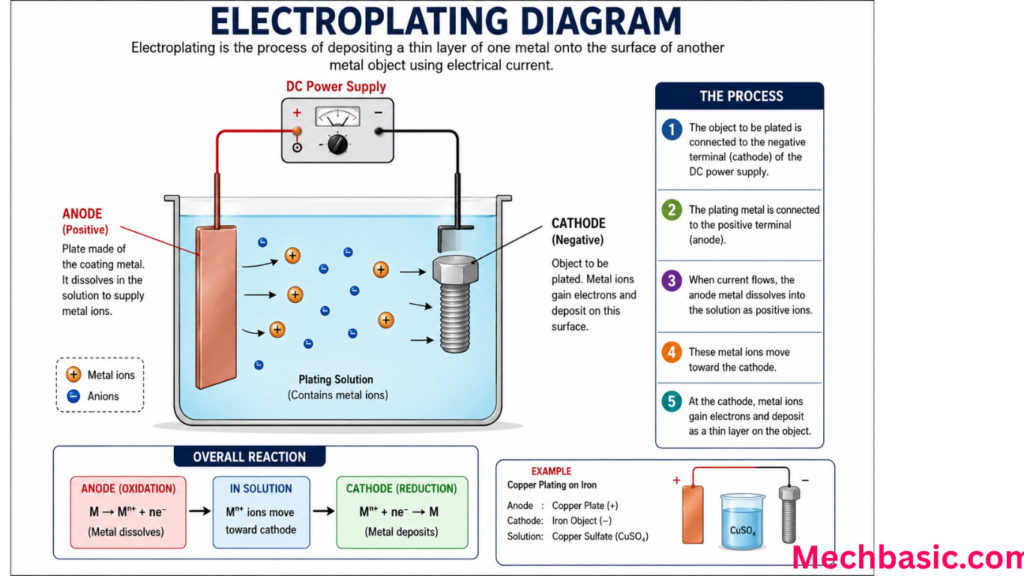
Main components of electroplating setup
An electroplating system generally contains:
1. Anode
The metal that supplies the coating material.
Examples:
- Copper
- Nickel
- Chromium
- Gold
The anode is connected to the positive terminal of the power supply.
Function:
- Dissolves into the electrolyte
- Replaces metal ions used during plating
2. Cathode
The object to be plated.
Examples:
- Iron spoon
- Steel component
- Jewelry item
Connected to the negative terminal.
Function:
- Receives metal ions
- Gets coated with the plating metal
3. Electrolyte solution
Contains dissolved metal salts.
Examples:
- Copper sulfate solution
- Nickel sulfate solution
- Chromium solution
Function:
Provides metal ions for coating.
4. DC power supply
Direct current supplies electrical energy needed for electrolysis.
Working process of electroplating
Step 1: Surface preparation
The object is cleaned thoroughly to remove:
- Dust
- Grease
- Rust
- Oil
Clean surfaces ensure proper adhesion.
Step 2: Immersion
The anode and cathode are immersed in the electrolyte solution.
Step 3: Current application
Direct current is passed through the system.
At the anode:
Metal atoms lose electrons:
M → M⁺ + e⁻
At the cathode:
Metal ions gain electrons:
M⁺ + e⁻ → M
The metal deposits onto the object surface.
Step 4: Formation of coating
A thin, uniform metal layer forms on the object.
Common metals used for electroplating
Examples include:
- Copper
- Nickel
- Chromium
- Gold
- Silver
- Zinc
- Tin
These coatings are selected based on application requirements.
Applications of electroplating
Electroplating is widely used in industries and daily life.
Examples:
- Gold-plated jewelry
- Chrome-plated car bumpers
- Tin-coated food cans
- Zinc-coated screws and bolts
- Electronic connectors
- Medical instruments
- Machine parts
Advantages of electroplating
- Prevents corrosion
- Improves appearance
- Increases hardness
- Improves wear resistance
- Enhances electrical conductivity
- Extends service life
- Reduces cost by using cheaper base metals
Disadvantages of electroplating
- Uses chemicals that may pollute the environment
- Requires careful process control
- Can be expensive for large-scale coating
- Improper coating may peel off
Example
A common example is chromium plating on steel car bumpers:
- Steel provides strength
- Chromium provides shine and corrosion resistance
Conclusion
Electroplating is an important industrial process where a thin layer of metal is deposited on another material using electricity. It improves durability, protection, appearance, and performance, making it widely used in automotive, electronics, jewelry, and manufacturing industries.
Other courses:





