
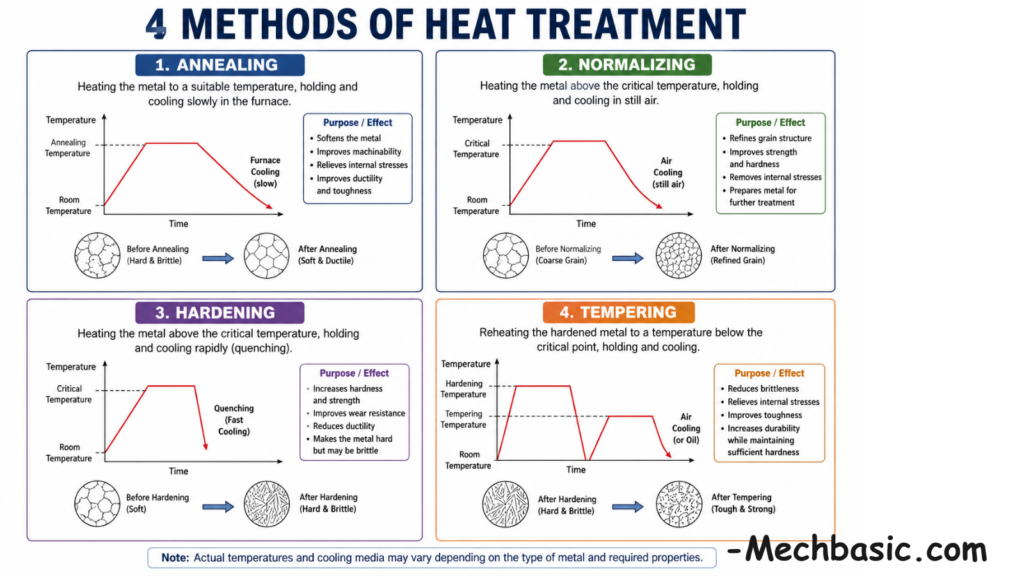
The four common methods of heat treatment are annealing, normalizing, hardening, and tempering.
These processes involve heating and cooling metals under controlled conditions.
They are used to improve strength, hardness, toughness, and ductility of materials.
In this article:
4 methods of heat treatment?
Heat treatment is a manufacturing process in which metals are heated and cooled under controlled conditions to change their mechanical properties such as hardness, strength, toughness, ductility, and wear resistance.
The four major methods of heat treatment commonly studied are:
- Annealing
- Normalizing
- Hardening
- Tempering
Each method uses different heating and cooling conditions and produces different results.
1. Annealing
Annealing is a heat treatment process in which a metal is heated to a suitable temperature, held there for a certain period, and then cooled slowly, usually inside the furnace.
Purpose
- Reduce hardness
- Relieve internal stresses
- Improve ductility
- Improve machinability
- Refine grain structure
Process steps
- Heat metal to the required temperature
- Hold (soak) at that temperature
- Cool very slowly inside the furnace
Effects on material
- Softer structure
- Increased toughness
- Better formability
Applications
- Sheet metal processing
- Wire manufacturing
- Forged parts before machining
Example
Annealing of steel before bending or drawing operations.
2. Normalizing
Normalizing involves heating the metal above its critical temperature and then cooling it in still air.
Purpose
- Refine grain structure
- Improve mechanical properties
- Remove internal stresses
- Produce uniform structure
Process steps
- Heat above critical temperature
- Hold for a specific time
- Remove from furnace
- Cool naturally in air
Effects on material
- Increased strength
- Finer grain structure
- Better toughness than untreated material
Applications
- Structural steel
- Castings
- Forgings
Example
Normalizing steel components after forging.
3. Hardening
Hardening increases the hardness and strength of metals.
The metal is heated above its critical temperature and then rapidly cooled (quenched).
Quenching media
- Water
- Oil
- Brine
- Air
Purpose
- Increase hardness
- Improve wear resistance
- Increase strength
Process steps
- Heat metal above critical temperature
- Hold at temperature
- Quench rapidly
Effects on material
- Very hard structure
- Increased wear resistance
- Reduced ductility
- Internal stresses may develop
Applications
- Cutting tools
- Gears
- Dies
- Machine components
Example
Hardening high-carbon steel tools.
4. Tempering
Tempering is performed after hardening.
Hardened metal is reheated to a lower temperature and then cooled.
Purpose
- Reduce brittleness
- Relieve stresses
- Improve toughness
- Maintain useful hardness
Process steps
- Harden the metal first
- Reheat below critical temperature
- Hold for a period
- Cool gradually
Effects on material
- Reduced brittleness
- Better toughness
- Improved impact resistance
Applications
- Springs
- Cutting tools
- Automotive parts
Example
Tempering hardened steel tools.
Summary Table
| Method | Heating and cooling method | Main purpose |
|---|---|---|
| Annealing | Heat + very slow furnace cooling | Soften material |
| Normalizing | Heat + air cooling | Refine grain structure |
| Hardening | Heat + rapid quenching | Increase hardness |
| Tempering | Reheat after hardening | Reduce brittleness |
Comparison of effects
- Annealing: Softest condition
- Normalizing: Stronger than annealed metal
- Hardening: Maximum hardness
- Tempering: Balanced hardness and toughness
Conclusion
The four major heat treatment methods—annealing, normalizing, hardening, and tempering—are used to obtain specific material properties. Selecting the correct method depends on the required strength, hardness, toughness, and application of the metal component.
Other courses:





