
The main types of Vernier scales are direct Vernier, retrograde (backward) Vernier, and extended Vernier.
They differ in the direction and arrangement of scale divisions.
These scales are used to improve measurement accuracy in precision instruments.
In this article:
- Types of Vernier Scale
- Classification of Vernier Scales
- 1. Direct Vernier Scale (Forward Vernier)
- 2. Retrograde Vernier Scale (Backward Vernier)
- 3. Metric Vernier Scale
- 4. Imperial Vernier Scale
- 5. Vernier Scale on Vernier Caliper
- 6. Vernier Scale on Height Gauge
- 7. Vernier Scale on Depth Gauge
- 8. Vernier Scale on Bevel Protractor
- Vernier Scale Based on Accuracy
- Comparison of Vernier Scale Types
- Advantages of Vernier Scales
- Limitations
- Common Interview Question
- Conclusion
Types of Vernier Scale
What is a Vernier Scale?
A Vernier Scale is a secondary scale that slides along the main scale of a measuring instrument. It is used to measure dimensions more accurately than can be read from the main scale alone.
Vernier scales are commonly found on:
- Vernier Calipers
- Height Gauges
- Depth Gauges
- Bevel Protractors
The Vernier scale allows measurements of fractions of the smallest main scale division.
Classification of Vernier Scales
There are two main types of Vernier scales:
- Direct Vernier Scale (Forward Vernier)
- Retrograde Vernier Scale (Backward Vernier)
Additionally, Vernier scales can be classified by their least count and design.
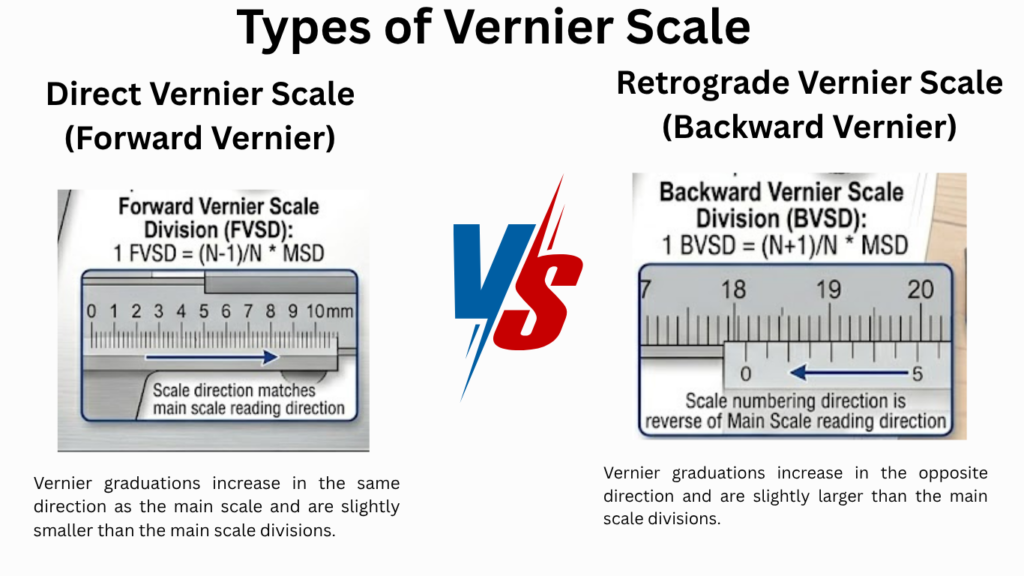
1. Direct Vernier Scale (Forward Vernier)
Definition
A Direct Vernier Scale is constructed so that:
- Vernier divisions are slightly smaller than main scale divisions.
- The Vernier scale readings increase in the same direction as the main scale.
Relationship
For example:
10 VSD = 9 MSDWhere:
- VSD = Vernier Scale Division
- MSD = Main Scale Division
Working Principle
Since:
1 MSD = 1 mmThen:
10 VSD = 9 mmTherefore:
1 VSD = 0.9 mmLeast Count:
LC = 1 MSD − 1 VSDLC = 1 − 0.9LC = 0.1 mmFeatures
- Most common type
- Easy to read
- Used in standard Vernier calipers
Applications
- Mechanical workshops
- Manufacturing
- Quality control
- Educational laboratories
2. Retrograde Vernier Scale (Backward Vernier)
Definition
A Retrograde Vernier Scale is arranged so that:
- Vernier graduations increase in the opposite direction to the main scale.
- Vernier divisions are slightly larger than main scale divisions.
Relationship
Example:
10 VSD = 11 MSDThus:
1 VSD = 1.1 MSDWorking Principle
The Vernier scale moves in the reverse direction.
Reading is obtained by finding the coinciding Vernier line.
Features
- Less common
- Slightly more difficult to read
- Used in specialized measuring instruments
Applications
- Precision instruments
- Certain scientific equipment
Classification by Least Count
Vernier scales are also classified according to their least count.
3. Metric Vernier Scale
Definition
A Vernier scale designed for metric measurements.
Common Values
Main scale:
1 MSD = 1 mmTypical Vernier:
50 VSD = 49 MSDLeast Count
LC = 0.02 mmor
LC = 0.05 mmdepending on design.
Applications
- Engineering
- Manufacturing
- Inspection
4. Imperial Vernier Scale
Definition
Used for inch-based measurements.
Main Scale
Graduated in:
inchor
fraction of inchTypical Least Count
0.001 inchor
0.002 inchApplications
- Aerospace industries
- American manufacturing systems
Classification by Instrument Type
5. Vernier Scale on Vernier Caliper
Most widely used.
Measures
- External dimensions
- Internal dimensions
- Depth
- Step measurements
Typical Least Counts
0.1 mm0.05 mm0.02 mm6. Vernier Scale on Height Gauge
Used for vertical measurements.
Applications
- Tool rooms
- Surface plate measurements
- Precision inspection
7. Vernier Scale on Depth Gauge
Used to measure:
- Hole depths
- Slot depths
- Groove depths
8. Vernier Scale on Bevel Protractor
Used for accurate angle measurement.
Typical Accuracy
5 minutesor
1/12 degreeVernier Scale Based on Accuracy
A. 0.1 mm Vernier
Relationship:
10 VSD = 9 MSDLeast Count:
0.1 mmB. 0.05 mm Vernier
Relationship:
20 VSD = 19 MSDLeast Count:
0.05 mmC. 0.02 mm Vernier
Relationship:
50 VSD = 49 MSDLeast Count:
0.02 mmD. 0.01 mm Vernier
Used in highly precise instruments.
Provides extremely fine measurements.
Comparison of Vernier Scale Types
| Type | Direction | Common Use |
|---|---|---|
| Direct Vernier | Same as main scale | Most Vernier calipers |
| Retrograde Vernier | Opposite direction | Special instruments |
| Metric Vernier | Millimeters | Engineering |
| Imperial Vernier | Inches | American industries |
| Caliper Vernier | Length measurement | Workshops |
| Height Gauge Vernier | Vertical measurement | Inspection |
| Depth Gauge Vernier | Depth measurement | Machining |
| Bevel Protractor Vernier | Angle measurement | Tool rooms |
Advantages of Vernier Scales
- Higher accuracy than ordinary rulers
- Simple mechanical construction
- No batteries required
- Durable and reliable
- Suitable for workshop environments
Limitations
- Requires skill to read correctly
- Reading errors may occur
- Slower than digital instruments
- Sensitive to dirt and wear
Common Interview Question
What are the two main types of Vernier scales?
Answer:
- Direct Vernier Scale (Forward Vernier) – Vernier graduations increase in the same direction as the main scale and are slightly smaller than the main scale divisions.
- Retrograde Vernier Scale (Backward Vernier) – Vernier graduations increase in the opposite direction and are slightly larger than the main scale divisions.
Conclusion
The Vernier scale is a precision measuring scale used to obtain accurate readings beyond the smallest division of a main scale. The two principal types are Direct Vernier and Retrograde Vernier. Vernier scales are further classified by measurement system (metric or imperial), instrument type (caliper, height gauge, depth gauge, bevel protractor), and least count (0.1 mm, 0.05 mm, 0.02 mm, etc.). Understanding these types is essential for precision measurement in engineering, manufacturing, metrology, and quality control.
Other courses:





