
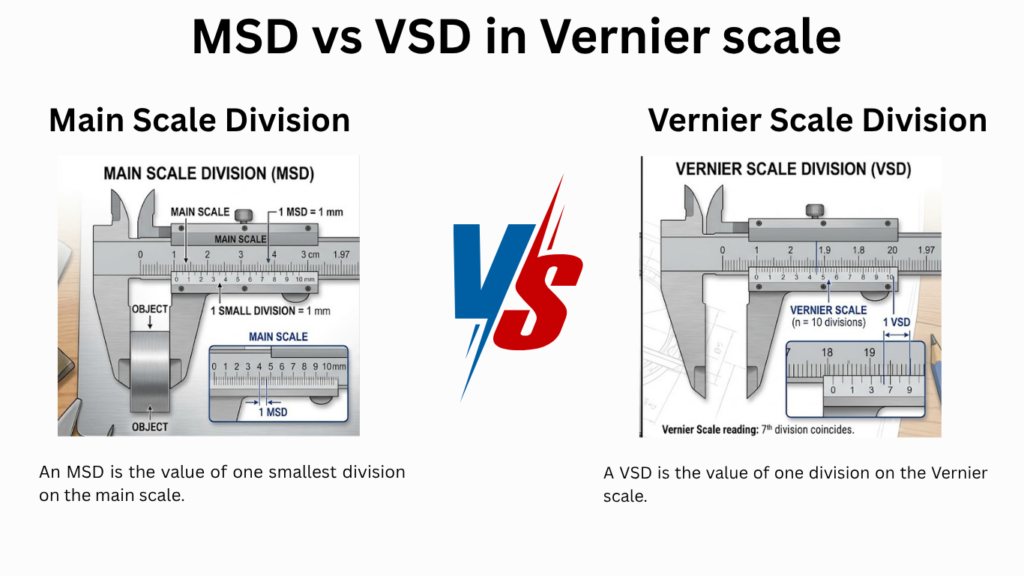
MSD (Main Scale Division) is the value of one division on the main scale of a Vernier caliper.
VSD (Vernier Scale Division) is the value of one division on the Vernier scale.
The difference between MSD and VSD gives the least count of the Vernier caliper.
In this article:
MSD vs VSD in Vernier Scale
When using a Vernier Caliper, two scales are involved:
- Main Scale (MS)
- Vernier Scale (VS)
The terms MSD and VSD are fundamental for understanding how a Vernier Caliper works.
What is MSD?
MSD = Main Scale Division
An MSD is the value of one smallest division on the main scale.
Example
Suppose:
10 main scale divisions = 10 mmThen:
1 MSD = 1 mmTherefore, each division on the main scale represents 1 mm.
Function of MSD
The MSD provides:
- Whole-number measurements
- Basic dimension reading
- Reference for Vernier scale calculations
What is VSD?
VSD = Vernier Scale Division
A VSD is the value of one division on the Vernier scale.
The Vernier scale is designed slightly differently from the main scale to allow more precise measurements.
Example
In a standard metric Vernier Caliper:
50 VSD = 49 MSDSince:
1 MSD = 1 mmThen:
50 VSD = 49 mmTherefore:
1 VSD = 49/50 mm1 VSD = 0.98 mmRelationship Between MSD and VSD
The Vernier principle depends on a small difference between MSD and VSD.
Standard Metric Vernier
1 MSD = 1.00 mm1 VSD = 0.98 mmDifference:
1 MSD - 1 VSD= 1.00 - 0.98= 0.02 mmThis difference is called the Least Count.
Formula
Least Count (LC)
LC = 1MSD – 1VSD
Example
LC = 1.00 – 0.98
LC = 0.02 mm
Why Is VSD Smaller Than MSD?
If MSD and VSD were exactly equal:
1 MSD = 1 VSDthere would be no relative movement between the scales, and precise measurement would be impossible.
The Vernier scale is intentionally made slightly smaller.
This allows:
- Alignment of lines
- Fractional measurements
- Higher accuracy
Standard Vernier Caliper Example
Main Scale
1 MSD = 1 mmVernier Scale
50 VSD = 49 MSDTherefore:
1 VSD = 49/50 mm1 VSD = 0.98 mmLeast Count
LC = 1 – 0.98
LC = 0.02 mm
Comparison Between MSD and VSD
| Feature | MSD | VSD |
|---|---|---|
| Full Form | Main Scale Division | Vernier Scale Division |
| Location | Main Scale | Vernier Scale |
| Purpose | Primary measurement | Fine measurement |
| Typical Value | 1 mm | 0.98 mm |
| Size | Larger | Slightly smaller |
| Accuracy Contribution | Basic reading | Precision reading |
How MSD and VSD Are Used in Measurement
Suppose a measurement is taken.
Main Scale Reading
25 mmVernier Coincidence
7th Vernier division matches.
Least Count
0.02 mmVernier Reading
7 * 0.02 = 0.14 mm
Total Reading
25 + 0.14 = 25.14 mm
Importance of MSD and VSD
Understanding MSD and VSD helps you:
- Calculate least count
- Read Vernier calipers correctly
- Achieve precision measurements
- Avoid reading errors
These concepts are widely used in:
- Mechanical engineering
- Manufacturing
- Quality control
- Metrology
- Machine shops
Common Interview Question
Question:
What is the difference between MSD and VSD?
Answer:
MSD (Main Scale Division) is the smallest division on the main scale, while VSD (Vernier Scale Division) is the smallest division on the Vernier scale. The difference between one MSD and one VSD gives the least count of the Vernier caliper, which determines its measuring accuracy.
Conclusion
- MSD = Main Scale Division
- VSD = Vernier Scale Division
- Usually 1 MSD > 1 VSD
- Least Count = MSD − VSD
- In a common metric Vernier caliper:
- 1 MSD = 1 mm
- 1 VSD = 0.98 mm
- Least Count = 0.02 mm
Together, they allow a Vernier caliper to measure dimensions much more accurately than an ordinary ruler.
Other courses:





