
A Vernier scale is a measuring scale used to obtain precise readings beyond the main scale divisions.
It is commonly used in instruments such as Vernier calipers and height gauges.
The Vernier scale improves measurement accuracy by reading small fractions of a division.
In this article:
- Vernier Scale in Engineering Drawing
- What is a Vernier Scale?
- Purpose of a Vernier Scale
- Principle of Vernier Scale
- Components of a Vernier Scale
- Terms Used in Vernier Scale
- Types of Vernier Scales
- Use of Vernier Scale in Engineering Drawing
- Instruments Using Vernier Scale
- How to Read a Vernier Scale
- Advantages of Vernier Scale
- Limitations of Vernier Scale
- Applications in Engineering
- Importance in Engineering Drawing
- Common Interview Questions
- Conclusion
Vernier Scale in Engineering Drawing
Introduction
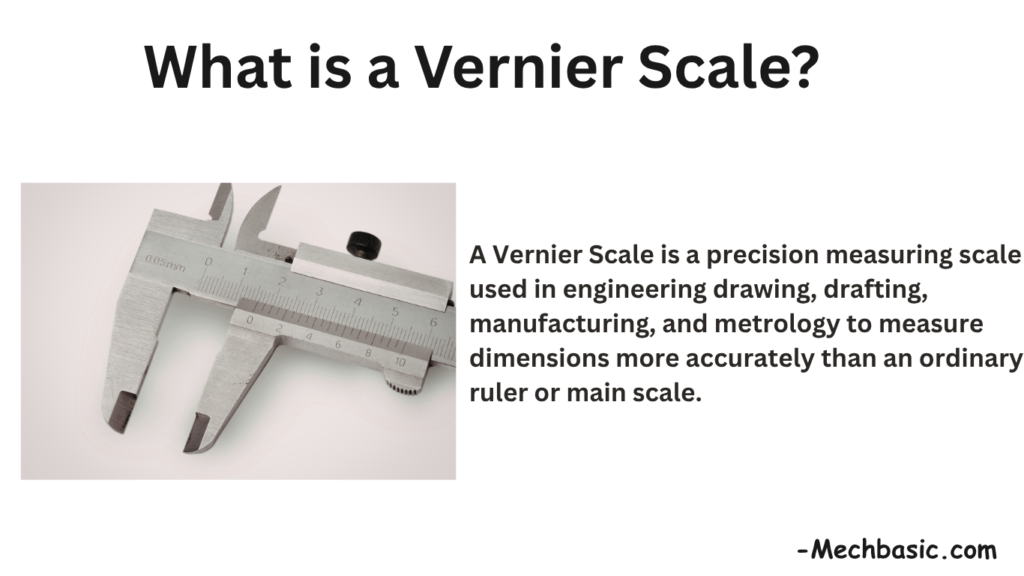
A Vernier Scale is a precision measuring scale used in engineering drawing, drafting, manufacturing, and metrology to measure dimensions more accurately than an ordinary ruler or main scale.
In engineering drawing, accuracy is extremely important. A small measurement error can lead to incorrect designs, poor fitting parts, and manufacturing defects. The Vernier scale helps measure dimensions with high precision, often up to 0.02 mm, 0.05 mm, or 0.1 mm.
What is a Vernier Scale?
A Vernier scale is a secondary scale that slides alongside a main scale. It allows the user to read fractions of the smallest main scale division.
Inventor
The Vernier scale was invented by:
Pierre Vernier
in 1631.
Purpose of a Vernier Scale
The main purpose is to:
- Increase measurement accuracy
- Read small fractions of a division
- Reduce measurement errors
- Measure dimensions precisely
Principle of Vernier Scale
The Vernier scale works on the principle that:
A certain number of Vernier Scale Divisions (VSD) are equal to a slightly different number of Main Scale Divisions (MSD).
For example:
50 VSD = 49 MSDIf:
1 MSD = 1 mmThen:
50 VSD = 49 mmTherefore:
1 VSD = 49/50 mm1 VSD = 0.98 mmDifference:
1 MSD − 1 VSD1.00 − 0.98= 0.02 mmThis difference is called the Least Count.
Components of a Vernier Scale
1. Main Scale
The fixed scale.
Functions
- Provides the whole-number reading
- Acts as the reference scale
Example
Graduated in:
- Millimeters
- Centimeters
- Inches
2. Vernier Scale
The movable scale.
Functions
- Provides fractional readings
- Improves accuracy
Terms Used in Vernier Scale
MSD (Main Scale Division)
The smallest division on the main scale.
Example:
1 MSD = 1 mmVSD (Vernier Scale Division)
The smallest division on the Vernier scale.
Example:
1 VSD = 0.98 mmLeast Count (LC)
The smallest measurement that can be accurately read.
Formula
Example
LC = 1.00 − 0.98LC = 0.02 mmTypes of Vernier Scales
1. Direct Vernier Scale
Characteristics
- Most common type
- Vernier markings increase in the same direction as the main scale
- VSD is slightly smaller than MSD
Example
10 VSD = 9 MSD2. Retrograde Vernier Scale
Characteristics
- Vernier markings increase in the opposite direction
- Less commonly used
- Found in special instruments
Use of Vernier Scale in Engineering Drawing
In engineering drawing and drafting, Vernier scales are used for:
Measuring line lengths
Accurate measurement of drawn dimensions.
Geometric construction
Checking dimensions during construction work.
Preparing technical drawings
Ensuring dimensional accuracy.
Layout work
Transferring measurements accurately.
Inspection of drawings
Verifying dimensions before manufacturing.
Instruments Using Vernier Scale
Vernier Caliper
Measures:
- External dimensions
- Internal dimensions
- Depths
- Steps
Vernier Height Gauge
Measures:
- Vertical dimensions
- Heights on surface plates
Vernier Depth Gauge
Measures:
- Hole depth
- Groove depth
- Slot depth
Vernier Bevel Protractor
Measures:
- Angles
- Inclinations
How to Read a Vernier Scale
Suppose:
Main Scale Reading
25 mmVernier Coinciding Division
7Least Count
0.02 mmVernier Reading
Total Reading
25 + 0.14= 25.14 mmFinal Measurement:
25.14 mm
Advantages of Vernier Scale
High Accuracy
Measures small dimensions precisely.
Reliable
Mechanical system requiring no power.
Durable
Suitable for workshop use.
Economical
Less expensive than many digital instruments.
Versatile
Used in multiple measuring instruments.
Limitations of Vernier Scale
Requires Skill
Reading can be difficult for beginners.
Human Error
Incorrect alignment can cause errors.
Slower Than Digital Instruments
Digital instruments provide instant readings.
Wear and Tear
Damaged scales affect accuracy.
Applications in Engineering
Mechanical Engineering
- Component inspection
- Machine design
- Manufacturing
Civil Engineering
- Layout measurements
- Structural drawings
Production Engineering
- Process inspection
- Quality control
Tool Rooms
- Precision measurement
Engineering Drawing Laboratories
- Educational purposes
- Drafting practice
Importance in Engineering Drawing
The Vernier scale is important because it:
- Improves dimensional accuracy
- Reduces measurement errors
- Ensures interchangeability of parts
- Supports quality control
- Helps create precise engineering drawings
Without accurate measurement, engineering drawings cannot be converted into correctly manufactured components.
Common Interview Questions
What is a Vernier Scale?
A Vernier scale is a secondary scale used with a main scale to measure dimensions more accurately than the smallest division on the main scale.
What is the least count of a Vernier Scale?
The least count is the smallest value that can be measured accurately and is calculated by:
Least Count = 1 MSD − 1 VSD
What are the two main types?
- Direct Vernier Scale
- Retrograde Vernier Scale
Conclusion
A Vernier Scale is a precision measuring scale used in engineering drawing and measurement instruments to obtain highly accurate readings. It consists of a main scale and a Vernier scale, working together to measure fractions of the smallest main scale division. Vernier scales are widely used in Vernier calipers, height gauges, depth gauges, and bevel protractors, making them essential tools in engineering drawing, manufacturing, quality control, and metrology. Understanding the Vernier scale is fundamental for every engineering student, draftsman, machinist, and quality inspector.
Other courses:





