
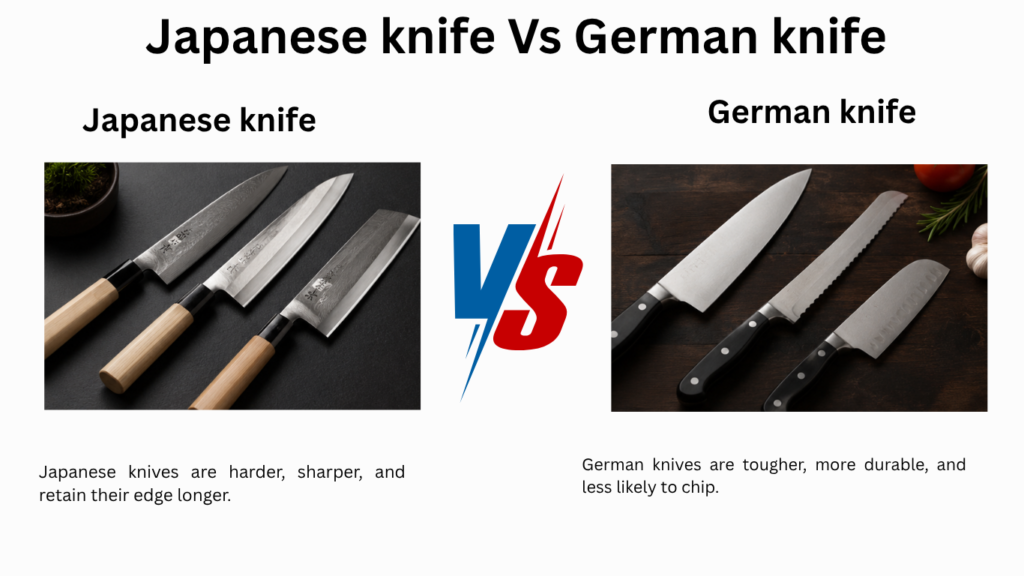
Japanese knives are harder, sharper, and retain their edge longer.
German knives are tougher, more durable, and less likely to chip.
Japanese knives suit precision cutting, while German knives are better for heavy-duty use.
In this article:
- Japanese vs German Knives: 10 Differences You Need to Know
- 1. Steel Type
- 2. Hardness (HRC)
- 3. Sharpness
- 4. Blade Thickness
- 5. Weight
- 6. Blade Shape
- 7. Edge Retention
- 8. Durability and Toughness
- 9. Maintenance Requirements
- 10. Best Uses
- Side-by-Side Comparison
- Popular Japanese Knife Brands
- Popular German Knife Brands
- Which Should You Choose?
- Conclusion
Japanese vs German Knives: 10 Differences You Need to Know
Japanese and German knives are both world-renowned, but they are designed with different philosophies. Japanese knives emphasize precision, sharpness, and fine cutting, while German knives prioritize durability, versatility, and ease of maintenance.
1. Steel Type
Japanese Knives
Typically use:
- Hard high-carbon steel
- High-carbon stainless steel
- Advanced powdered steels
Examples:
- VG-10
- SG2/R2
- Blue Steel (Aogami)
- White Steel (Shirogami)
Characteristics
- Very hard
- Excellent edge retention
- Extremely sharp
German Knives
Typically use:
- Softer stainless steel
- Corrosion-resistant alloys
Examples:
- X50CrMoV15
- X55CrMo14
Characteristics
- Tough and durable
- More resistant to chipping
- Easier to sharpen
2. Hardness (HRC)
Hardness is measured using the Rockwell Hardness Scale.
Japanese Knives
Typical hardness:
60–66 HRCSome premium models exceed 67 HRC.
Benefits
- Longer edge retention
- Finer cutting performance
Drawback
- More brittle
German Knives
Typical hardness:
56–58 HRCBenefits
- Tougher
- Less likely to chip
Drawback
- Requires more frequent sharpening
3. Sharpness
Japanese Knives
Known for razor-like edges.
Typical edge angle:
10°–15° per sideResult
- Extremely sharp
- Clean cuts
- Minimal food crushing
Excellent for:
- Fish
- Vegetables
- Precision slicing
German Knives
Typical edge angle:
15°–20° per sideResult
- Good sharpness
- Greater durability
Better suited for heavy-duty kitchen work.
4. Blade Thickness
Japanese Knives
Generally thinner.
Advantages
- Less cutting resistance
- More precise cuts
Ideal For
- Sushi
- Sashimi
- Vegetable preparation
German Knives
Generally thicker.
Advantages
- Stronger blade
- Better for tougher foods
Ideal For
- Dense vegetables
- Poultry
- General-purpose tasks
5. Weight
Japanese Knives
Usually lighter.
Benefits
- Less hand fatigue
- Greater control
Preferred by chefs who perform detailed cutting.
German Knives
Usually heavier.
Benefits
- Powerful cutting action
- More momentum
Preferred for prolonged prep involving tougher ingredients.
6. Blade Shape
Japanese Knives
Common styles include:
- Gyuto
- Santoku
- Nakiri
- Yanagiba
Characteristics:
- Flatter edge profile
- Push-cutting motion
German Knives
Common style:
- Chef’s knife
Characteristics:
- Curved belly
- Rocking cutting motion
7. Edge Retention
Japanese Knives
Excellent edge retention due to harder steel.
Example
May stay sharp for months in home use.
Advantage
Less frequent sharpening.
German Knives
Lose sharpness faster.
Advantage
Can be sharpened quickly and easily.
8. Durability and Toughness
Japanese Knives
Strengths
- Exceptional cutting performance
Weaknesses
Avoid:
- Bones
- Frozen foods
- Hard impacts
Can chip if misused.
German Knives
Strengths
- Highly durable
- Better impact resistance
Suitable for heavier kitchen tasks.
9. Maintenance Requirements
Japanese Knives
Require more care.
Recommended
- Hand wash only
- Dry immediately
- Proper storage
- Use wooden or plastic cutting boards
German Knives
More forgiving.
Benefits
- Easier maintenance
- Better corrosion resistance
Still recommended:
- Hand washing
- Proper storage
10. Best Uses
Japanese Knives
Best for:
- ✔ Precision slicing
- ✔ Sushi and sashimi
- ✔ Vegetables
- ✔ Fine culinary work
- ✔ Professional chefs seeking maximum sharpness
German Knives
Best for:
✔ General kitchen use
✔ Meat preparation
✔ Tough vegetables
✔ Home cooking
✔ Users seeking durability
Side-by-Side Comparison
| Feature | Japanese Knives | German Knives |
|---|---|---|
| Steel Hardness | Higher | Lower |
| Sharpness | Extremely sharp | Very sharp |
| Edge Angle | 10°–15° | 15°–20° |
| Blade Thickness | Thin | Thick |
| Weight | Light | Heavy |
| Edge Retention | Excellent | Good |
| Toughness | Lower | Higher |
| Chipping Resistance | Lower | Higher |
| Maintenance | More demanding | Easier |
| Best For | Precision cutting | All-purpose use |
Popular Japanese Knife Brands
Some well-known Japanese brands include:
- Shun
- Miyabi
- Masamoto
- Global
Popular German Knife Brands
Some well-known German brands include:
- Wüsthof
- Zwilling J.A. Henckels
- Messermeister
- Güde
Which Should You Choose?
Choose Japanese Knives If:
- You value extreme sharpness.
- You frequently cut vegetables or fish.
- You enjoy precision work.
- You don’t mind extra maintenance.
Choose German Knives If:
- You want one versatile knife.
- You regularly cut tougher foods.
- You prioritize durability.
- You prefer easier maintenance.
Conclusion
The choice between Japanese and German knives is not about which is universally “better”—it’s about which suits your needs. Japanese knives excel in sharpness, precision, and edge retention, making them ideal for delicate cutting tasks. German knives excel in toughness, versatility, and durability, making them excellent all-purpose kitchen tools. Professional chefs often own both styles and use each where its strengths are most valuable.
Other courses:





