
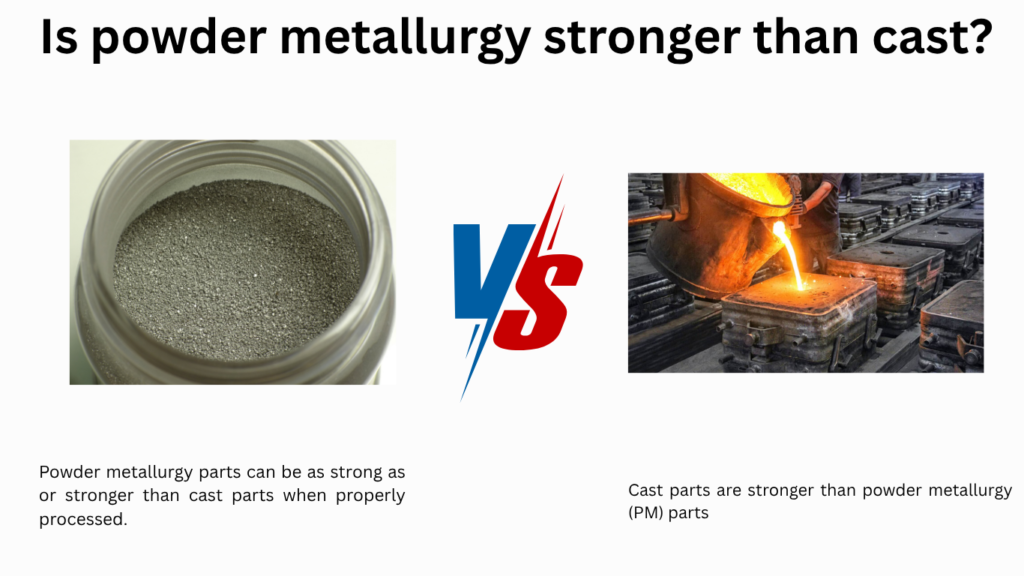
Powder metallurgy parts can be as strong as or stronger than cast parts when properly processed.
They have uniform structure and fewer defects compared to casting.
However, strength depends on density, material, and manufacturing conditions.
In this article:
👉 Cast parts are stronger than powder metallurgy (PM) parts
👉 But PM can be comparable or even superior in some special cases
Let’s break it down clearly.
Powder Metallurgy vs Casting — Strength Comparison
1. Overall Strength
Casting — Generally Stronger
- Metal is fully melted and solidified
- Produces a dense, continuous structure
- Fewer internal voids (if done properly)
Powder Metallurgy — Usually Lower Strength
- Contains residual porosity (tiny voids)
- These pores reduce:
- Load-bearing area
- Mechanical strength
✅ Winner (overall strength): Casting
2. Density and Porosity
Casting
- Nearly 100% dense
- Stronger due to full material continuity
Powder Metallurgy
- Typically 85–95% dense (unless specially treated)
- Porosity acts as weak points
👉 Porosity = reduced strength
3. Tensile Strength
Casting
- Higher tensile strength
- Better for heavy structural loads
Powder Metallurgy
- Lower tensile strength due to pores
- Can improve with:
- Hot pressing
- Infiltration
4. Fatigue Strength
Casting
- Moderate fatigue strength
Powder Metallurgy
- Lower fatigue strength (pores initiate cracks)
5. Hardness and Wear Resistance
Powder Metallurgy — Better in Some Cases
- Can add:
- Carbides
- Special alloys
- Produces very hard and wear-resistant parts
Casting
- Limited control compared to PM
✅ Winner (wear resistance): Powder Metallurgy (in special cases)
6. Special High-Performance Cases
Powder metallurgy can be stronger than casting when:
- Using hot isostatic pressing (HIP)
- Producing superalloys or tool materials
- Making uniform microstructures
👉 In these cases:
- Strength can match or exceed cast materials
Summary Table
| Property | Powder Metallurgy 🧪 | Casting 🏭 |
|---|---|---|
| Overall Strength | Lower | Higher ✅ |
| Density | Lower (porous) | Higher ✅ |
| Tensile Strength | Lower | Higher ✅ |
| Fatigue Strength | Lower | Higher ✅ |
| Wear Resistance | High (customizable) | Moderate |
| Precision | High ✅ | Moderate |
Summary
👉 Casting is generally stronger because it produces a fully dense material
👉 Powder metallurgy is weaker in basic form, but:
- Can be improved
- Can outperform casting in specialized applications
👉 Porosity is the main reason PM parts are usually weaker than cast parts
Conclusion
Casting generally produces stronger components than powder metallurgy due to higher density and absence of porosity, although PM can achieve comparable strength with advanced processing techniques.
Other courses:





