
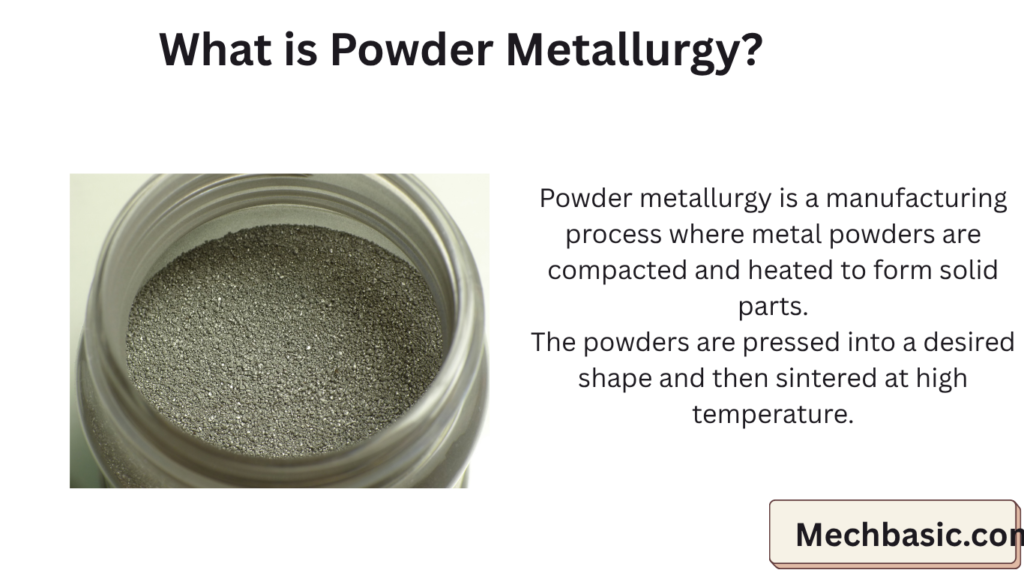
Powder metallurgy is a manufacturing process where metal powders are compacted and heated to form solid parts.
The powders are pressed into a desired shape and then sintered at high temperature.
It is used to produce precise, and complex components with minimal waste.
In this article:
Powder Metallurgy (PM) is a manufacturing process in which metal powders are compacted into a desired shape and then heated (sintered) to form a solid component—without fully melting the material.
What is Powder Metallurgy?
👉 It is the process of:
- Producing metal powders
- Shaping them in a die
- Heating them below melting point (sintering)
Basic Steps in Powder Metallurgy
1. Powder Production
Metal powders are produced using different methods:
Mechanical Methods
- Crushing or milling solid metals
Atomization (Most common)
- Molten metal is sprayed into fine droplets and solidified
Chemical Methods
- Reduction of metal oxides
- Electrolysis
2. Blending and Mixing
- Powders are mixed with:
- Lubricants
- Binders
- Alloying elements
👉 Ensures uniform composition
3. Compaction (Pressing)
- Powder is placed in a die
- High pressure is applied
👉 Forms a “green compact” (weak but shaped part)
4. Sintering
- Heated in a controlled atmosphere
- Temperature is below melting point
👉 Effects:
- Particles bond together
- Strength increases
- Porosity reduces
5. Secondary Operations (Optional)
- Sizing
- Machining
- Heat treatment
- Impregnation (oil filling for bearings)
Summary
Powder metallurgy works based on:
👉 Diffusion bonding during sintering
- At high temperature, atoms move across particle boundaries
- Creates a strong solid structure
Advantages of Powder Metallurgy
1. Minimal Material Waste
- Nearly 100% material utilization
2. Complex Shapes Possible
- Can produce intricate parts without machining
3. Good Surface Finish
- Smooth and accurate components
4. Controlled Porosity
- Useful for:
- Self-lubricating bearings
- Filters
5. Suitable for High Melting Point Metals
- Example:
- Tungsten
- Molybdenum
6. Mass Production
- Ideal for large-scale manufacturing
Disadvantages of Powder Metallurgy
1. High Initial Cost
- Expensive equipment and dies
2. Limited Part Size
- Not suitable for very large components
3. Lower Strength (Sometimes)
- Due to residual porosity
4. Powder Handling Issues
- Risk of:
- Contamination
- Oxidation
5. Not Ideal for Small Production Runs
- Economical only for bulk production
Applications of Powder Metallurgy
Automotive
- Gears
- Bearings
- Bushings
Industrial
- Cutting tools
- Filters
- Structural parts
Aerospace
- High-temperature components
Electrical
- Contacts
- Magnets
Special Applications
- Self-lubricating bearings (oil-impregnated)
Comparison with Conventional Methods
| Feature | Powder Metallurgy | Casting/Machining |
|---|---|---|
| Material Waste | Very low | High |
| Shape Complexity | High | Moderate |
| Strength | Moderate | High |
| Cost (mass prod.) | Low | Higher |
Summary
👉 Powder metallurgy is best when you need:
- Precision + mass production + minimal waste
👉 Especially useful for:
- Small, complex, and high-performance components
Conclusion
Powder metallurgy is a manufacturing process in which metal powders are compacted and sintered to produce solid components with minimal waste and high precision.
Other courses:





