
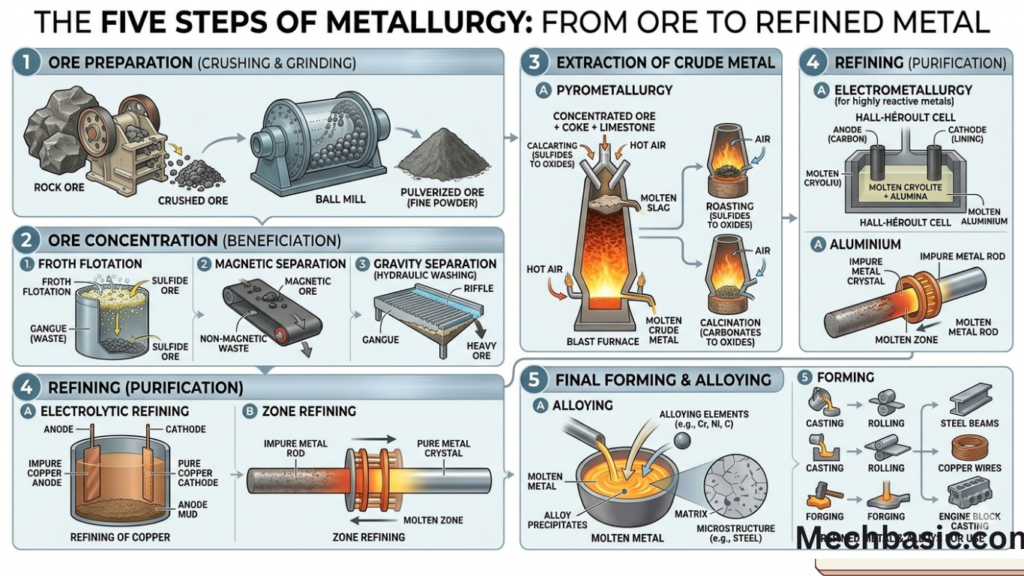
The five main steps of metallurgy are crushing and grinding of ore.
Then concentration, followed by extraction of the metal.
Finally, refining and purification to obtain pure metal.
In this article:
The “5 steps of metallurgy” usually refer to the sequence of operations used to extract a metal from its ore and refine it into a usable form. These steps are fundamental in extractive metallurgy.
5 Steps of Metallurgy
1. Crushing and Grinding (Comminution)
What happens
- The ore is broken into small pieces using crushers and grinders
Purpose
- Increase surface area
- Make separation of valuable minerals easier
Key Point
👉 Smaller particles → better efficiency in later processes
2. Concentration (Ore Dressing / Beneficiation)
What happens
- Unwanted materials (gangue) are removed from the ore
Common Methods
- Gravity separation
- Magnetic separation
- Froth flotation (very important for sulphide ores)
Purpose
- Increase the metal content in the ore
3. Calcination or Roasting
Calcination
- Heating ore in absence or limited air
- Used for carbonate ores
Roasting
- Heating ore in excess air
- Used for sulphide ores
Purpose
- Remove:
- Moisture
- Volatile impurities
- Convert ore into oxide form
4. Reduction (Smelting)
What happens
- Metal oxide is reduced to metal using:
- Carbon
- Carbon monoxide
- Other reducing agents
Example
- Iron extraction in a blast furnace
Purpose
- Obtain crude metal
5. Refining (Purification)
What happens
- Impure metal is purified
Methods
- Electrolytic refining
- Distillation
- Zone refining
- Liquation
Purpose
- Achieve required purity and properties
Summary Table
| Step | Process | Purpose |
|---|---|---|
| 1 | Crushing & Grinding | Reduce size |
| 2 | Concentration | Remove impurities |
| 3 | Calcination/Roasting | Convert to oxide |
| 4 | Reduction (Smelting) | Extract metal |
| 5 | Refining | Purify metal |
Summary:
👉 Metallurgy is essentially:
“Separating metal from ore and making it pure and usable.”
Conclusion
The five steps of metallurgy are crushing and grinding, concentration, calcination or roasting, reduction (smelting), and refining.
Other courses:





