
Electric vehicles (EVs) use rechargeable batteries to power an electric motor instead of an internal combustion engine.
The battery pack, electric motor, inverter, and powertrain work together to deliver efficient and smooth performance.
EV technology offers low emissions, high energy efficiency, and reduced maintenance costs.
In this article:
- Electric Vehicle Technology: Battery Basics and Powertrains
- What is an Electric Vehicle (EV)?
- Types of Electric Vehicles
- Basic Components of an Electric Vehicle
- EV Battery Basics
- Battery Cell Structure
- Main Battery Components
- Types of EV Batteries
- Battery Capacity
- Battery Voltage
- Battery Management System (BMS)
- Advantages of Electric Vehicles
- Limitations of Electric Vehicles
- Applications of Electric Vehicles
- Comparison: Electric Vehicle vs. Internal Combustion Engine Vehicle
- Summary Table
- Frequently Asked Questions (FAQs)
- Conclusion
Electric Vehicle Technology: Battery Basics and Powertrains
Introduction
Electric Vehicles (EVs) are transforming the global transportation industry by offering cleaner, quieter, and more energy-efficient alternatives to conventional internal combustion engine (ICE) vehicles. Instead of using gasoline or diesel to generate power, EVs use electric motors powered by rechargeable batteries to propel the vehicle.
Rapid advancements in battery technology, power electronics, electric motors, and charging infrastructure have made EVs increasingly practical for personal, commercial, and industrial use. Governments worldwide are also promoting EV adoption to reduce greenhouse gas emissions, improve air quality, and decrease dependence on fossil fuels.
This guide explains the fundamentals of electric vehicle technology, focusing on battery basics, EV powertrains, their components, working principles, advantages, limitations, and future developments.
What is an Electric Vehicle (EV)?
Definition
An Electric Vehicle (EV) is a vehicle that uses one or more electric motors for propulsion, with energy stored in rechargeable batteries or supplied by another electrical source.
Unlike conventional vehicles, EVs do not rely on fuel combustion inside an engine to produce mechanical power.
Also Read : The 10 Biggest Global Electric Vehicle Companies
Types of Electric Vehicles
1. Battery Electric Vehicle (BEV)
A Battery Electric Vehicle operates entirely on electricity stored in rechargeable batteries.
Characteristics
- No internal combustion engine
- Zero tailpipe emissions
- Fully rechargeable
- Uses only electric motors
Examples
- Electric passenger cars
- Electric buses
- Electric delivery vans
2. Hybrid Electric Vehicle (HEV)
An HEV combines an internal combustion engine with an electric motor.
Characteristics
- Battery charged by the engine and regenerative braking
- Cannot usually be plugged in
- Improved fuel efficiency
3. Plug-in Hybrid Electric Vehicle (PHEV)
A PHEV combines an electric motor with an internal combustion engine but also allows external battery charging.
Characteristics
- Can operate in electric-only mode for short distances
- Engine provides extended driving range
4. Fuel Cell Electric Vehicle (FCEV)
An FCEV generates electricity using hydrogen fuel cells.
Characteristics
- Hydrogen stored in tanks
- Produces electricity onboard
- Water vapor is the primary emission
Basic Components of an Electric Vehicle
An EV typically consists of:
- Battery pack
- Electric motor
- Inverter
- Power electronics controller
- Transmission or reduction gearbox
- On-board charger
- DC-DC converter
- Thermal management system
- Battery Management System (BMS)
- Regenerative braking system
EV Battery Basics
What is an EV Battery?
The battery pack is the primary energy storage device in an electric vehicle. It stores electrical energy chemically and supplies power to the electric motor when needed.
The battery is often considered the “fuel tank” of an EV.
Battery Cell Structure
Each battery pack consists of many individual cells, which are connected to form:
- Cells
- Modules
- Battery pack
Thousands of cells may be used depending on the vehicle’s capacity.
Main Battery Components
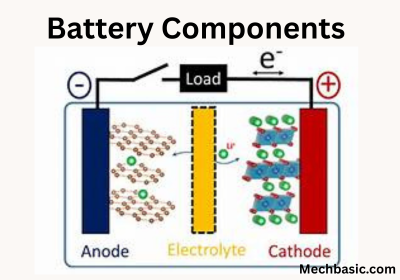
A battery cell contains:
Anode
Stores lithium ions during charging.
Common material:
- Graphite
Cathode
Releases lithium ions during discharge.
Common materials:
- Lithium Nickel Manganese Cobalt Oxide (NMC)
- Lithium Iron Phosphate (LFP)
- Lithium Cobalt Oxide (LCO)
Electrolyte
Allows lithium ions to move between the anode and cathode.
Separator
Prevents direct contact between electrodes while allowing ion flow.
Types of EV Batteries
1. Lithium-Ion Battery
The most widely used battery technology.
Advantages
- High energy density
- Long cycle life
- Lightweight
- Fast charging
- High efficiency
Applications
- Passenger EVs
- Electric buses
- Electric motorcycles
2. Lithium Iron Phosphate (LFP)
A subtype of lithium-ion chemistry.
Advantages
- Excellent safety
- Long lifespan
- Lower cost
- Stable performance
Limitations
- Lower energy density than NMC
3. Nickel Metal Hydride (NiMH)
Commonly used in hybrid vehicles.
Advantages
- Reliable
- Durable
Limitations
- Lower energy density
- Heavier than lithium-ion batteries
4. Solid-State Batteries
An emerging technology replacing liquid electrolytes with solid materials.
Potential Benefits
- Higher energy density
- Improved safety
- Faster charging
- Longer lifespan
Currently, these batteries are under development for large-scale automotive use.
Battery Capacity
Battery capacity is measured in kilowatt-hours (kWh).
Example:
- 40 kWh battery
- 60 kWh battery
- 100 kWh battery
Higher capacity generally provides greater driving range but increases weight and cost.
Battery Voltage
Typical EV battery packs operate at:
- 300–400 V (standard systems)
- 800 V (high-performance and fast-charging systems)
Higher voltages reduce current requirements and enable faster charging.
Battery Management System (BMS)
Purpose
The Battery Management System monitors and protects the battery pack.
Functions
- Cell voltage monitoring
- Temperature monitoring
- State of Charge (SOC) estimation
- State of Health (SOH) estimation
- Cell balancing
- Overcharge protection
- Over-discharge protection
- Short-circuit protection
The BMS is essential for battery safety, efficiency, and longevity.
EV Powertrain
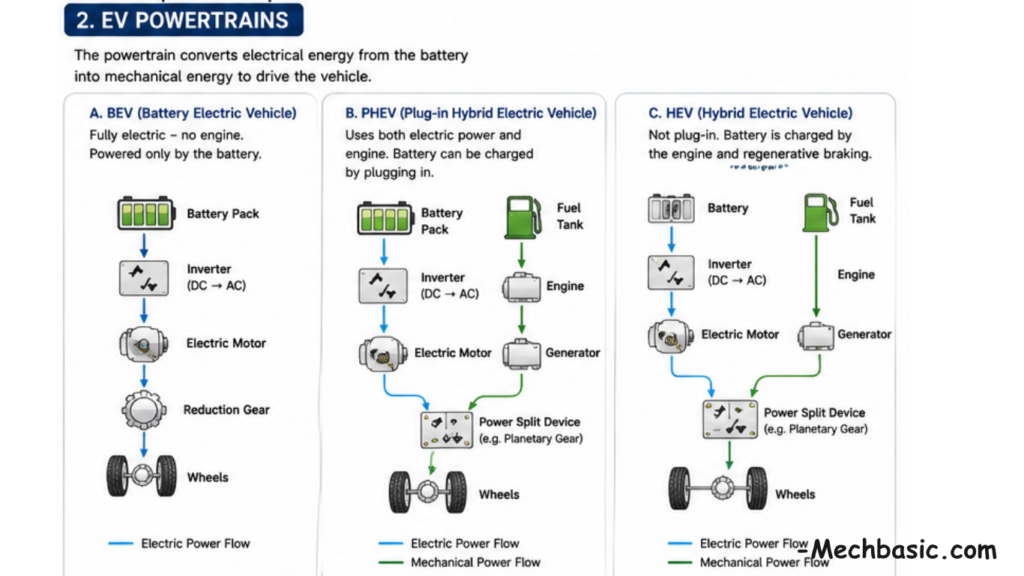
Definition
The electric vehicle powertrain consists of all components that generate, control, and transmit power from the battery to the wheels.
Main Powertrain Components
Battery Pack
Stores electrical energy.
Inverter
Converts DC power from the battery into AC power required by many electric motors. It also converts AC back to DC during regenerative braking.
Electric Motor
Converts electrical energy into mechanical rotation.
Common motor types include:
- Permanent Magnet Synchronous Motor (PMSM)
- Induction Motor
- Brushless DC Motor (BLDC)
- Switched Reluctance Motor (SRM)
Reduction Gearbox
Most EVs use a single-speed reduction gearbox that reduces motor speed and increases torque delivered to the wheels.
Differential
Distributes torque between the drive wheels while allowing them to rotate at different speeds during turns.
Controller
The power electronics controller regulates motor speed, torque, and overall vehicle performance based on driver input.
Working of an EV Powertrain
Step 1: Battery Supplies DC Power
The battery pack provides direct current (DC) electricity.
Step 2: Inverter Converts DC to AC
The inverter converts DC into alternating current (AC) for the electric motor (in AC motor systems).
Step 3: Electric Motor Generates Torque
The motor converts electrical energy into rotational mechanical energy.
Step 4: Gear Reduction
The gearbox reduces motor speed while increasing torque.
Step 5: Wheels Rotate
Torque is transmitted through the differential to the drive wheels, propelling the vehicle.
Regenerative Braking
Definition
Regenerative braking recovers kinetic energy during deceleration and converts it into electrical energy to recharge the battery.
Advantages
- Increases driving range
- Reduces brake wear
- Improves energy efficiency
- Enhances overall vehicle performance
Charging Methods
Level 1 Charging
- Standard household outlet
- Slow charging
- Suitable for overnight charging
Level 2 Charging
- Dedicated AC charger
- Faster than Level 1
- Common in homes and workplaces
DC Fast Charging
- High-power DC charging
- Rapid charging for long-distance travel
- Common at highway charging stations
Advantages of Electric Vehicles
- Zero tailpipe emissions (BEVs)
- High energy efficiency
- Quiet operation
- Lower maintenance costs
- Instant torque
- Smooth acceleration
- Regenerative braking
- Reduced dependence on fossil fuels
Limitations of Electric Vehicles
- Higher initial purchase cost
- Charging time compared with refueling
- Limited driving range in some models
- Battery degradation over time
- Charging infrastructure availability in certain regions
- Performance can be affected by extreme temperatures
Applications of Electric Vehicles
Electric vehicles are increasingly used in:
Passenger Transportation
- Cars
- SUVs
- Taxis
Public Transportation
- Electric buses
- Metro feeder vehicles
Commercial Vehicles
- Delivery vans
- Trucks
Industrial Applications
- Forklifts
- Airport vehicles
- Warehouse equipment
Two-Wheelers
- Electric motorcycles
- Electric scooters
- Electric bicycles
Future Trends
Electric vehicle technology is advancing rapidly with:
- Solid-state batteries
- Ultra-fast charging systems
- Wireless charging
- Vehicle-to-Grid (V2G) integration
- AI-based battery management
- Improved battery recycling
- Silicon-anode batteries
- Sodium-ion battery research
- Higher-voltage architectures
- Autonomous electric vehicles
These innovations aim to improve range, safety, affordability, and sustainability.
Comparison: Electric Vehicle vs. Internal Combustion Engine Vehicle
| Feature | Electric Vehicle (EV) | Internal Combustion Engine (ICE) Vehicle |
|---|---|---|
| Energy Source | Rechargeable battery | Gasoline or diesel |
| Propulsion | Electric motor | Internal combustion engine |
| Tailpipe Emissions | Zero (BEV) | Produces exhaust gases |
| Efficiency | Higher | Lower |
| Noise | Very low | Higher |
| Maintenance | Lower | Higher |
| Torque Delivery | Instant | Builds with engine speed |
| Refueling/Charging | Charging required | Fuel filling |
| Number of Moving Parts | Fewer | More |
Summary Table
| Component | Function |
|---|---|
| Battery Pack | Stores electrical energy |
| Battery Management System (BMS) | Monitors and protects the battery |
| Inverter | Converts DC to AC and manages power flow |
| Electric Motor | Converts electrical energy into mechanical motion |
| Reduction Gearbox | Reduces speed and increases torque |
| Differential | Transfers torque to the wheels |
| Regenerative Braking System | Recovers energy during braking |
| On-board Charger | Converts AC from the grid to DC for battery charging |
| DC-DC Converter | Supplies low-voltage power to auxiliary systems |
Frequently Asked Questions (FAQs)
1. What is the main source of energy in an electric vehicle?
The primary energy source is a rechargeable battery pack, most commonly based on lithium-ion technology.
2. Why are lithium-ion batteries widely used in EVs?
Lithium-ion batteries offer high energy density, long cycle life, fast charging capability, relatively low weight, and high efficiency.
3. What is the function of the Battery Management System (BMS)?
The BMS monitors battery voltage, temperature, state of charge, and health, balances individual cells, and protects the battery from unsafe operating conditions.
4. How does regenerative braking improve efficiency?
It converts part of the vehicle’s kinetic energy during braking into electrical energy, which is stored back in the battery instead of being lost as heat.
5. Do electric vehicles have a gearbox?
Most battery electric vehicles use a single-speed reduction gearbox because electric motors provide a wide operating speed range and high torque from zero speed.
6. What is the role of the inverter in an EV?
The inverter converts direct current (DC) from the battery into alternating current (AC) for the electric motor (where applicable) and manages power flow during both driving and regenerative braking.
7. What are the main advantages of electric vehicles?
They offer zero tailpipe emissions (BEVs), high energy efficiency, instant torque, quiet operation, lower maintenance requirements, and reduced dependence on fossil fuels.
8. What are the challenges of electric vehicles?
Common challenges include higher initial cost, charging time, battery degradation, limited charging infrastructure in some areas, and reduced range under certain conditions.
9. What are solid-state batteries?
Solid-state batteries use a solid electrolyte instead of a liquid one, offering the potential for higher energy density, improved safety, faster charging, and longer service life.
10. What is the future of electric vehicle technology?
The future includes advances in solid-state batteries, ultra-fast charging, wireless charging, AI-driven battery management, vehicle-to-grid integration, improved battery recycling, and more efficient electric powertrains.
Conclusion
Electric vehicle technology represents a major advancement in sustainable transportation. The battery pack serves as the primary energy source, while the electric powertrain efficiently converts stored electrical energy into mechanical motion through components such as the inverter, electric motor, reduction gearbox, and battery management system. Compared with conventional internal combustion engine vehicles, EVs provide higher efficiency, lower maintenance, instant torque, and zero tailpipe emissions in battery electric models. Continued innovations in battery chemistry, charging technologies, power electronics, and intelligent energy management are expected to further improve vehicle range, safety, affordability, and overall performance, making electric vehicles an increasingly important part of the future of mobility.
Other courses:





