
McPherson strut suspension is simple, lightweight, and widely used in passenger cars for its compact design.
Double wishbone suspension uses two control arms to provide better handling, stability, and wheel control.
Both systems improve ride comfort, steering, and vehicle performance, but they differ in design and application.
In this article:
- Suspension Systems: McPherson Strut and Double Wishbone
- What is a Suspension System?
- Functions of a Suspension System
- Main Components of a Suspension System
- Types of Suspension Systems
- McPherson Strut Suspension
- Construction of McPherson Strut Suspension
- Working Principle of McPherson Strut
- Advantages of McPherson Strut
- Disadvantages of McPherson Strut
- Applications of McPherson Strut
- Double Wishbone Suspension
- Construction of Double Wishbone Suspension
- Working Principle of Double Wishbone Suspension
- Advantages of Double Wishbone Suspension
- Disadvantages of Double Wishbone Suspension
- Applications of Double Wishbone Suspension
- McPherson Strut vs. Double Wishbone
- Suspension Geometry
- Role of Shock Absorbers
- Role of Coil Springs
- Stabilizer (Anti-Roll) Bar
- Common Suspension Problems
- Future Trends in Suspension Systems
- Summary Table
- Frequently Asked Questions (FAQs)
- Conclusion
Suspension Systems: McPherson Strut and Double Wishbone
Introduction
The suspension system is one of the most important systems in an automobile, designed to support the vehicle’s weight, absorb road shocks, maintain tire contact with the road, and provide a comfortable and stable ride. Without an effective suspension system, vehicles would experience excessive vibrations, poor handling, increased tire wear, and reduced safety.
Modern automobiles use various suspension designs, but the McPherson Strut and Double Wishbone suspensions are the two most common independent suspension systems. The McPherson strut is widely used in passenger cars because of its compact design and cost-effectiveness, while the double wishbone suspension is preferred in high-performance, luxury, and off-road vehicles due to its superior handling and wheel control.
This guide explains the construction, working principles, advantages, disadvantages, applications, and differences between McPherson strut and double wishbone suspension systems.
What is a Suspension System?
Definition
A suspension system is a combination of mechanical components that connects a vehicle’s wheels to its frame or body. It supports the vehicle, absorbs shocks from uneven road surfaces, and ensures stable handling by maintaining continuous tire contact with the road.
Functions of a Suspension System
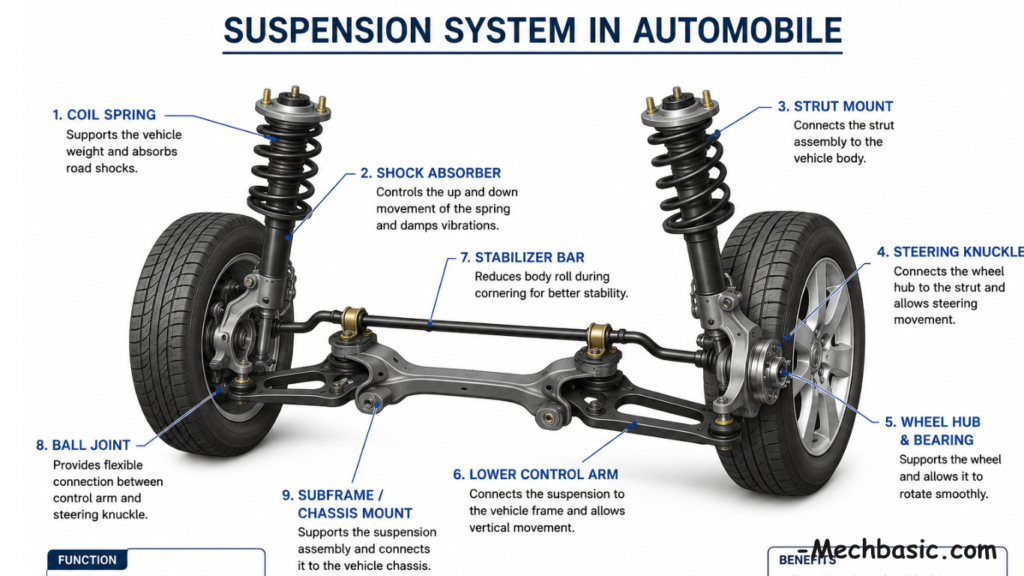
The suspension system performs several important functions:
- Supports the weight of the vehicle.
- Absorbs road shocks and vibrations.
- Maintains tire contact with the road.
- Improves ride comfort.
- Enhances steering stability.
- Reduces body roll during cornering.
- Improves braking performance.
- Protects vehicle components from excessive impact loads.
Main Components of a Suspension System
A typical suspension system consists of:
- Springs
- Shock absorbers (dampers)
- Control arms
- Ball joints
- Steering knuckle
- Stabilizer (anti-roll) bar
- Bushings
- Wheel hub
- Suspension links
Types of Suspension Systems
Suspension systems can be classified into:
1. Dependent Suspension
The wheels on the same axle are mechanically connected. Movement of one wheel affects the other.
Examples:
- Solid axle
- Live axle
2. Independent Suspension
Each wheel moves independently, improving ride comfort and handling.
Examples:
- McPherson Strut
- Double Wishbone
- Multi-link
- Trailing arm
Also Read: Types of Suspension System
McPherson Strut Suspension
Definition
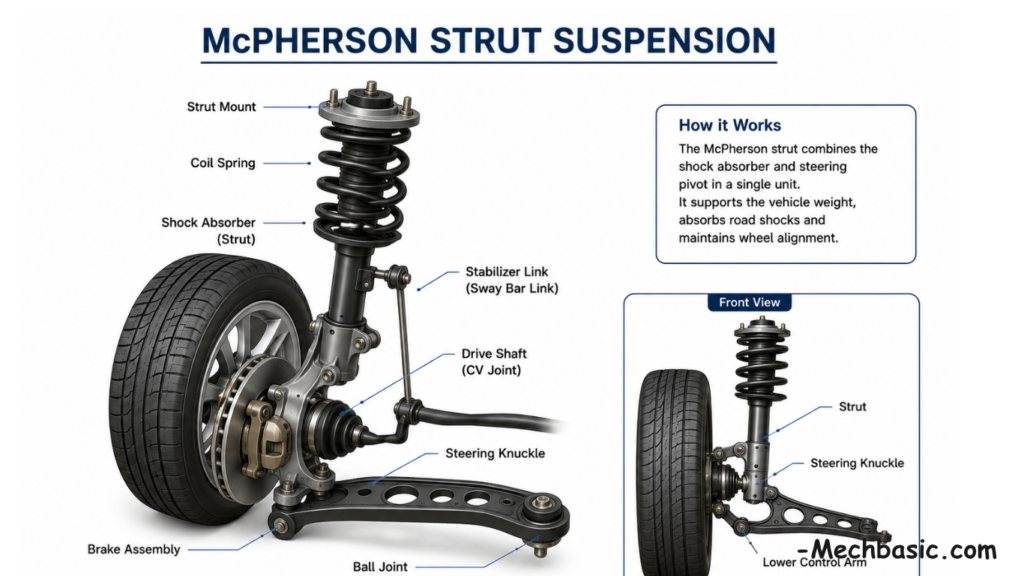
The McPherson Strut is an independent suspension system that combines the shock absorber and coil spring into a single structural unit (strut). It also serves as a steering pivot in many front-wheel-drive vehicles.
It was developed by Earle S. MacPherson and has become one of the most widely used suspension systems in the automotive industry.
Construction of McPherson Strut Suspension
The main components include:
1. Strut Assembly
Consists of:
- Shock absorber
- Coil spring
- Upper strut mount
2. Lower Control Arm
Connects the steering knuckle to the vehicle frame and controls wheel movement.
3. Steering Knuckle
Holds the wheel hub and connects the suspension to the steering system.
4. Ball Joint
Allows smooth movement between the control arm and steering knuckle.
5. Stabilizer Bar
Reduces body roll during cornering.
Working Principle of McPherson Strut
Step 1: Vehicle Encounters a Bump
The wheel moves upward when it passes over an uneven surface.
Step 2: Spring Compression
The coil spring compresses to absorb the impact.
Step 3: Shock Absorber Damping
The shock absorber controls spring oscillations, preventing excessive bouncing.
Step 4: Wheel Returns
The spring expands, restoring the wheel to its normal position while maintaining road contact.
Advantages of McPherson Strut
1. Simple Design
Fewer components simplify manufacturing and assembly.
2. Lightweight
The compact design reduces overall vehicle weight.
3. Lower Manufacturing Cost
Requires fewer parts and less assembly time.
4. Compact Construction
Provides more space in the engine compartment, especially in front-wheel-drive vehicles.
5. Easy Maintenance
Fewer moving parts make servicing relatively straightforward.
Disadvantages of McPherson Strut
- Limited control of wheel alignment during suspension travel.
- Greater body roll compared to some advanced suspension designs.
- Higher stress on the strut tower.
- Reduced performance in aggressive cornering.
- Less flexibility in suspension geometry.
Applications of McPherson Strut
Commonly used in:
- Passenger cars
- Compact cars
- Hatchbacks
- Sedans
- Small SUVs
- Front-wheel-drive vehicles
Double Wishbone Suspension
Definition
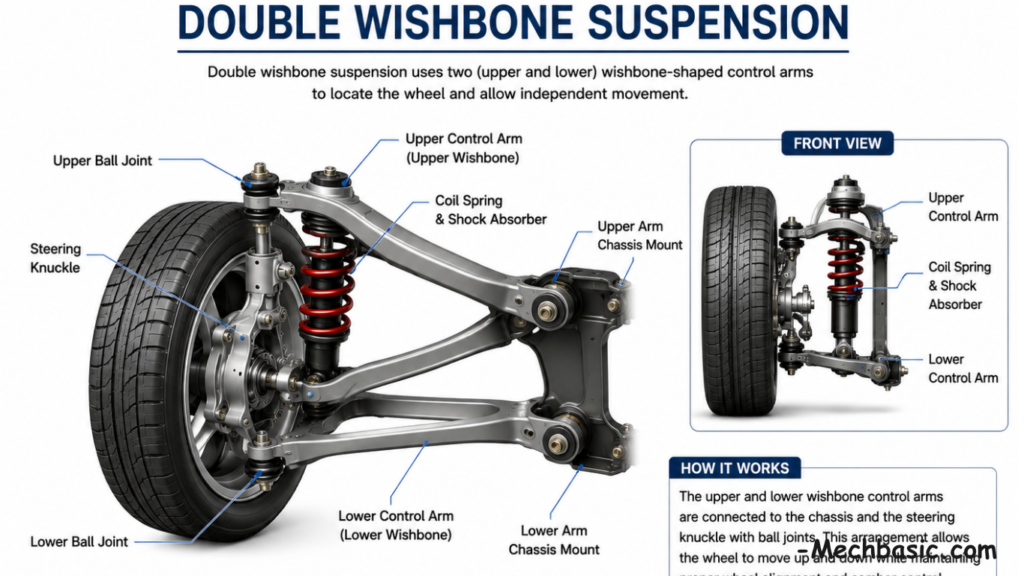
The Double Wishbone Suspension is an independent suspension system that uses two wishbone-shaped control arms (upper and lower) to precisely control wheel movement.
It provides excellent wheel alignment, handling, and ride stability.
Construction of Double Wishbone Suspension
The main components include:
1. Upper Control Arm
Controls the upper position of the wheel and helps maintain proper camber.
2. Lower Control Arm
Supports the wheel and carries most of the suspension load.
3. Coil Spring
Supports vehicle weight and absorbs road impacts.
4. Shock Absorber
Controls spring movement and minimizes oscillations.
5. Steering Knuckle
Connects the wheel hub to the suspension arms.
6. Ball Joints
Allow rotational movement between control arms and steering knuckle.
7. Stabilizer Bar
Reduces body roll during cornering.
Working Principle of Double Wishbone Suspension
Step 1: Wheel Encounters a Bump
The wheel moves upward.
Step 2: Control Arms Move
Both upper and lower wishbones rotate through their pivots.
Step 3: Spring Compression
The coil spring compresses to absorb road shock.
Step 4: Shock Absorber Damping
The shock absorber controls spring rebound.
Step 5: Wheel Alignment Maintained
The geometry of the wishbones helps maintain optimal camber and tire contact throughout suspension travel.
Advantages of Double Wishbone Suspension
1. Superior Handling
Provides excellent cornering stability and steering precision.
2. Better Camber Control
Maintains favorable tire contact with the road during suspension movement.
3. Improved Ride Comfort
Handles road irregularities effectively while maintaining stability.
4. High Performance
Ideal for sports cars, racing vehicles, and luxury automobiles.
5. Reduced Tire Wear
More consistent wheel alignment helps extend tire life.
Disadvantages of Double Wishbone Suspension
- More complex construction.
- Higher manufacturing cost.
- Greater weight.
- Requires more installation space.
- More components increase maintenance complexity.
Applications of Double Wishbone Suspension
Commonly found in:
- Sports cars
- Luxury cars
- Performance sedans
- Racing cars
- Off-road vehicles
- High-end SUVs
McPherson Strut vs. Double Wishbone
| Feature | McPherson Strut | Double Wishbone |
|---|---|---|
| Suspension Type | Independent | Independent |
| Main Components | Strut, spring, lower control arm | Upper and lower control arms, spring, damper |
| Complexity | Simple | Complex |
| Manufacturing Cost | Lower | Higher |
| Weight | Lighter | Heavier |
| Space Requirement | Compact | Larger |
| Camber Control | Moderate | Excellent |
| Ride Comfort | Good | Excellent |
| Handling | Good | Superior |
| Maintenance | Easier | More complex |
| Typical Applications | Economy and passenger cars | Performance, luxury, and off-road vehicles |
Suspension Geometry
Proper suspension geometry affects:
- Camber angle
- Caster angle
- Toe angle
- Kingpin inclination
- Roll center
Maintaining correct geometry improves:
- Tire life
- Steering stability
- Cornering performance
- Braking efficiency
The double wishbone suspension generally offers greater flexibility in controlling these parameters.
Role of Shock Absorbers
Shock absorbers (dampers) are essential in both suspension systems.
Their functions include:
- Controlling spring oscillations.
- Reducing vehicle bounce.
- Improving ride comfort.
- Maintaining tire contact with the road.
- Enhancing braking and steering stability.
Without dampers, the springs would continue to oscillate after every bump.
Role of Coil Springs
Coil springs:
- Support the vehicle’s weight.
- Absorb impacts from uneven roads.
- Store and release energy during suspension movement.
- Help maintain proper ride height.
Stabilizer (Anti-Roll) Bar
A stabilizer bar connects the left and right suspension assemblies.
Its purpose is to:
- Reduce body roll during cornering.
- Improve vehicle stability.
- Enhance driver confidence.
- Maintain balanced handling.
Maintenance Tips
Regular maintenance helps ensure suspension performance:
- Inspect shock absorbers for leaks.
- Check coil springs for cracks or sagging.
- Examine ball joints and bushings for wear.
- Lubricate components where applicable.
- Perform wheel alignment after replacing suspension parts or after significant impacts.
- Replace worn components promptly.
Common Suspension Problems
Worn Shock Absorbers
Symptoms:
- Excessive bouncing
- Poor ride comfort
- Longer braking distances
Broken Coil Springs
Symptoms:
- Uneven ride height
- Noise over bumps
- Reduced stability
Worn Ball Joints
Symptoms:
- Steering looseness
- Clunking noises
- Uneven tire wear
Damaged Bushings
Symptoms:
- Vibrations
- Noise
- Poor handling
Misaligned Wheels
Symptoms:
- Vehicle pulls to one side
- Uneven tire wear
- Reduced steering precision
Future Trends in Suspension Systems
Modern suspension technology continues to evolve with:
- Adaptive suspension systems
- Electronically controlled dampers
- Air suspension
- Active suspension
- Semi-active suspension
- Magnetorheological (magnetic fluid) dampers
- AI-based suspension control
- Predictive suspension using cameras and sensors
These technologies improve ride quality, handling, and safety.
Summary Table
| Aspect | McPherson Strut | Double Wishbone |
|---|---|---|
| Cost | Lower | Higher |
| Design | Simple | Complex |
| Ride Comfort | Good | Excellent |
| Handling | Good | Excellent |
| Weight | Light | Heavier |
| Space Required | Less | More |
| Camber Control | Moderate | Superior |
| Typical Use | Passenger cars | Sports, luxury, and off-road vehicles |
Frequently Asked Questions (FAQs)
1. What is the primary purpose of a suspension system?
The suspension system supports the vehicle, absorbs road shocks, maintains tire contact with the road, and improves ride comfort, handling, and safety.
2. What is a McPherson strut?
A McPherson strut is an independent suspension design that combines the shock absorber and coil spring into a single structural unit, simplifying construction and reducing weight.
3. What is a double wishbone suspension?
A double wishbone suspension uses separate upper and lower control arms to guide wheel movement, providing better control of suspension geometry and improved handling.
4. Why is the McPherson strut widely used?
It is compact, lightweight, cost-effective, easy to manufacture, and well suited to front-wheel-drive passenger vehicles where engine compartment space is limited.
5. Why do performance cars often use double wishbone suspension?
Double wishbone suspension offers superior camber control, better tire contact during cornering, improved steering precision, and enhanced stability under demanding driving conditions.
6. What role do shock absorbers play in a suspension system?
Shock absorbers dampen spring oscillations, reduce vehicle bounce, improve ride comfort, and help maintain continuous tire contact with the road.
7. What is the purpose of a stabilizer bar?
A stabilizer (anti-roll) bar reduces body roll during cornering by linking the left and right suspension systems, improving vehicle stability and handling.
8. Which suspension system is easier to maintain?
McPherson strut suspension is generally easier and less expensive to maintain because it has fewer components than a double wishbone system.
9. Can a vehicle use different suspension systems at the front and rear?
Yes. Many vehicles use a McPherson strut suspension at the front and a different independent or semi-independent suspension, such as a multi-link or torsion beam system, at the rear.
10. What are the future developments in automotive suspension systems?
Future developments include adaptive and active suspension systems, electronically controlled dampers, air suspension, magnetorheological dampers, predictive suspension using cameras and sensors, and AI-based suspension control for improved comfort and safety.
Conclusion
The suspension system is essential for ensuring vehicle stability, comfort, and safety by supporting the vehicle, absorbing road impacts, and maintaining tire contact with the road. The McPherson strut is a simple, compact, and economical suspension design that is widely used in passenger vehicles due to its low cost and efficient packaging. In contrast, the double wishbone suspension provides superior wheel control, handling, and ride quality, making it the preferred choice for high-performance, luxury, and off-road vehicles. Selecting the appropriate suspension system depends on factors such as vehicle type, performance requirements, cost, available space, and intended use. As automotive technology advances, adaptive and electronically controlled suspension systems will continue to enhance ride comfort, handling precision, and overall driving safety.
Other courses:





