
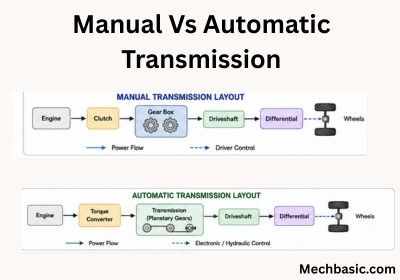
A manual transmission requires the driver to change gears using a clutch and gear lever, offering greater control.
An automatic transmission changes gears automatically, providing easier and smoother driving.
Manual systems are generally less expensive and more fuel-efficient, while automatic systems offer greater comfort and convenience.
In this article:
- Automotive Transmission Systems: Manual vs. Automatic
- What is an Automotive Transmission?
- Functions of a Transmission System
- Main Components of a Transmission System
- Manual Transmission
- Working Principle of Manual Transmission
- Main Components of a Manual Transmission
- Advantages of Manual Transmission
- Disadvantages of Manual Transmission
- Automatic Transmission
- Working Principle of Automatic Transmission
- Main Components of an Automatic Transmission
- Advantages of Automatic Transmission
- Disadvantages of Automatic Transmission
- Types of Automatic Transmissions
- Manual vs. Automatic Transmission Comparison
- Gear Ratios
- Transmission Fluids
- Maintenance Tips
- Applications
- Emerging Technologies
- Advantages and Limitations Summary
- Choosing the Right Transmission
- Frequently Asked Questions (FAQs)
- Conclusion
Automotive Transmission Systems: Manual vs. Automatic
Introduction
The transmission system is one of the most important components of an automobile. It transfers power from the engine to the drive wheels while providing different gear ratios to meet varying driving conditions. Without a transmission, a vehicle would struggle to start from rest, climb hills, or travel efficiently at different speeds.
Modern vehicles use two primary types of transmission systems:
- Manual Transmission (MT) – The driver manually selects gears using a gear lever and operates a clutch pedal.
- Automatic Transmission (AT) – The transmission automatically changes gears based on vehicle speed, engine load, and throttle position without requiring driver intervention.
Each transmission type has its own advantages, disadvantages, and ideal applications. This guide provides a detailed comparison of manual and automatic transmission systems, including their construction, working principles, benefits, limitations, and future trends.
What is an Automotive Transmission?
Definition
An automotive transmission is a mechanical system that transmits engine power to the drive wheels while allowing the engine to operate within its optimal speed range. It provides different gear ratios to balance torque, speed, fuel efficiency, and performance.
Functions of a Transmission System
The primary functions of a transmission are:
- Transfer engine power to the wheels.
- Provide different gear ratios for various driving conditions.
- Increase torque during vehicle starting and hill climbing.
- Reduce engine speed at high vehicle speeds for better fuel economy.
- Allow reverse motion.
- Provide a neutral position where the engine can run without driving the wheels.
- Improve vehicle performance and drivability.
Main Components of a Transmission System
Although designs vary, a typical transmission includes:
- Clutch (manual transmission)
- Torque converter (automatic transmission)
- Input shaft
- Countershaft (layshaft)
- Output shaft
- Gear sets
- Synchronizers (manual)
- Planetary gear sets (automatic)
- Shift mechanism
- Bearings
- Lubrication system
- Electronic control unit (automatic)
Manual Transmission
Definition
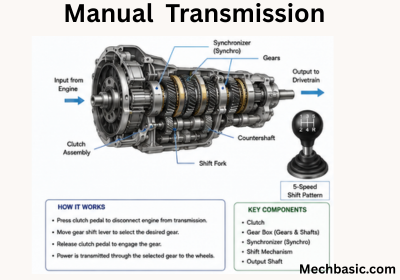
A manual transmission is a gearbox in which the driver manually selects gears using a gear lever while operating a clutch pedal to engage or disengage the engine from the transmission.
It is also known as a stick shift or standard transmission.
Working Principle of Manual Transmission
The manual transmission works through the following sequence:
Step 1: Clutch Disengagement
The driver presses the clutch pedal, disconnecting the engine from the gearbox.
Step 2: Gear Selection
The desired gear is selected using the gear lever. Synchronizers help match gear speeds for smooth engagement.
Step 3: Clutch Engagement
The driver gradually releases the clutch pedal, reconnecting the engine to the transmission.
Step 4: Power Transmission
Engine torque passes through the gearbox to the differential and finally to the drive wheels.
Main Components of a Manual Transmission
- Clutch
- Flywheel
- Gear lever
- Synchronizers
- Input shaft
- Countershaft
- Output shaft
- Gear sets
- Shift forks
- Bearings
Advantages of Manual Transmission
1. Better Driver Control
Drivers can select gears according to road and traffic conditions.
2. Lower Initial Cost
Manual transmissions are generally less expensive to manufacture and purchase.
3. Simpler Construction
They contain fewer hydraulic and electronic components, making them mechanically simpler.
4. Better Fuel Efficiency (Traditional Designs)
Older manual transmissions often provided better fuel economy than conventional automatics. Modern automatic transmissions, however, can match or exceed manual efficiency.
5. Lower Maintenance Costs
Repairs are often simpler and less costly than those for automatic transmissions.
Disadvantages of Manual Transmission
- Requires driver skill and coordination.
- Frequent clutch operation can be tiring in heavy traffic.
- Learning curve for new drivers.
- Increased risk of engine stalling.
- Less convenient in stop-and-go driving.
Automatic Transmission
Definition
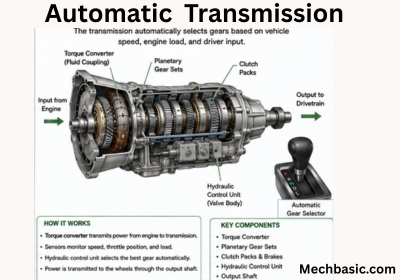
An automatic transmission changes gears automatically without requiring the driver to operate a clutch pedal or manually shift gears.
Electronic and hydraulic systems determine the optimal gear based on driving conditions.
Working Principle of Automatic Transmission
Step 1: Torque Converter
The torque converter transmits engine power to the transmission using transmission fluid, eliminating the need for a clutch pedal.
Step 2: Planetary Gear Sets
Different gear ratios are produced by engaging various combinations of planetary gears.
Step 3: Hydraulic System
Hydraulic pressure operates clutches and bands to engage the required gear.
Step 4: Electronic Control
Sensors monitor vehicle speed, engine load, throttle position, and other parameters. The Transmission Control Unit (TCU) selects the most suitable gear.
Main Components of an Automatic Transmission
- Torque converter
- Planetary gear sets
- Hydraulic pump
- Valve body
- Clutches
- Bands
- Transmission fluid
- Electronic control unit (TCU)
- Sensors
- Output shaft
Advantages of Automatic Transmission
1. Easy to Drive
No clutch pedal or manual gear shifting is required, making driving simpler.
2. Comfortable in Traffic
Automatic gear changes reduce driver fatigue, especially in urban congestion.
3. Smooth Gear Changes
Modern automatics provide seamless shifting, improving ride comfort.
4. Reduced Driver Error
Automatic systems prevent incorrect gear selection and reduce the risk of engine stalling.
5. Improved Performance
Advanced automatics optimize gear selection for acceleration and fuel efficiency.
Disadvantages of Automatic Transmission
- Higher purchase cost.
- More complex construction.
- Repairs can be expensive.
- Slightly heavier than manual transmissions.
- Requires regular transmission fluid maintenance.
Types of Automatic Transmissions
1. Conventional Automatic Transmission (AT)
Uses a torque converter and planetary gear sets. It offers smooth operation and is common in passenger cars.
2. Continuously Variable Transmission (CVT)
Uses belts and pulleys to provide an infinite range of gear ratios, improving fuel efficiency and smoothness.
3. Dual-Clutch Transmission (DCT)
Employs two clutches—one for odd gears and one for even gears—to deliver rapid, efficient gear changes.
4. Automated Manual Transmission (AMT)
A conventional manual gearbox with electronically controlled clutch and gear shifting. It combines the simplicity of a manual with automatic operation.
Manual vs. Automatic Transmission Comparison
| Feature | Manual Transmission | Automatic Transmission |
|---|---|---|
| Gear Shifting | Driver-controlled | Automatic |
| Clutch Pedal | Required | Not required |
| Driver Skill | Higher | Lower |
| Driving Comfort | Moderate | High |
| Traffic Performance | Less convenient | Excellent |
| Fuel Efficiency | Traditionally higher | Comparable or higher in modern designs |
| Initial Cost | Lower | Higher |
| Maintenance Cost | Generally lower | Generally higher |
| Repair Complexity | Lower | Higher |
| Driver Engagement | High | Moderate |
| Risk of Stalling | Higher | Very low |
| Learning Curve | Steeper | Easier |
Also Read: Manual Vs Automatic cars-What to choose?
Gear Ratios
Gear ratios determine the relationship between engine speed and wheel speed.
Low Gears
- High torque
- Lower speed
- Used for starting, climbing, and towing
High Gears
- Lower torque
- Higher speed
- Better fuel economy during cruising
Selecting the appropriate gear ratio improves performance and efficiency.
Transmission Fluids
Transmission fluid performs several functions:
- Lubricates moving parts.
- Reduces friction and wear.
- Cools the transmission.
- Cleans internal components.
- Provides hydraulic pressure in automatic transmissions.
Regular fluid checks and timely replacement are essential for reliable operation.
Maintenance Tips
To maximize transmission life:
- Follow the manufacturer’s maintenance schedule.
- Check transmission fluid level and condition regularly.
- Avoid aggressive driving and sudden acceleration.
- Do not overload the vehicle.
- Address leaks promptly.
- Replace worn clutch components (manual transmission).
- Use the correct transmission fluid specified by the manufacturer.
Applications
Manual Transmission
Commonly used in:
- Entry-level passenger cars
- Sports cars
- Commercial vehicles
- Off-road vehicles
- Agricultural equipment
Automatic Transmission
Widely used in:
- Passenger cars
- Luxury vehicles
- SUVs
- Urban taxis
- Hybrid vehicles
- Electric vehicles (single-speed reductions in many EVs)
Emerging Technologies
Modern transmission systems are evolving with:
- AI-assisted shift optimization.
- Adaptive learning algorithms.
- Eight-, nine-, and ten-speed automatic transmissions.
- Improved CVT technology.
- Electrified and hybrid powertrains.
- Integrated electric drive units.
- Smart predictive shifting using GPS and navigation data.
These technologies improve efficiency, comfort, and performance.
Advantages and Limitations Summary
| Transmission Type | Advantages | Limitations |
|---|---|---|
| Manual | Lower cost, greater driver control, simpler design | Requires more skill, less convenient in traffic |
| Automatic | Easier driving, smoother shifts, excellent in traffic | Higher cost, more complex maintenance |
Choosing the Right Transmission
| Requirement | Recommended Transmission |
|---|---|
| Maximum driver involvement | Manual |
| Daily city commuting | Automatic |
| Heavy traffic | Automatic |
| Lower purchase cost | Manual |
| Ease of learning | Automatic |
| Performance driving | Manual or Dual-Clutch Transmission (DCT) |
| Long highway journeys | Automatic or Manual (depending on preference) |
| Commercial fleet operation | Depends on duty cycle and operating conditions |
Frequently Asked Questions (FAQs)
1. What is the main function of an automotive transmission?
The transmission transfers engine power to the drive wheels while providing different gear ratios to optimize torque, speed, fuel efficiency, and vehicle performance.
2. What is the main difference between manual and automatic transmissions?
A manual transmission requires the driver to operate a clutch pedal and manually select gears, whereas an automatic transmission changes gears automatically without driver intervention.
3. Which transmission is better for beginners?
Automatic transmissions are generally better for beginners because they are easier to operate and eliminate the need for clutch control and manual gear changes.
4. Are modern automatic transmissions fuel-efficient?
Yes. Many modern automatic transmissions, including advanced multi-speed automatics, CVTs, and DCTs, provide fuel efficiency comparable to or even better than traditional manual transmissions.
5. What is a torque converter?
A torque converter is a fluid coupling used in conventional automatic transmissions that transfers engine power to the gearbox while allowing the engine to continue running when the vehicle is stationary.
6. What is a Dual-Clutch Transmission (DCT)?
A DCT uses two separate clutches to pre-select gears, enabling extremely fast and efficient gear changes with minimal interruption in power delivery.
7. Why is transmission fluid important?
Transmission fluid lubricates components, dissipates heat, reduces wear, and, in automatic transmissions, provides the hydraulic pressure needed for gear changes.
8. Which transmission requires more maintenance?
Automatic transmissions generally require more specialized maintenance and repairs due to their complex hydraulic and electronic systems, while manual transmissions often have lower maintenance costs.
9. Can manual transmissions improve driver control?
Yes. Manual transmissions allow drivers to choose gears based on road conditions, engine speed, and driving style, offering greater control and engagement.
10. What is the future of automotive transmission systems?
The future includes AI-assisted shifting, adaptive transmission control, advanced dual-clutch systems, continuously variable transmissions, integrated electric drive units, and optimized gear management for hybrid and electric vehicles.
Conclusion
The transmission system is essential for delivering engine power efficiently under a wide range of driving conditions. Manual transmissions offer greater driver involvement, mechanical simplicity, and lower ownership costs, making them attractive for enthusiasts and certain commercial applications. Automatic transmissions provide superior convenience, smoother gear changes, and reduced driver fatigue, making them the preferred choice for modern passenger vehicles and urban driving. Advances in electronics, control systems, and transmission design have significantly improved the efficiency and performance of automatic systems, narrowing the gap with manual transmissions. Choosing the right transmission depends on driving preferences, operating conditions, maintenance considerations, and overall vehicle requirements.
Other courses:





