
SLS (Selective Laser Sintering) is an additive manufacturing process that uses a laser to fuse powdered material layer by layer.
The powder bed supports the part, so no support structures are needed.
It produces strong, durable, and complex parts used in industrial applications.
In this article:
What is the SLS Process in Additive Manufacturing? (in Detail)
SLS (Selective Laser Sintering) is an advanced powder-based additive manufacturing process in which a high-power laser fuses powdered material layer by layer to form a solid 3D object.
👉 It is widely used for strong, functional, and complex industrial parts.
Definition
Selective Laser Sintering (SLS) is an additive manufacturing process in which a laser selectively fuses powdered material (such as nylon) layer by layer to build a 3D object without the need for support structures.
Working Principle of SLS
SLS works on the principle of:
laser sintering (partial melting and fusion of powder particles)
Step-by-Step SLS Process
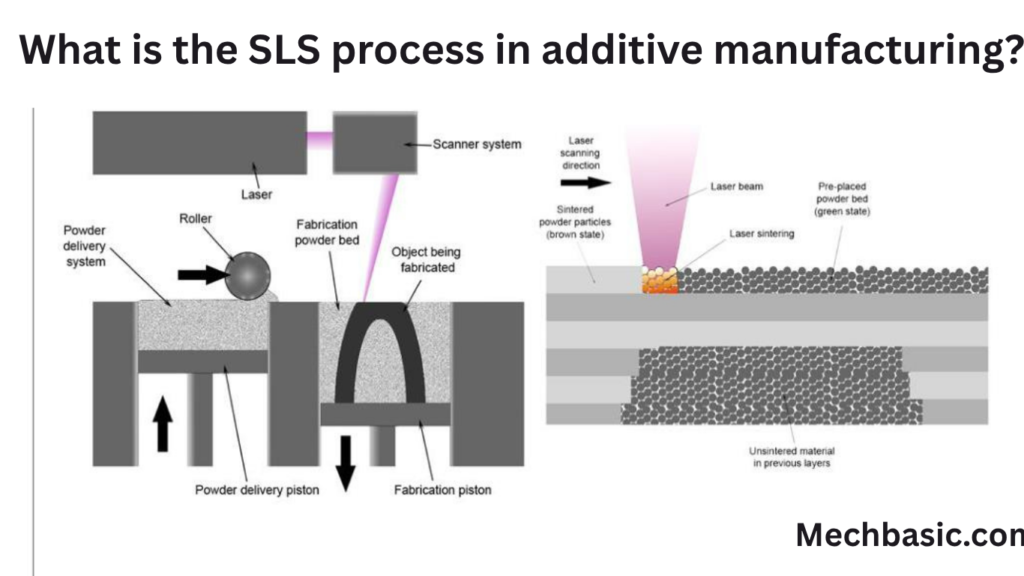
1. CAD Model Creation
- A 3D model is designed using CAD software (SolidWorks, Fusion 360)
2. Slicing
- Model is divided into thin layers
- Toolpaths for laser are generated
3. Powder Bed Preparation
- A thin layer of powder (e.g., nylon) is spread evenly on the build platform
4. Laser Scanning & Sintering
- A high-power laser scans the layer
- Powder particles in selected areas are heated and fused together
5. Layer Addition
- Build platform lowers slightly
- A new powder layer is spread on top
6. Repetition
- Steps 3–5 repeat until full object is built
7. Cooling Phase
- Entire powder bed is allowed to cool slowly
- Prevents warping and stress
8. Part Removal & Cleaning
- Printed part is removed from powder bed
- Excess powder is brushed or blasted off
- Unused powder is recycled
9. Post-Processing (Optional)
- Surface finishing
- Dyeing or coating
- Machining for precision
Materials Used in SLS
Common materials
- Nylon (PA12, PA11)
- Polyamide powders
- Thermoplastic elastomers (TPU)
- Metal powders (in advanced DMLS systems)
Key Components of SLS Machine
- Powder delivery system
- Build platform
- High-power laser
- Recoater (spreads powder evenly)
- Heated chamber
Advantages of SLS
1. No Support Structures Needed
- Powder itself supports the part
2. High Strength Parts
- Strong and durable components
- Good mechanical properties
3. Complex Geometry
- Can print hollow and intricate shapes
4. Efficient Material Usage
- Unused powder can be reused
5. Suitable for Functional Parts
- Used in real engineering applications
Disadvantages of SLS
1. Expensive Equipment
- Industrial-grade machines
2. Rough Surface Finish
- Powder texture visible
3. Post-Processing Required
- Cleaning and finishing needed
4. High Energy Consumption
- Laser and heated chamber required
Applications of SLS
Aerospace
- Lightweight structural parts
Automotive
- Functional prototypes and end-use parts
Industrial Manufacturing
- Jigs, fixtures, and tooling
Medical
- Prosthetics and custom implants
SLS vs FDM :
| Feature | SLS | FDM |
|---|---|---|
| Material | Powder | Filament |
| Strength | High | Medium |
| Supports | Not needed | Needed |
| Cost | High | Low |
| Surface finish | Medium | Rough |
Summary:
👉 SLS is best described as:
“A laser-based powder bed fusion process that creates strong and complex parts without support structures.”
Conclusion:
Selective Laser Sintering (SLS) is an additive manufacturing process in which a high-power laser selectively fuses powdered material layer by layer to form a solid object. The process involves spreading powder, laser sintering, lowering the build platform, and repeating the cycle. It produces strong, complex parts without the need for support structures.
Other courses:





