The K-factor in sheet metal is a dimensionless constant that represents the position of the neutral axis within the material thickness during bending. It is used in bend allowance and flat pattern calculations to accurately determine the developed length of sheet metal parts.
In this article:
K-Factor in Sheet Metal
The K-factor is a fundamental concept in sheet metal design and bending operations. It is used to calculate the flat (developed) length of a sheet metal part by accounting for the position of the neutral axis during bending.
Understanding the K-factor helps in accurate blank size calculation, bend allowance, and bend deduction, ensuring that the final formed part meets design specifications.
1. Definition of K-Factor
The K-factor is defined as the ratio of the distance from the neutral axis to the inner surface of the bend to the total sheet thickness.
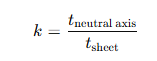
Where:
- k = K-factor (dimensionless)
- tneutral axis = Distance from the inside bend surface to the neutral axis
- tsheet= Total thickness of the sheet
The neutral axis is the plane within the sheet that experiences no length change during bending.
- Material inside the bend compresses
- Material outside the bend stretches
- Neutral axis lies somewhere between the inner and outer surfaces
2. Importance of K-Factor
- Determines bend allowance (BA): material length along neutral axis consumed in bending.
- Helps calculate flat pattern/blank length accurately.
- Accounts for material thickness, bend radius, and material properties.
- Crucial for high-precision sheet metal components.
3. Typical Values of K-Factor
| Bend Type / Material | K-Factor Approx. |
|---|---|
| Mild steel, inside radius ≥ sheet thickness | 0.3 – 0.5 |
| Aluminum | 0.44 – 0.5 |
| Stainless steel | 0.45 – 0.5 |
| Very sharp bend (R < t) | 0.33 – 0.4 |
| Air bending (large radius) | 0.35 – 0.45 |
Observation:
- K < 0.5: neutral axis closer to inner surface.
- K = 0.5: neutral axis exactly at mid-thickness.
4. Relationship with Bend Allowance
The bend allowance (BA) is the length of material along the neutral axis consumed in bending:
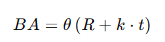
Where:
- BA= Bend allowance (mm)
- θ= Bend angle in radians
- R = Inside bend radius (mm)
- t = Sheet thickness (mm)
- k = K-factor, location of the neutral axis
Increasing K-factor moves the neutral axis outward, increasing bend allowance.
5. Relationship with Bend Deduction
The bend deduction (BD) is the amount subtracted from total flange lengths to calculate the flat length:

Since flat length depends on bend allowance, the K-factor directly influences bend deduction.
6. Factors Affecting K-Factor
- Material Type – Ductility, yield strength.
- Bend Radius – Smaller radius → neutral axis closer to inner surface → smaller K.
- Sheet Thickness – Thicker sheets → neutral axis slightly shifts outward.
- Bend Method – Air bending, bottoming, coining affect K.
- Temperature – Hot forming may slightly change K.
7. Practical Example
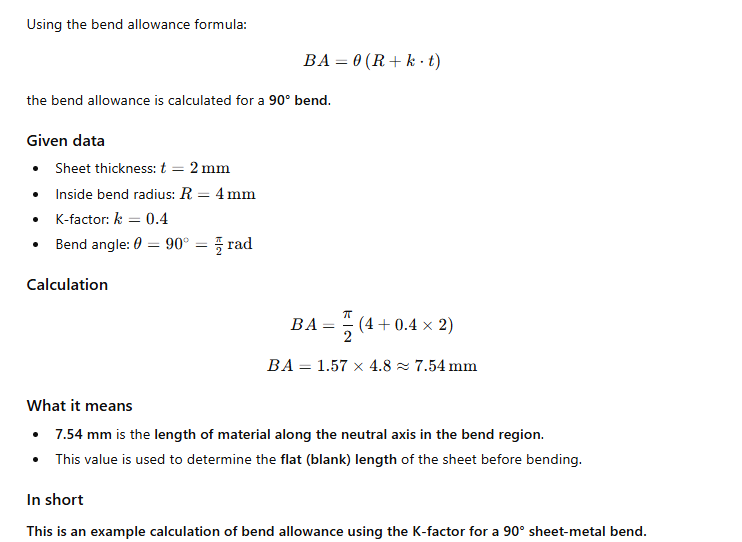
This is the length of sheet along the neutral axis consumed in bending.
8. Summary
- K-factor = ratio of neutral axis location to sheet thickness.
- Used to calculate bend allowance, bend deduction, and flat length.
- Typical values: 0.3 – 0.5 depending on material and bend radius.
- Accurate K-factor selection is critical for precision sheet metal parts.
9. Key Points to Remember
- Neutral axis = plane of zero length change during bending.
- K-factor < 0.5 → neutral axis closer to inner bend.
- K-factor = 0.5 → neutral axis mid-thickness.
- Higher K-factor → more material length along bend → increases blank size.
Other courses: