
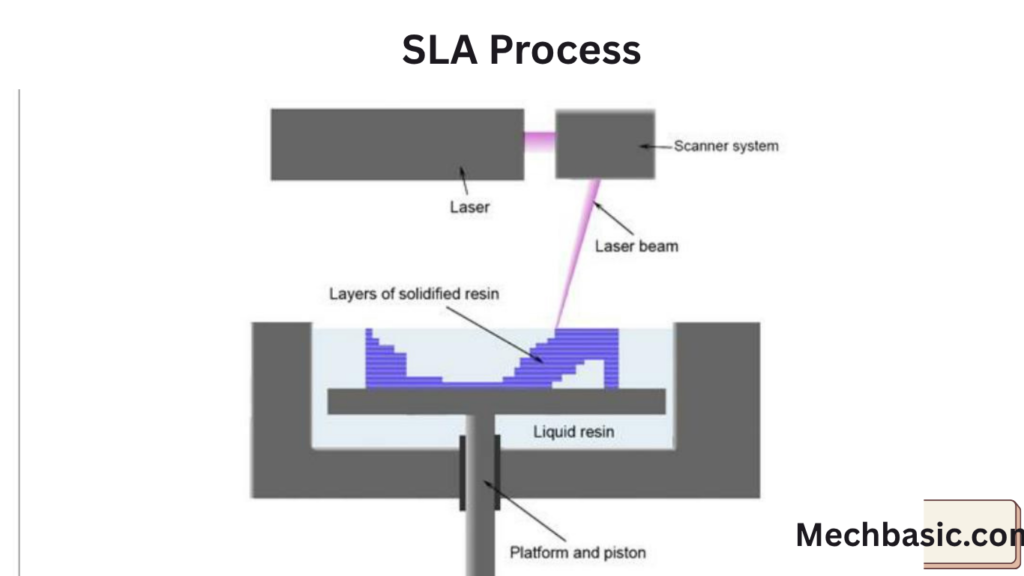
SLA (Stereolithography) is an additive manufacturing process that uses a laser to cure liquid resin layer by layer.
It produces highly detailed and smooth-surface parts with high accuracy.
It is widely used for prototypes, dental models, and jewelry applications.
In this article:
What is SLA in Additive Manufacturing?
SLA (Stereolithography Apparatus) is one of the earliest and most precise additive manufacturing (3D printing) technologies. It uses UV light (laser or projector) to harden liquid resin layer by layer and build a 3D object.
👉 It is known for very high accuracy and smooth surface finish.
Definition
Stereolithography (SLA) is an additive manufacturing process in which a UV laser or light source selectively cures liquid photopolymer resin layer by layer to form a solid 3D object.
Working Principle of SLA
SLA works on the principle of:
photo-polymerization (light-induced solidification)
Step-by-Step Process
1. CAD Model Creation
- 3D model is designed using CAD software (SolidWorks, Fusion 360)
2. Slicing
- Model is divided into thin layers
- Supports are automatically generated
3. Resin Preparation
- Liquid photopolymer resin is filled in a vat
4. Layer Curing
- UV laser or projector traces each layer
- Resin hardens where light hits
5. Layer-by-Layer Building
- Build platform moves up/down
- Each new layer is cured on top of previous one
6. Part Removal
- Printed object is removed from resin vat
7. Post-Processing
- Washing (to remove uncured resin)
- UV curing (final hardening)
- Support removal
- Polishing
Materials Used in SLA
Photopolymer Resins
- Standard resin (general use)
- Tough resin (engineering use)
- Flexible resin
- Dental/biocompatible resin
- Castable resin (jewelry)
Key Components of SLA Printer
- Resin vat
- UV laser or LCD projector
- Build platform
- Z-axis lifting system
- Control system
Advantages of SLA
1. Very High Accuracy
- Extremely fine details possible
2. Smooth Surface Finish
- Almost injection-mold quality
3. Complex Geometry
- Can print intricate shapes
4. High Resolution
- Very thin layer thickness
Disadvantages of SLA
1. Brittle Materials
- Resin parts are not very strong
2. Expensive Materials
- Resin cost is high
3. Post-processing Required
- Washing and UV curing needed
4. Limited Material Choices
- Only photopolymer resins
5. Safety Concerns
- Liquid resin can irritate skin
Applications of SLA
Dental Industry
- Dental models
- Aligners
- Surgical guides
Jewelry
- Wax-like cast models
Medical
- Anatomical models
- Pre-surgical planning
Design & Prototyping
- High-detail prototypes
- Miniature models
SLA vs FDM
| Feature | SLA | FDM |
|---|---|---|
| Material | Liquid resin | Plastic filament |
| Accuracy | Very high | Medium |
| Surface finish | Smooth | Rough |
| Strength | Low–medium | Medium |
| Cost | High | Low |
| Speed | Fast for small parts | Better for large parts |
Summary:
👉 SLA is best described as:
“High-precision 3D printing using UV light to solidify liquid resin layer by layer.”
Conclusion:
Stereolithography (SLA) is an additive manufacturing process in which a UV laser or light source cures liquid photopolymer resin layer by layer to create a solid object. It is known for high accuracy and smooth surface finish but produces brittle parts and requires post-processing.
Other courses:





