
Hot riveting is done by heating the rivet before placing it, making it easier to deform and form a tight joint.
Cold riveting is done at room temperature without heating the rivet.
Both methods are used to permanently join metal parts depending on strength and application needs.
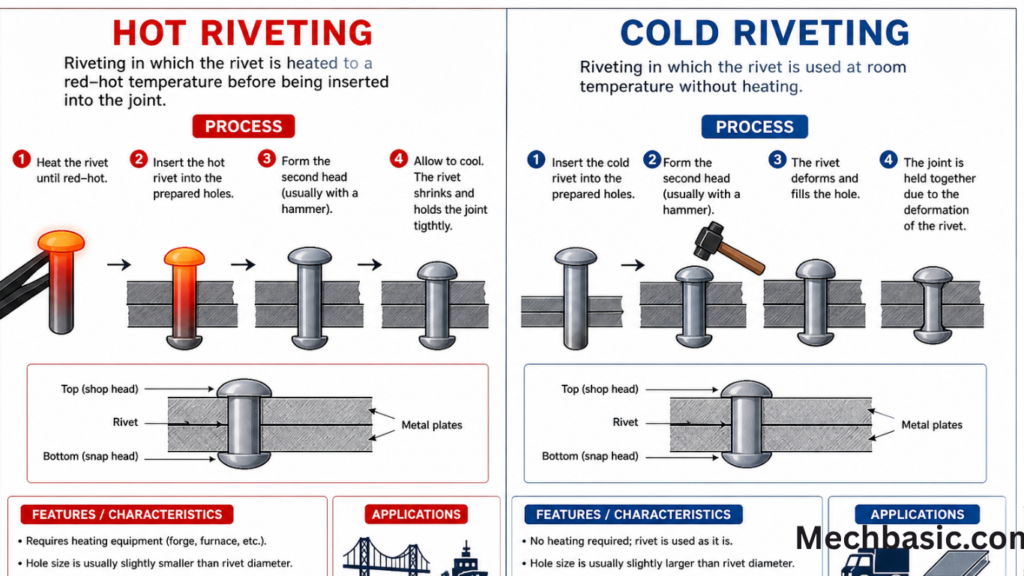
Two types of riveting
Riveting is broadly classified into two main types based on how the rivet is installed and formed:
1. Hot Riveting
Definition
In hot riveting, the rivet is heated (usually red-hot) before being inserted into the hole and formed.
Process
- Rivet is heated in a furnace to about 800–1000°C
- The hot rivet is inserted into the hole
- One side is supported (factory head)
- The other end is hammered or pressed to form the second head
- As the rivet cools, it contracts and pulls the plates tightly together
Key Principle
- Works on thermal contraction
- Cooling causes shrinkage, creating a very tight joint
Advantages
- Produces very strong and tight joints
- Excellent for heavy structures
- Reduces chances of loosening
Disadvantages
- Requires heating equipment
- Time-consuming
- Needs skilled labor
- Not suitable for thin or heat-sensitive materials
Applications
- Bridges
- Boilers
- Shipbuilding
- Heavy structural steel work
2. Cold Riveting
Definition
In cold riveting, the rivet is used at room temperature and deformed mechanically.
Process
- Rivet is inserted into the hole at room temperature
- One side is supported
- The other end is hammered, squeezed, or pressed to form the second head
- The rivet expands slightly to fill the hole
Key Principle
- Works on plastic deformation only (no heating involved)
Advantages
- Simple and quick process
- No heating required
- Suitable for thin sheets and small components
- Less equipment needed
Disadvantages
- Joint is not as tight as hot riveting
- Lower strength compared to hot riveting
- More chances of loosening under vibration
Applications
- Sheet metal work
- Light structures
- Electronics enclosures
- Automotive panels
Key Differences
| Feature | Hot Riveting 🔥 | Cold Riveting ❄️ |
|---|---|---|
| Temperature | Heated | Room temperature |
| Strength | Very high | Moderate |
| Tightness | Excellent (due to shrinkage) | Good but less tight |
| Equipment | Furnace required | Simple tools |
| Applications | Heavy structures | Light/medium work |
Summary
- Hot riveting = Heat + Shrink = Strongest joint
- Cold riveting = No heat + Simpler = Light work
Other courses:





