
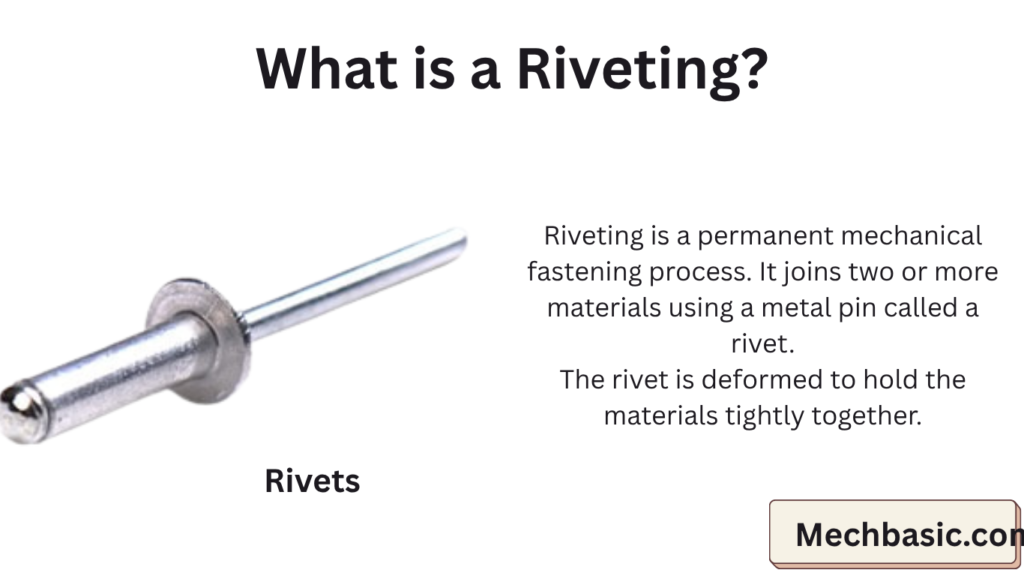
Riveting is a permanent mechanical fastening process. It joins two or more materials using a metal pin called a rivet.
The rivet is deformed to hold the materials tightly together.
In this article:
Riveting is a permanent mechanical fastening process used to join two or more materials—most commonly metal plates—by inserting and deforming a metal pin called a rivet. It’s widely used in structures where strength and reliability are critical, like aircraft, bridges, boilers, and ships.
What is a Rivet?
A rivet is a short cylindrical rod with:
- A head on one end (factory head)
- A tail on the other end, which is deformed during installation to create a second head (shop head)
How Riveting Works (Step-by-Step)
- Drilling holes
Matching holes are drilled or punched through the materials to be joined. - Inserting the rivet
The rivet is placed into the aligned holes. - Supporting the head
The factory head is held firmly using a tool or backing bar. - Forming the second head
The tail is hammered or pressed, causing it to expand and form a second head. - Clamping action
As the rivet deforms, it tightly clamps the materials together.
Types of Rivets
1. Solid Rivets
- Oldest and strongest type
- Used in aircraft and structural work
- Require access to both sides
2. Blind Rivets (Pop Rivets)
- Used when only one side is accessible
- Common in sheet metal and DIY work
3. Tubular Rivets
- Hollow inside
- Require less force to install
- Used in lighter applications (e.g., leather goods)
4. Split Rivets
- Split tail spreads during installation
- Used for softer materials like wood or plastic
Types of Riveted Joints
1. Lap Joint
- Plates overlap each other
- Rivets pass through both layers
2. Butt Joint
- Plates are aligned edge-to-edge
- Joined using cover plates (straps)
Advantages of Riveting
- Very strong and reliable
- Permanent (won’t loosen easily)
- Good for materials that can’t be welded
- Performs well under vibration
Disadvantages
- Not removable without damage
- Labor-intensive compared to modern methods
- Adds extra weight
- Requires precise hole alignment
Where Riveting is Used
- Aircraft fuselage and wings
- Steel bridges
- Shipbuilding
- Boilers and pressure vessels
- Structural frameworks
Summary
Riveting works because the plastic deformation of the rivet locks it in place and creates a tight clamping force—making it extremely dependable even under dynamic loads and vibration.
Other courses:





