
The three common types of electroplating are barrel plating, rack plating, and brush plating.
Barrel plating is used for small parts in bulk quantities.
Rack and brush plating are used for larger or specific components requiring precision.
In this article:
Types of electroplating?
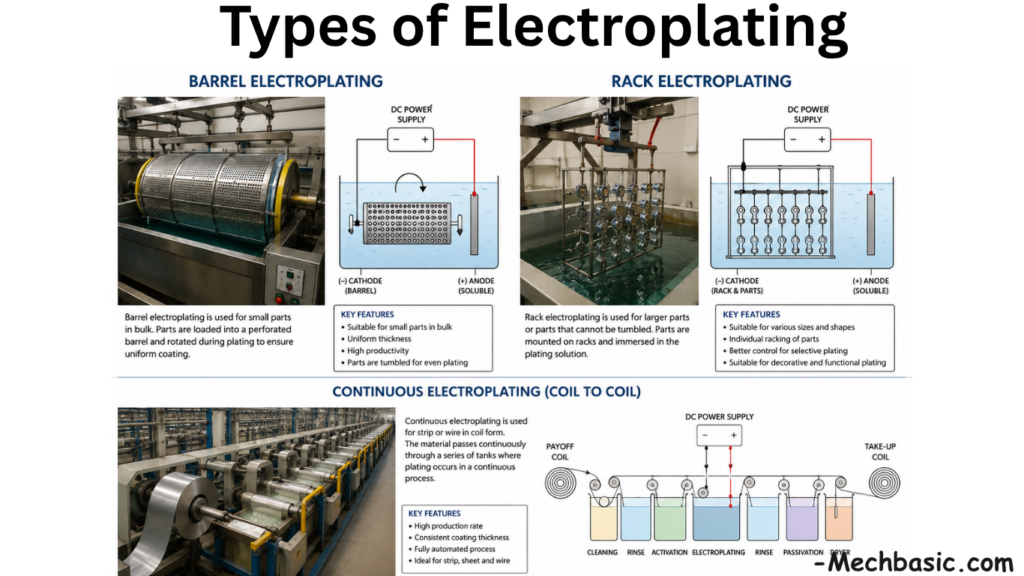
Electroplating can be classified in different ways based on the process and purpose. The three commonly discussed types of electroplating are:
- Barrel electroplating
- Rack electroplating
- Continuous electroplating
These differ in how components are held and processed during plating.
1. Barrel Electroplating
In barrel electroplating, a large number of small parts are placed inside a rotating non-conductive barrel. The barrel slowly rotates while the parts remain in contact with a conductive path and are immersed in the electrolyte solution.
Working principle
- Small components are loaded into a perforated barrel.
- The barrel rotates slowly in the plating bath.
- Electric current passes through conductive contacts.
- Metal ions deposit on the surfaces of the parts.
Suitable for
- Nuts
- Bolts
- Screws
- Washers
- Small machine components
Advantages
- Economical for mass production
- Can plate many items at once
- Lower labor cost
- Good productivity
Disadvantages
- Parts may rub against each other
- Surface finish may not be highly decorative
- Not suitable for delicate parts
2. Rack Electroplating
In rack electroplating, components are individually mounted on racks or fixtures and immersed in the plating solution.
Working principle
- Parts are attached to conductive racks.
- Racks hold the items in fixed positions.
- Current flows through the rack to the workpiece.
- Metal deposits evenly over exposed surfaces.
Suitable for
- Automobile parts
- Jewelry
- Large components
- Decorative products
- Fragile items
Advantages
- Better control over coating quality
- High-quality surface finish
- Uniform coating thickness
- Less chance of damage
Disadvantages
- Higher cost
- More labor required
- Slower process compared to barrel plating
3. Continuous Electroplating
Continuous electroplating is used when materials move continuously through plating equipment rather than being processed as separate pieces.
Working principle
- A strip, wire, or sheet continuously passes through tanks.
- Cleaning, plating, rinsing, and drying occur in sequence.
- Electric current deposits metal continuously.
Suitable for
- Metal strips
- Wires
- Sheets
- Foils
Applications
- Electronic components
- Battery materials
- Steel strips
- Packaging materials
Advantages
- High production speed
- Uniform coating
- Efficient for large-scale manufacturing
- Automated operation
Disadvantages
- Expensive equipment
- Limited to continuous products
Summary Table
| Type | Used for | Main Advantage | Main Limitation |
|---|---|---|---|
| Barrel electroplating | Small bulk parts | Low cost, mass production | Surface damage possible |
| Rack electroplating | Large or delicate parts | Better finish | Higher cost |
| Continuous electroplating | Strips and wires | High speed | Specialized use |
Other classifications sometimes mentioned
Electroplating may also be described by coating material, such as:
- Chrome plating
- Nickel plating
- Gold plating
- Silver plating
- Zinc plating
These describe the deposited metal rather than the plating method itself.
Conclusion
The three major types of electroplating are barrel, rack, and continuous electroplating. Each type is selected according to component size, production quantity, cost, and surface finish requirements. Choosing the correct method helps achieve efficient production and good coating quality.
Other courses:





