
Barrel electroplating is a method used to electroplate small metal parts in large quantities.
The components are placed in a rotating barrel and immersed in the plating solution.
It is economical and commonly used for screws, nuts, bolts, and small parts.
In this article:
Barrel Electroplating:
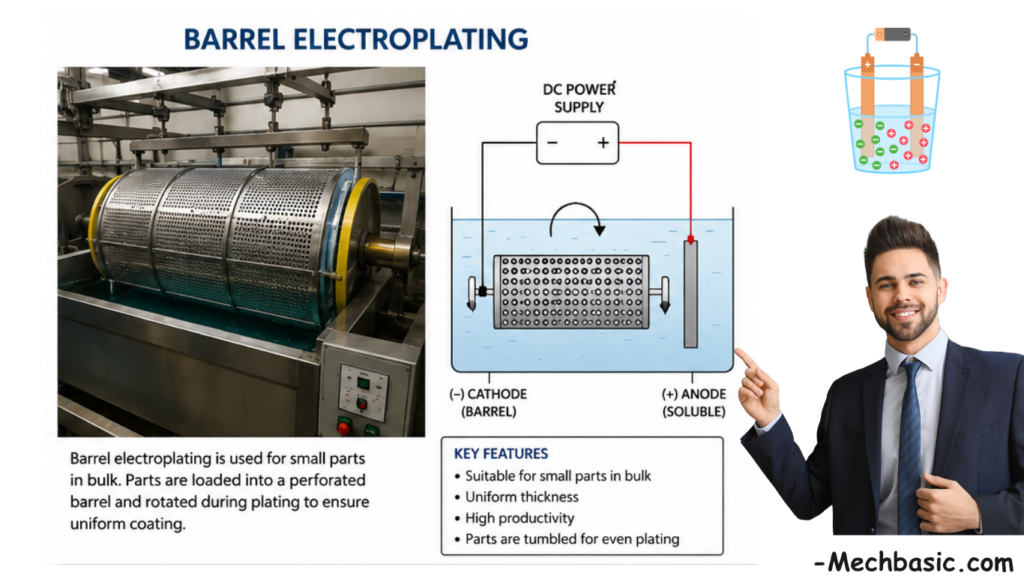
Barrel electroplating is a type of electroplating process used mainly for small, durable components produced in large quantities. In this method, parts are placed inside a rotating barrel and electroplated while the barrel slowly turns in an electrolyte solution.
It is widely used because it can plate hundreds or thousands of small parts at the same time, making it economical for mass production.
Definition
Barrel electroplating is an electroplating process in which small components are loaded into a rotating non-conductive barrel and coated with metal while immersed in an electrolyte using electric current.
Principle of barrel electroplating
Barrel electroplating works on the principle of electrolysis.
During the process:
- The workpieces act as the cathode
- The plating metal acts as the anode
- The electrolyte contains metal ions
- Electric current causes metal ions to deposit on the workpieces
The barrel rotates slowly so all surfaces are exposed evenly.
Main components of a barrel electroplating system
1. Rotating barrel
The barrel is usually made of:
- Plastic
- PVC
- Non-conductive materials
Features:
- Contains small perforations
- Allows electrolyte circulation
- Rotates slowly
Function:
- Holds components
- Provides movement for uniform coating
2. Conductive contacts (danglers)
Since the barrel itself is non-conductive, conductive elements are provided inside.
Function:
- Carry electrical current
- Transfer electricity to moving parts
3. Anode
The anode consists of the coating metal.
Examples:
- Zinc
- Nickel
- Copper
- Chromium
Connected to the positive terminal.
Function:
Supplies metal ions to the electrolyte.
4. Cathode (workpieces)
Small components inside the barrel become the cathode.
Examples:
- Screws
- Nuts
- Bolts
- Washers
- Small metal fittings
Connected to the negative terminal.
5. Electrolyte solution
Contains dissolved metal salts.
Examples:
- Zinc sulfate
- Copper sulfate
- Nickel solutions
Function:
Provides ions for metal deposition.
6. DC power supply
Direct current drives electrolysis.
Working process of barrel electroplating
Step 1: Cleaning
Components are cleaned to remove:
- Oil
- Dirt
- Rust
- Grease
- Oxides
Cleaning ensures proper adhesion.
Step 2: Loading
Large numbers of small components are loaded into the barrel.
Step 3: Immersion
The loaded barrel is immersed in the plating bath.
Step 4: Rotation
The barrel rotates slowly.
Purpose:
- Move parts continuously
- Expose all surfaces
- Improve coating uniformity
Step 5: Current application
Electric current is supplied.
At the anode:
Metal dissolves:
M → M⁺ + e⁻
At the cathode:
Metal ions deposit:
M⁺ + e⁻ → M
A coating forms on the parts.
Step 6: Washing and drying
After plating:
- Components are rinsed
- Excess chemicals removed
- Parts dried
Common metals used in barrel electroplating
Examples:
- Zinc
- Nickel
- Copper
- Tin
- Silver
- Gold
Choice depends on application requirements.
Applications of barrel electroplating
Used for mass production of small parts such as:
- Screws
- Nuts
- Bolts
- Washers
- Electrical contacts
- Fasteners
- Small machine components
- Clips
- Springs
Advantages of barrel electroplating
1. Suitable for mass production
Many components can be processed together.
2. Low operating cost
Less labor required.
3. High productivity
Large quantities plated quickly.
4. Uniform coating on multiple items
Rotation improves surface exposure.
5. Automation possible
Can be integrated with production systems.
Disadvantages of barrel electroplating
1. Not suitable for fragile parts
Parts may collide and become damaged.
2. Surface scratches may occur
Continuous movement causes contact.
3. Lower decorative finish quality
Compared with rack plating.
4. Limited for large components
Large objects cannot rotate effectively.
Comparison: Barrel vs Rack electroplating
| Feature | Barrel electroplating | Rack electroplating |
|---|---|---|
| Part size | Small parts | Large or delicate parts |
| Quantity | Very high | Lower |
| Cost | Lower | Higher |
| Surface finish | Moderate | Better |
| Risk of damage | Higher | Lower |
| Production speed | High | Lower |
Conclusion
Barrel electroplating is a cost-effective electroplating method used for coating large quantities of small durable components. By rotating parts in a barrel during electrolysis, it provides reasonably uniform coatings and high production efficiency, making it widely used in fastener and small-part manufacturing industries.
Other courses:





