
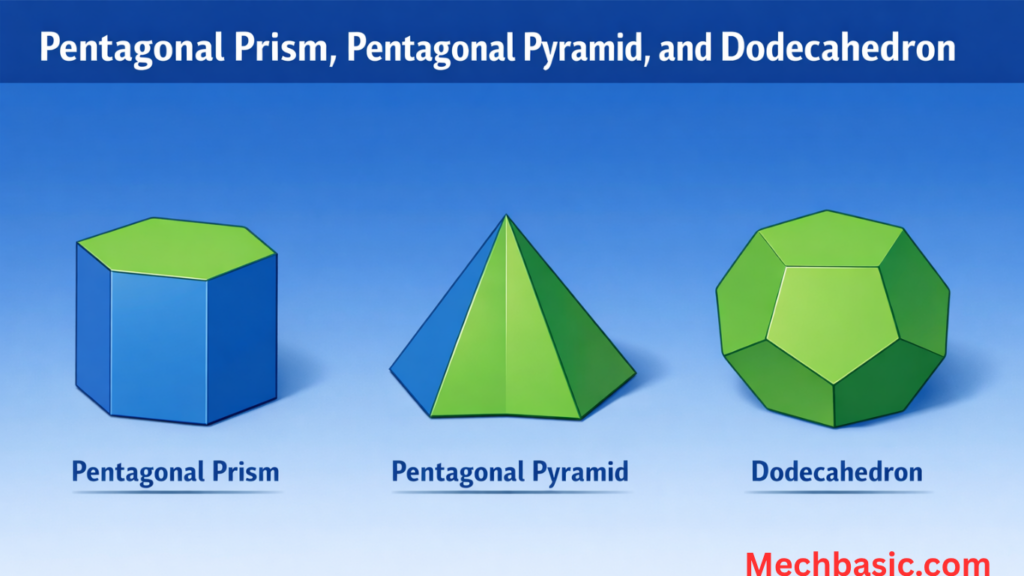
A pentagon is a 2D shape, so there is no single 3D shape called a “3D pentagon.” Instead, 3D solids that have pentagonal faces have specific names.
A “3D pentagon” doesn’t actually exist as a standalone solid, because a pentagon is a 2D polygon (five sides, flat surface). But when you extend pentagonal geometry into three dimensions, you get polyhedra that use pentagons as their faces.
Here are the main 3D shapes built from pentagons:
| Shape | Description | Faces |
|---|---|---|
| Pentagonal prism | Two parallel pentagonal faces connected by five rectangular faces. It’s like stretching a pentagon straight up into the third dimension. | 7 faces (2 pentagons + 5 rectangles) |
| Pentagonal pyramid | A pyramid with a pentagonal base and five triangular faces meeting at a single apex. | 6 faces (1 pentagon + 5 triangles) |
| Dodecahedron | One of the five Platonic solids, made entirely of regular pentagonal faces. It’s perfectly symmetrical and closed. | 12 faces (all regular pentagons) |
💡 In summary:
- A “3D pentagon” is not a single object but refers to solids that incorporate pentagonal faces.
- The most famous one is the regular dodecahedron, which is a fully 3D shape composed only of regular pentagons.
Other courses:





