
A pentagon is a 2D (two-dimensional) shape — meaning it lies flat on a plane and has only length and width, but no depth.
In this article:
Is a pentagon 2D or 3D?
A pentagon is a 2D (two-dimensional) shape.
It has five sides and five angles, all lying on a flat surface.
Unlike 3D shapes, a pentagon has no thickness or volume.
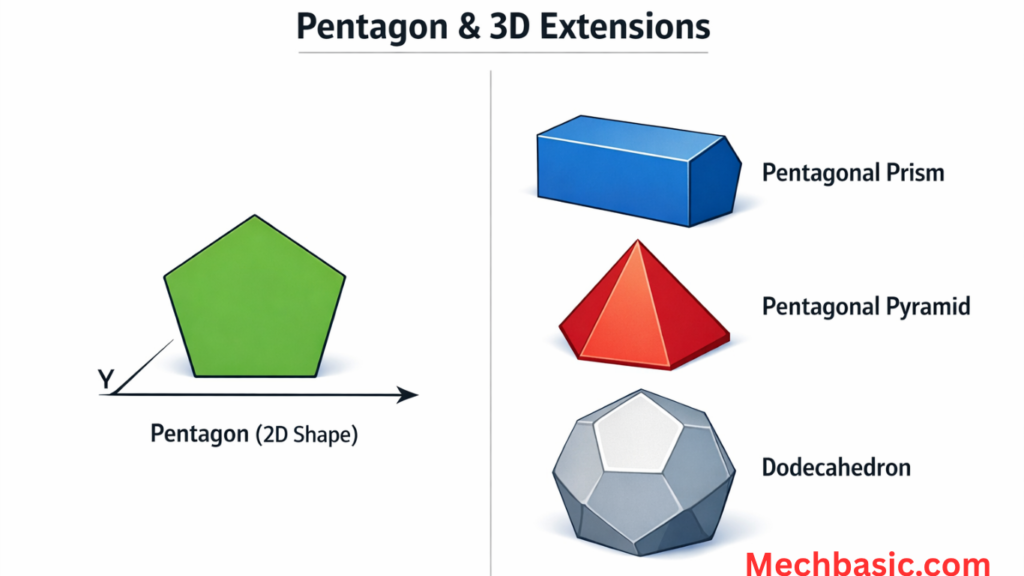
Here’s a detailed breakdown to make that distinction clear:
2D Nature of a Pentagon
- Definition: A pentagon is a polygon with five straight sides and five interior angles.
- Dimensions: It exists entirely in a plane — you can draw it on paper or a screen.
- Examples: Regular pentagon (equal sides and angles), irregular pentagon (unequal sides and angles).
- Properties:
- 5 sides
- 5 vertices
- Sum of interior angles =
3D Connection
When you extend a pentagon into the third dimension, you get polyhedra (3D solids) that use pentagons as faces, such as:
- Pentagonal prism → two pentagonal faces + five rectangular faces
- Pentagonal pyramid → one pentagonal base + five triangular faces
- Dodecahedron → twelve regular pentagonal faces
So, the pentagon itself is 2D, but it can serve as the building block for 3D solids.
Conclusion:
A pentagon is a 2D (two-dimensional) shape, not a 3D object. It has five sides, five angles, and a flat surface with only length and width. Three-dimensional shapes that include pentagonal faces are called pentagonal prisms, pentagonal pyramids, or dodecahedrons, but the pentagon itself is always a 2D polygon.
Other courses:





