
TQM (Total Quality Management) is a management approach focused on continuous quality improvement in all processes.
It involves all employees working together to meet customer requirements and improve satisfaction.
TQM aims to reduce defects, improve efficiency, and ensure long-term success.
In this article:
TQM (Total Quality Management)
TQM (Total Quality Management) is a management approach focused on continuous improvement of quality in all areas of an organization, involving every employee, from top management to workers on the shop floor.
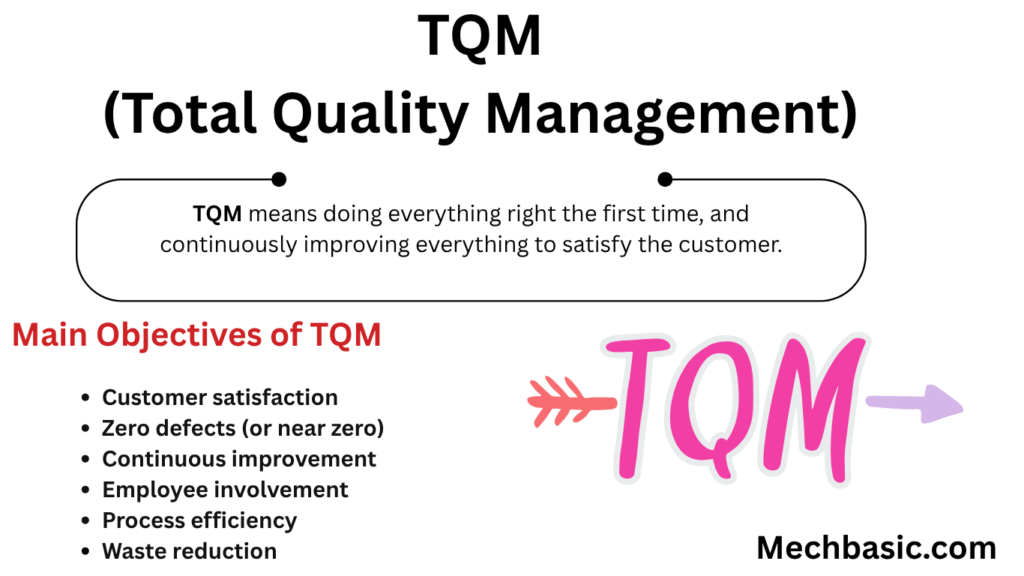
TQM means doing everything right the first time, and continuously improving everything to satisfy the customer.
Definition of TQM
TQM is a company-wide system that aims to:
- Improve product and service quality
- Reduce defects and waste
- Increase customer satisfaction
- Continuously improve processes
Core Idea of TQM
TQM is based on one key idea:
Quality is everyone’s responsibility, not just the inspection department.
Main Objectives of TQM
- Customer satisfaction
- Zero defects (or near zero)
- Continuous improvement
- Employee involvement
- Process efficiency
- Waste reduction
Key Principles of TQM
1. Customer Focus
The customer defines quality.
Meaning:
- Understand customer needs
- Meet or exceed expectations
Example:
A phone manufacturer designs products based on customer feedback (battery life, camera quality).
2. Total Employee Involvement
Everyone in the organization participates.
Includes:
- Managers
- Engineers
- Operators
- Inspectors
Benefits:
- More ideas for improvement
- Higher responsibility
- Better teamwork
3. Process-Centered Approach
Focus is on improving processes, not just results.
Idea:
If the process is good, output will automatically be good.
4. Integrated System
All departments must work together:
- Production
- Quality control
- Maintenance
- Purchase
- Design
5. Continuous Improvement (Kaizen)
TQM is never-ending improvement.
Small improvements happen daily.
6. Fact-Based Decision Making
Decisions are based on data, not opinions.
Tools used:
- SPC charts
- Pareto charts
- Histograms
7. Communication
Good communication ensures:
- Clear goals
- Faster problem solving
- Better coordination
TQM Tools
TQM uses several quality tools, including:
- SPC (Statistical Process Control)
- Pareto analysis
- Fishbone diagram
- Flowcharts
- Check sheets
- Histograms
- Control charts
Steps in TQM Implementation
Step 1: Management Commitment
Top management must support quality culture.
Step 2: Training
Employees are trained in quality tools and methods.
Step 3: Customer Focus
Understand customer requirements clearly.
Step 4: Process Improvement
Identify and improve weak processes.
Step 5: Employee Involvement
Encourage participation from all employees.
Step 6: Measurement and Feedback
Use data to monitor performance.
Step 7: Continuous Improvement
Keep improving every process regularly.
Example of TQM in Industry
Example: Automobile Manufacturing
A car company implements TQM:
- Workers report small defects immediately
- Engineers improve assembly line process
- Quality teams use SPC charts
- Customer feedback is analyzed
Result:
✔ Fewer defects
✔ Higher reliability
✔ Better customer satisfaction
Benefits of TQM
1. Improved Quality
Reduces defects and improves product reliability.
2. Customer Satisfaction
Better quality leads to happier customers.
3. Reduced Cost
Less scrap, rework, and waste.
4. Better Efficiency
Processes become smoother and faster.
5. Employee Motivation
Workers feel involved and valued.
6. Competitive Advantage
Helps companies stay ahead in the market.
Limitations of TQM
1. Time-Consuming
Implementation takes time.
2. Requires Cultural Change
Employees must change mindset.
3. Training Needed
Workers need education in quality tools.
4. Initial Cost
Training and system setup cost money.
TQM vs Traditional Quality Control
| Feature | TQM | Traditional QC |
|---|---|---|
| Focus | Prevention | Detection |
| Responsibility | Everyone | Inspection department |
| Approach | Proactive | Reactive |
| Goal | Continuous improvement | Finding defects |
| Timing | Throughout process | End of process |
TQM vs Six Sigma
| Feature | TQM | Six Sigma |
|---|---|---|
| Approach | Broad philosophy | Data-driven method |
| Goal | Continuous improvement | Near-zero defects |
| Tools | Basic + advanced tools | Statistical methods |
| Structure | Less formal | Structured (DMAIC) |
Real-Life Analogy
Think of a school:
Without TQM:
- Only final exam matters
- Teachers and students work separately
With TQM:
- Continuous learning
- Teachers, students, and management all involved
- Regular feedback and improvement
Industries Using TQM
- Automotive (Toyota, Honda)
- Electronics (Samsung, Sony)
- Aerospace
- Healthcare
- Manufacturing industries
- Service industries (banks, hotels)
Conclusion
Total Quality Management (TQM) is a company-wide philosophy that focuses on continuous improvement, customer satisfaction, and involvement of all employees in maintaining and improving quality. It shifts quality from being the responsibility of a single department to being the responsibility of the entire organization. By using tools like SPC, process improvement, and employee involvement, TQM helps organizations reduce defects, improve efficiency, and achieve long-term success.
Other courses:





