
An ellipse has four vertices.
The two major vertices lie at the ends of the major axis, and the two minor vertices lie at the ends of the minor axis.
These vertices help define the shape and size of the ellipse.
An ellipse has 4 vertices in total, but the term vertices is often used in two ways depending on the context.
1. Major Vertices (Primary Vertices)
These are the two endpoints of the major axis (the longest diameter of the ellipse).
If the ellipse is centered at the origin and has a horizontal major axis:
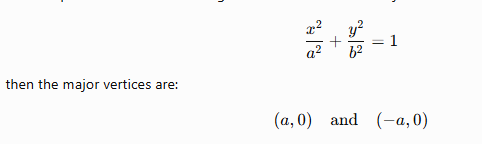
These are usually referred to simply as the vertices of the ellipse.
2. Minor Vertices (Co-Vertices)
These are the two endpoints of the minor axis (the shortest diameter).
Their coordinates are:

These are called co-vertices.
Total Number of Vertices
| Type | Number |
|---|---|
| Major vertices | 2 |
| Minor vertices (co-vertices) | 2 |
| Total | 4 |
Example
Consider the ellipse:
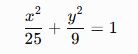
Here:
- (a = 5)
- (b = 3)
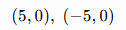
Major Vertices
Minor Vertices (Co-Vertices)
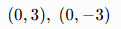
Thus, the ellipse has 4 vertices altogether.
Related Elements of an Ellipse
| Element | Number |
|---|---|
| Center | 1 |
| Major Axis | 1 |
| Minor Axis | 1 |
| Foci | 2 |
| Directrices | 2 |
| Vertices | 2 (major vertices) |
| Co-Vertices | 2 |
| Total Corner Points (Vertices + Co-Vertices) | 4 |
Interview Answer
Q: How many vertices does an ellipse have?
Answer: An ellipse has 2 major vertices located at the ends of the major axis and 2 co-vertices located at the ends of the minor axis. Therefore, an ellipse has 4 vertices in total, although the term “vertices” often refers specifically to the 2 endpoints of the major axis.
Other courses:





