
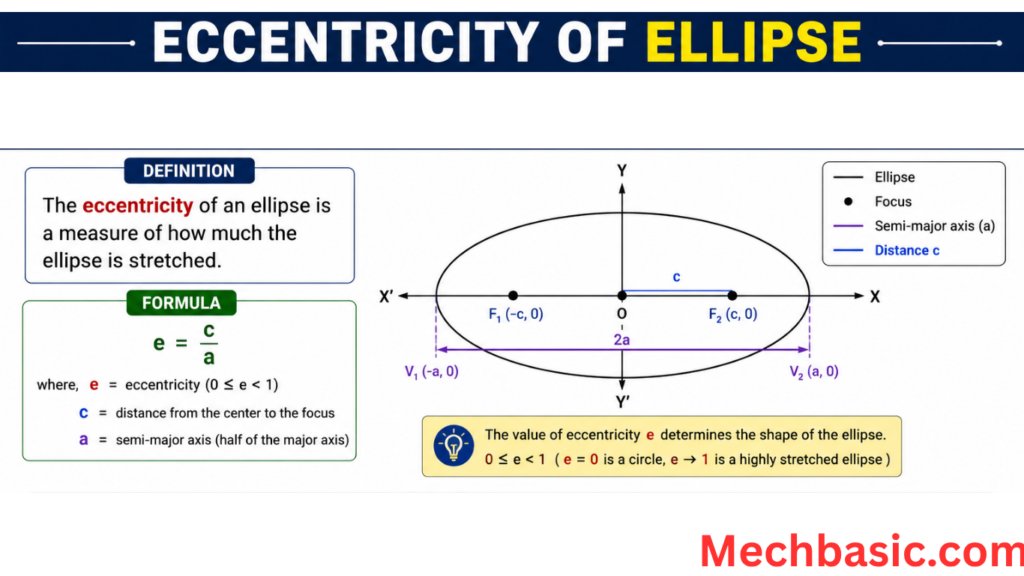
The eccentricity of an ellipse is a measure of how much the ellipse is stretched.
It is denoted by e and is given by the formula e = c/a, where c is the distance from the center to the focus and a is the semi-major axis.
For an ellipse, the eccentricity is always less than 1 (0 < e < 1).
In this article:
Eccentricity of an Ellipse
Eccentricity is a measure of how much an ellipse deviates from being a perfect circle. It indicates the shape or elongation of the ellipse.
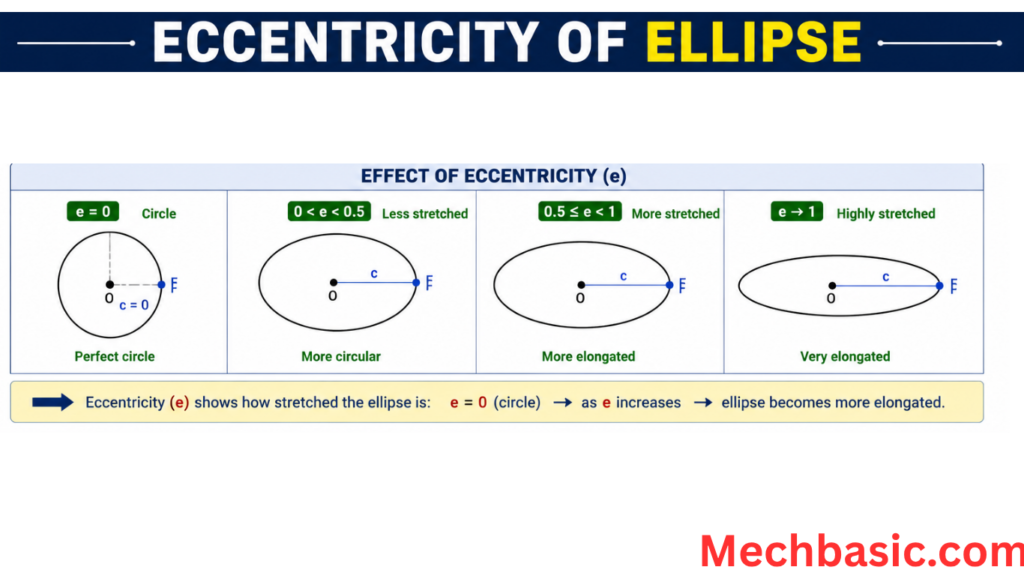
- A circle has an eccentricity of 0.
- An ellipse has an eccentricity greater than 0 but less than 1.
- The larger the eccentricity, the more elongated the ellipse.
Eccentricity is usually denoted by the letter (e).
Definition
The eccentricity of an ellipse is the constant ratio of:
- The distance of any point on the ellipse from a focus, to
- The perpendicular distance of that point from the corresponding directrix.
This relationship is:
where:
- (e) = Eccentricity
- (PF) = Distance from the point on the ellipse to the focus
- (PD) = Perpendicular distance from the point to the directrix
For an ellipse:
0 < e < 1
Formula for Eccentricity
For an ellipse with:
- Semi-major axis = (a)
- Semi-minor axis = (b)
- Distance from center to focus = (c)
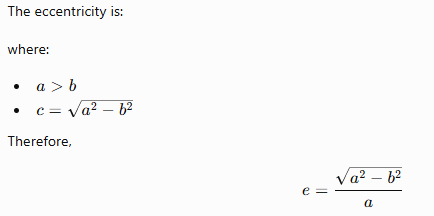
Relationship Between (a), (b), and (c)
The three quantities are related by:
where:
- (a) = Semi-major axis
- (b) = Semi-minor axis
- (c) = Distance from the center to either focus
Range of Eccentricity
| Conic Section | Eccentricity ((e)) |
|---|---|
| Circle | (e = 0) |
| Ellipse | (0 < e < 1) |
| Parabola | (e = 1) |
| Hyperbola | (e > 1) |
Effect of Eccentricity on the Shape
1. (e = 0)
- Perfect circle
- Focus coincides with the center
2. Small Eccentricity (e.g., 0.2)
- Ellipse is nearly circular
3. Medium Eccentricity (e.g., 0.6)
- Ellipse is moderately elongated
4. Large Eccentricity (e.g., 0.9)
- Ellipse is very elongated
- Foci are farther from the center
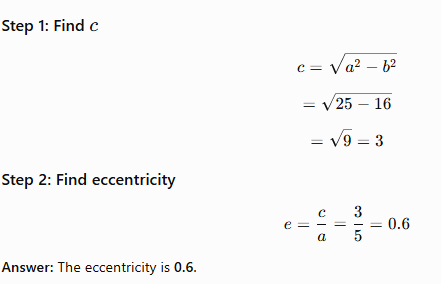
Example 1
Given:
- Semi-major axis, (a = 5)
- Semi-minor axis, (b = 4)
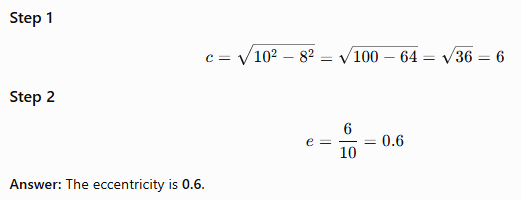
Example 2
Given:
- (a = 10)
- (b = 8)
Importance of Eccentricity
Eccentricity helps engineers and mathematicians:
- Describe the shape of an ellipse
- Locate the foci
- Construct ellipses using the focus-directrix method
- Analyze planetary orbits
- Design elliptical components in engineering
Applications of Eccentricity
1. Engineering Drawing
Used to construct ellipses accurately.
2. Mechanical Engineering
Applied in:
- Elliptical gears
- Cam mechanisms
- Machine design
3. Civil Engineering
Used in:
- Elliptical arches
- Bridge design
- Dome construction
4. Astronomy
The orbits of planets around the Sun are elliptical.
- Earth’s orbital eccentricity is about 0.0167, meaning its orbit is almost circular.
5. CAD and Computer Graphics
CAD software uses eccentricity to define and generate ellipses accurately.
Advantages of Knowing Eccentricity
- Defines the exact shape of the ellipse
- Helps locate the foci
- Useful in geometric constructions
- Essential in conic section analysis
- Important in engineering and architectural design
Interview Questions
1. What is the eccentricity of an ellipse?
It is the constant ratio of the distance from any point on the ellipse to a focus and its perpendicular distance to the corresponding directrix.
2. What is the range of eccentricity for an ellipse?
0 < e < 1
3. What is the formula for eccentricity?
e = c/a
where (c) is the distance from the center to a focus and (a) is the semi-major axis.
4. What does a larger eccentricity indicate?
A larger eccentricity indicates a more elongated ellipse.
5. What is the eccentricity of a circle?
The eccentricity of a circle is 0, because its foci coincide at the center.
Summary
| Parameter | Description |
|---|---|
| Symbol | (e) |
| Meaning | Measure of the elongation of an ellipse |
| Formula | (e=\frac{c}{a}) |
| Relationship | (c^2=a^2-b^2) |
| Range | (0<e<1) |
| Circle | (e=0) |
| Larger (e) | More elongated ellipse |
Conclusion
The eccentricity of an ellipse is a fundamental parameter that describes its shape. It is defined as the ratio of the distance from any point on the ellipse to a focus and its perpendicular distance to the corresponding directrix, or equivalently by the formula (e=\frac{c}{a}), where (c) is the distance from the center to a focus and (a) is the semi-major axis. Since the eccentricity of an ellipse always lies between 0 and 1, it distinguishes the ellipse from other conic sections and plays a vital role in engineering drawing, geometry, astronomy, and CAD applications.
Other courses:





