
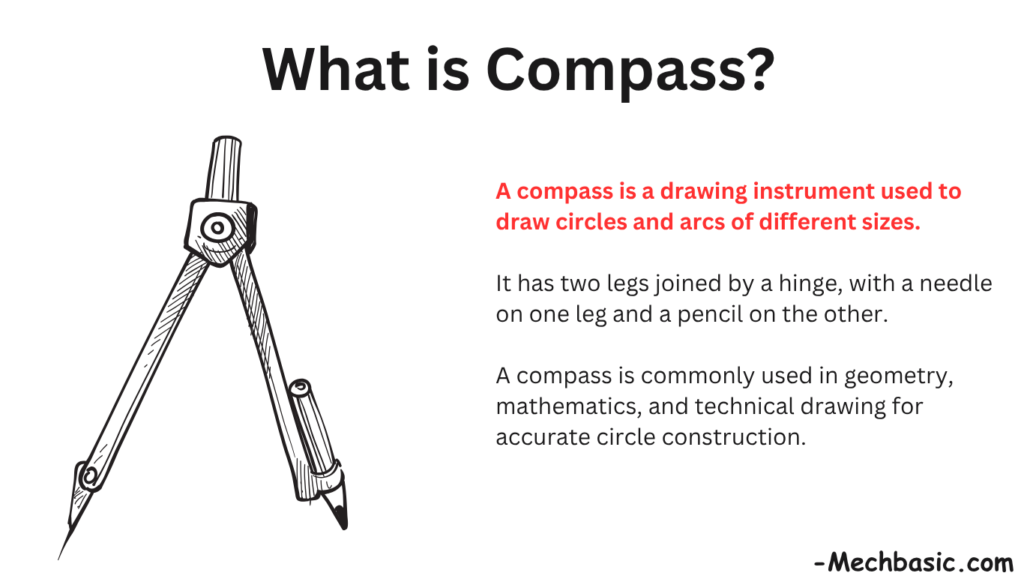
A compass is a drawing instrument used to draw circles and arcs of different sizes.
It consists of a pointed leg and a pencil or lead leg connected by a hinge.
Compasses are commonly used in engineering drawing, drafting, and geometry.
In this article:
- Compass (Drawing Instrument)
- Structure of a Compass
- Principle of Operation
- Types of Compasses
- Functions of a Compass
- How to Draw a Circle Using a Compass
- Radius and Diameter
- Uses in Engineering Drawing
- Geometric Constructions Using a Compass
- Advantages of a Compass
- Limitations
- Care and Maintenance
- Compass vs Divider
- Applications in Manufacturing
- Safety Precautions
- Conclusion
Compass (Drawing Instrument)
What is a Compass?
A compass is a drafting and drawing instrument used to draw circles, arcs, and curves with a precise radius. It is one of the most important tools in engineering drawing, technical drafting, geometry, architecture, and design.
In simple terms, a compass helps draw perfectly round circles and arcs that cannot be drawn accurately by hand.
Structure of a Compass
A typical compass consists of the following parts:
1. Pivot Joint (Hinge)
- Located at the top.
- Connects the two legs.
- Allows the legs to open and close.
2. Needle Point Leg
- Sharp metal point.
- Acts as the center of the circle.
3. Pencil or Lead Leg
- Holds pencil lead or an ink attachment.
- Draws the circle or arc.
4. Adjustment Mechanism
- Allows accurate radius setting.
- Found in precision compasses.
5. Handle or Knob
- Used to rotate the compass smoothly.
Principle of Operation
The compass works by:
- Fixing the needle point at the center.
- Setting the desired radius.
- Rotating the pencil leg around the center.
The distance between the two legs remains constant, producing a perfect circle.
Types of Compasses
1. Simple Compass
The most common type.
Features
- Needle point
- Pencil holder
- Manual adjustment
Uses
- School geometry
- Basic drafting
2. Bow Compass
Designed for small circles.
Features
- Spring-loaded adjustment
- Fine control
Uses
- Engineering drawing
- Precision work
3. Beam Compass
Used for large circles.
Features
- Long beam
- Adjustable radius
Uses
- Architecture
- Large-scale drafting
4. Drop Bow Compass
Used for very small circles.
Applications
- Instrument drawings
- Precision mechanical drafting
5. Ink Compass
Uses an ink pen instead of a pencil.
Uses
- Technical drawings
- Professional drafting (before CAD)
Functions of a Compass
1. Drawing Circles
The primary purpose.
Example
Draw a circle with:
- Radius = 25 mm
- Diameter = 50 mm
2. Drawing Arcs
A portion of a circle.
Applications
- Machine components
- Architectural designs
- Geometric constructions
3. Geometric Constructions
Used to construct:
- Triangles
- Hexagons
- Perpendicular bisectors
- Angle bisectors
4. Transferring Distances
A compass can also transfer measurements from one location to another.
How to Draw a Circle Using a Compass
Step 1
Mark the center point.
Step 2
Set the required radius.
Step 3
Place the needle point on the center.
Step 4
Rotate the pencil leg around the center.
Step 5
Complete the circle.
Radius and Diameter
The compass is usually set using the radius.
Relationship
D=2R
Where:
- D = Diameter
- R = Radius
Example
Radius = 30 mm
Diameter = 60 mm
Uses in Engineering Drawing
Compasses are essential for:
Mechanical Engineering
Drawing:
- Holes
- Shafts
- Bearings
- Flanges
Civil Engineering
Drawing:
- Curved roads
- Circular structures
Architecture
Drawing:
- Domes
- Arches
- Circular layouts
Geometric Constructions Using a Compass
1. Bisecting a Line
Used to locate the midpoint accurately.
2. Bisecting an Angle
Creates two equal angles.
3. Constructing a Hexagon
A regular hexagon can be constructed using the radius of a circle.
4. Constructing Equilateral Triangles
All sides equal.
Advantages of a Compass
High Accuracy
Produces perfect circles.
Easy to Use
Simple operation.
Reusable
Can create circles of various sizes.
Essential for Geometry
Many geometric constructions depend on a compass.
Limitations
Limited Circle Size
Depends on leg length.
Requires Careful Handling
Needle point can slip.
Less Suitable for Large Drawings
Large circles may require a beam compass.
Care and Maintenance
Keep Needle Sharp
Ensures accurate center positioning.
Protect Pencil Holder
Avoid damage to adjustment mechanisms.
Store Properly
Keep in a protective case.
Prevent Rust
Light oil may be applied to metal parts.
Compass vs Divider
| Feature | Compass | Divider |
|---|---|---|
| Draw Circles | Yes | No |
| Draw Arcs | Yes | Limited |
| Measure Distance | Limited | Yes |
| Transfer Distance | Yes | Excellent |
| Geometric Construction | Yes | Yes |
Key Difference
- Compass: One point + pencil.
- Divider: Two sharp points.
Applications in Manufacturing
Compasses are used to:
- Mark bolt circles
- Lay out hole patterns
- Scribe arcs on sheet metal
- Transfer dimensions
Example
A machinist marks six equally spaced holes on a flange using a compass and divider.
Safety Precautions
- Handle sharp points carefully.
- Keep away from children.
- Do not force the hinge mechanism.
- Store with protective covers if available.
Conclusion
A compass is a precision drawing instrument used to draw circles, arcs, and geometric constructions. It consists of a needle point, pencil leg, hinge, and adjustment mechanism. Compasses are widely used in engineering drawing, architecture, geometry, manufacturing, and drafting because they provide a simple and accurate method for creating circular features and performing essential geometric constructions. Mastering the compass is a fundamental skill for anyone learning technical drawing or engineering graphics.
Other courses:





