
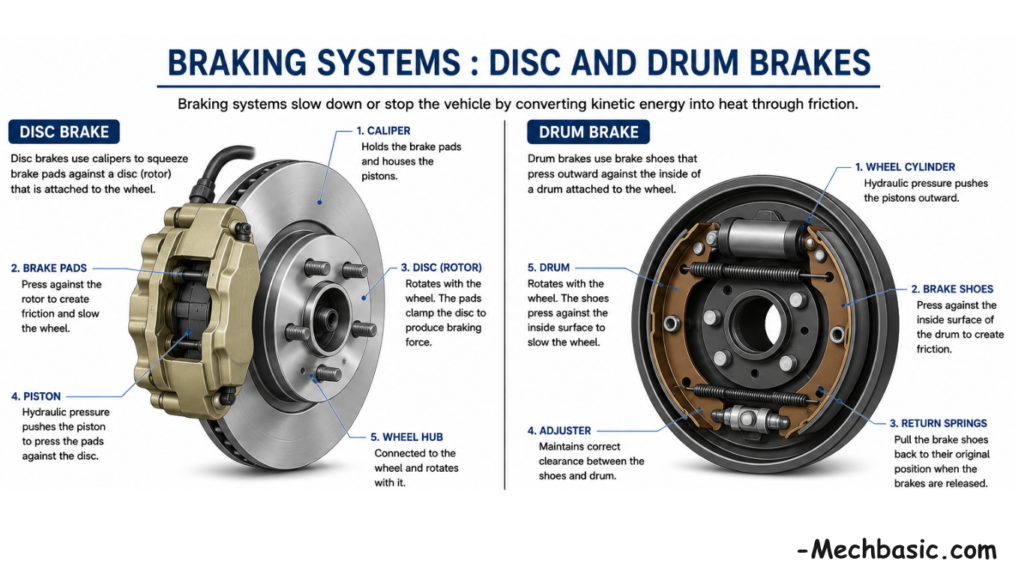
Disc brakes use a rotating disc and brake pads to provide strong and efficient stopping power.
Drum brakes use brake shoes that press against the inside of a rotating drum to slow the vehicle.
Disc brakes offer better cooling and braking performance, while drum brakes are less expensive and commonly used on rear wheels.
In this article:
- Braking Systems Explained: Disc and Drum Brakes
- What is a Braking System?
- Functions of a Braking System
- Principle of Braking
- Main Components of a Hydraulic Braking System
- Disc Brakes
- Main Components of a Disc Brake
- Working of Disc Brakes
- Types of Disc Brakes
- Advantages of Disc Brakes
- Disadvantages of Disc Brakes
- Main Components of a Drum Brake
- Working of Drum Brakes
- Advantages of Drum Brakes
- Disadvantages of Drum Brakes
- Disc Brake vs. Drum Brake
- Anti-lock Braking System (ABS)
- Common Brake Problems
- Brake Maintenance
- Applications
- Future Trends in Braking Systems
- Summary Table
- Frequently Asked Questions (FAQs)
- Conclusion
Braking Systems Explained: Disc and Drum Brakes
Introduction
A braking system is one of the most critical safety systems in any vehicle. Its primary purpose is to reduce speed, stop the vehicle, and keep it stationary when parked. Brakes work by converting the vehicle’s kinetic energy into heat energy through friction, allowing the vehicle to decelerate safely and efficiently.
Modern vehicles use two main types of friction brakes:
- Disc Brakes
- Drum Brakes
While both systems perform the same function, they differ in design, operation, performance, cooling, maintenance, and applications. Disc brakes are widely used on the front wheels of modern vehicles and increasingly on all four wheels, whereas drum brakes are still commonly used on the rear wheels of many passenger cars and commercial vehicles because of their lower cost and integrated parking brake mechanism.
This guide explains disc and drum brakes in detail, including their construction, working principles, advantages, disadvantages, maintenance, and comparisons.
What is a Braking System?
Definition
A braking system is a mechanical, hydraulic, or electronic system that slows or stops a moving vehicle by applying friction to the rotating wheels or drivetrain.
Also Read: Handbrake in a Car: What Is It and How to Use It?
Functions of a Braking System
The main functions are:
- Slow down the vehicle.
- Stop the vehicle safely.
- Hold the vehicle stationary (parking brake).
- Provide controlled deceleration.
- Improve driving safety.
- Assist in emergency braking.
Principle of Braking
Braking works on the principle of friction.
When the brake pedal is pressed:
- Hydraulic pressure is generated.
- The pressure is transmitted through brake fluid.
- Brake pads or shoes press against a rotating surface.
- Friction converts kinetic energy into heat.
- The wheels slow down or stop.
Main Components of a Hydraulic Braking System
A typical hydraulic braking system consists of:
- Brake pedal
- Brake booster (vacuum or electric)
- Master cylinder
- Brake fluid reservoir
- Brake lines and hoses
- Calipers or wheel cylinders
- Brake pads or brake shoes
- Brake discs (rotors) or brake drums
- Parking brake mechanism
- Anti-lock Braking System (ABS) components (in modern vehicles)
Disc Brakes
Definition
A disc brake is a braking system in which brake pads clamp onto a rotating disc (rotor) attached to the wheel, creating friction that slows or stops the vehicle.
Disc brakes are commonly used on:
- Passenger cars
- Sports cars
- SUVs
- Motorcycles
- Heavy commercial vehicles
- High-performance vehicles
Main Components of a Disc Brake
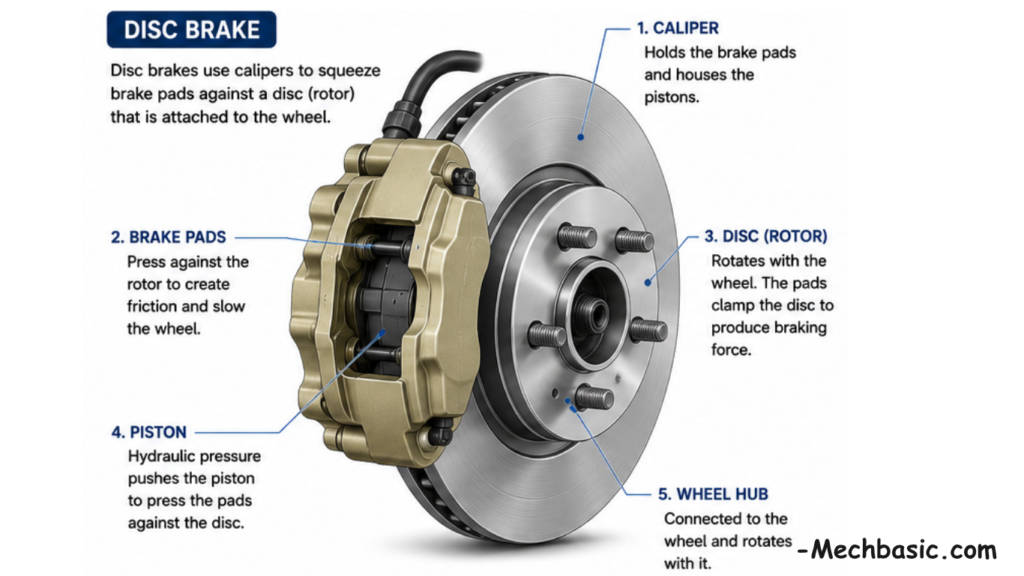
1. Brake Disc (Rotor)
- Rotates with the wheel.
- Made of cast iron, steel, or carbon-ceramic materials.
- Provides the friction surface for braking.
2. Brake Caliper
The caliper houses the brake pads and piston(s).
Types
- Floating (sliding) caliper
- Fixed caliper
3. Brake Pads
Brake pads are friction materials that press against the rotor.
Common materials include:
- Organic compounds
- Semi-metallic materials
- Ceramic composites
4. Brake Pistons
Hydraulic pressure pushes the pistons outward, forcing the brake pads against the disc.
5. Brake Fluid
Transfers hydraulic pressure from the master cylinder to the caliper.
Working of Disc Brakes
Step 1: Brake Pedal Pressed
The driver presses the brake pedal.
Step 2: Hydraulic Pressure Generated
The master cylinder generates hydraulic pressure.
Step 3: Pressure Reaches Caliper
Brake fluid carries the pressure to the brake caliper.
Step 4: Pads Clamp the Rotor
The pistons push the brake pads against both sides of the rotating disc.
Step 5: Friction Slows the Vehicle
The friction generated slows the rotor, reducing wheel speed until the vehicle stops.
Types of Disc Brakes
Solid Disc
A single-piece rotor with a solid construction.
Applications
- Small passenger vehicles
- Rear wheels
Ventilated Disc
Contains internal cooling passages between two friction surfaces.
Advantages
- Better heat dissipation
- Reduced brake fade
- Improved performance
Slotted Disc
Features machined slots to remove dust, water, and gases.
Applications
- High-performance vehicles
- Racing
Drilled Disc
Contains holes to improve cooling and water drainage.
Applications
- Sports cars
- Performance motorcycles
Advantages of Disc Brakes
- Excellent stopping performance.
- Superior heat dissipation.
- Reduced brake fade.
- Better performance in wet conditions.
- Easier inspection and maintenance.
- Faster response.
- More consistent braking.
Disadvantages of Disc Brakes
- Higher manufacturing cost.
- Faster brake pad wear in some conditions.
- More exposed to dirt and corrosion.
- Parking brake mechanism is more complex.
Drum Brakes
Definition
A drum brake uses brake shoes that press outward against the inside surface of a rotating drum attached to the wheel.
Drum brakes remain common on:
- Rear wheels of passenger cars
- Light trucks
- Commercial vehicles
- Trailers
Main Components of a Drum Brake
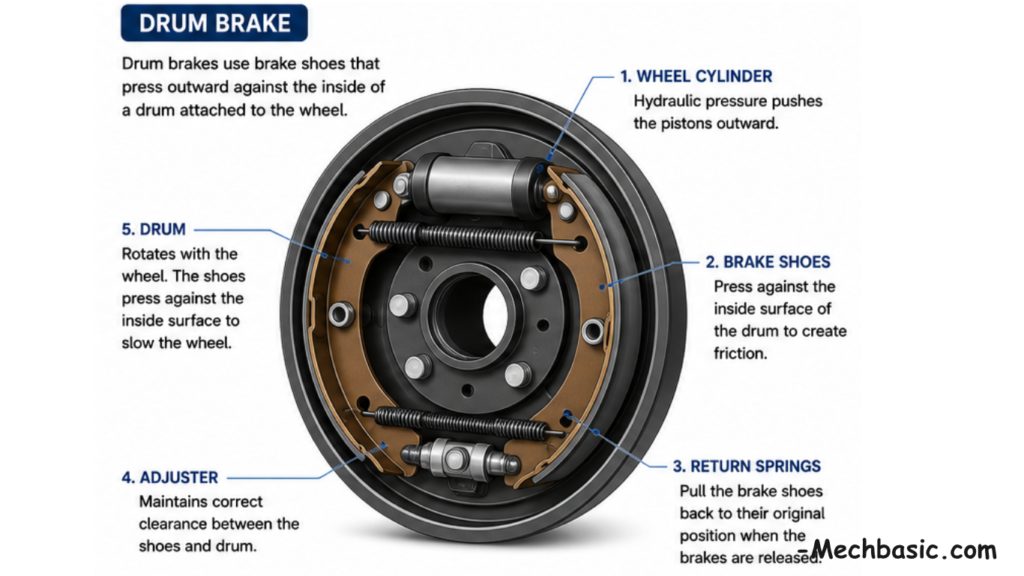
1. Brake Drum
A cylindrical component that rotates with the wheel.
2. Brake Shoes
Curved metal shoes lined with friction material.
3. Wheel Cylinder
Contains pistons that push the brake shoes outward.
4. Return Springs
Pull the brake shoes back after braking.
5. Backing Plate
Supports all drum brake components.
6. Adjuster Mechanism
Maintains proper clearance between the brake shoes and drum as the linings wear.
Working of Drum Brakes
Step 1: Brake Pedal Pressed
The driver presses the brake pedal.
Step 2: Hydraulic Pressure
Pressure reaches the wheel cylinder.
Step 3: Shoes Expand
Wheel cylinder pistons force the brake shoes outward.
Step 4: Shoes Contact Drum
The brake shoes press against the inner surface of the rotating drum.
Step 5: Friction Stops the Vehicle
Friction between the shoes and drum slows the wheel until it stops.
Advantages of Drum Brakes
- Lower manufacturing cost.
- Longer brake lining life under certain conditions.
- Built-in parking brake mechanism.
- Higher braking force due to self-energizing effect.
- Suitable for rear-wheel applications.
Disadvantages of Drum Brakes
- Poor heat dissipation.
- Brake fade during prolonged braking.
- More difficult maintenance.
- Reduced wet-weather performance.
- Heavier than disc brakes.
- Slower heat recovery.
Disc Brake vs. Drum Brake
| Feature | Disc Brake | Drum Brake |
|---|---|---|
| Braking Surface | Rotor (disc) | Drum |
| Friction Material | Brake pads | Brake shoes |
| Cooling | Excellent | Limited |
| Heat Dissipation | High | Low |
| Brake Fade | Minimal | More likely |
| Wet Performance | Better | Reduced |
| Maintenance | Easier | More complex |
| Weight | Lighter | Heavier |
| Cost | Higher | Lower |
| Stopping Performance | Excellent | Good |
| Parking Brake | Separate or integrated mechanism | Easily integrated |
| Typical Location | Front and rear (many modern vehicles) | Commonly rear wheels |
Brake Fade
Definition
Brake fade is the temporary reduction in braking performance caused by excessive heat buildup.
Causes
- Continuous braking on long downhill roads
- Heavy loads
- High-speed braking
- Overheated friction materials
Prevention
- Use ventilated disc brakes.
- Avoid continuous brake application; use engine braking when appropriate.
- Maintain the braking system.
- Use high-quality brake pads and fluid.
Brake Fluid
Brake fluid transfers hydraulic pressure throughout the braking system.
Characteristics
- High boiling point
- Low compressibility
- Corrosion resistance
- Lubrication of hydraulic components
Brake fluid should be inspected and replaced according to the manufacturer’s maintenance schedule.
Anti-lock Braking System (ABS)
Definition
The Anti-lock Braking System (ABS) prevents wheel lock-up during hard braking.
Advantages
- Improved steering control.
- Reduced skidding.
- Better braking on slippery roads.
- Increased vehicle stability.
ABS works with both disc and drum brake systems.
Common Brake Problems
Worn Brake Pads or Shoes
Symptoms:
- Reduced braking efficiency
- Squealing noise
- Longer stopping distance
Warped Brake Rotors
Symptoms:
- Brake pedal vibration
- Steering wheel shaking during braking
Brake Fluid Leakage
Symptoms:
- Soft brake pedal
- Reduced braking power
Brake Fade
Symptoms:
- Reduced braking response after repeated or prolonged braking
Uneven Brake Wear
Causes:
- Misaligned calipers
- Sticking pistons
- Incorrect installation
Brake Maintenance
Regular maintenance includes:
- Inspect brake pads and shoes.
- Check brake fluid level and condition.
- Inspect brake discs and drums for wear.
- Examine brake lines for leaks.
- Replace worn components promptly.
- Clean and lubricate moving parts where specified.
- Test the parking brake regularly.
Applications
Disc Brakes
Widely used in:
- Passenger cars
- Sports cars
- Motorcycles
- Buses
- Trucks
- Performance vehicles
Drum Brakes
Commonly used in:
- Rear wheels of economy cars
- Commercial trucks
- Trailers
- Parking brake systems
Future Trends in Braking Systems
Modern braking technology is evolving with:
- Electronic Brake-force Distribution (EBD)
- Brake Assist Systems (BAS)
- Regenerative braking in electric and hybrid vehicles
- Brake-by-wire systems
- Carbon-ceramic brake discs
- Smart brake monitoring sensors
- Autonomous emergency braking (AEB)
These technologies improve safety, efficiency, and braking performance.
Summary Table
| Aspect | Disc Brakes | Drum Brakes |
|---|---|---|
| Braking Efficiency | High | Moderate |
| Cooling Performance | Excellent | Limited |
| Maintenance | Easier | More involved |
| Heat Resistance | High | Lower |
| Manufacturing Cost | Higher | Lower |
| Common Applications | Front wheels, high-performance vehicles | Rear wheels, commercial vehicles, parking brakes |
Frequently Asked Questions (FAQs)
1. What is the primary function of a braking system?
The braking system slows down or stops a vehicle by converting kinetic energy into heat energy through friction.
2. What is the main difference between disc and drum brakes?
Disc brakes use brake pads that clamp onto a rotating disc (rotor), while drum brakes use brake shoes that press outward against the inside of a rotating drum.
3. Why are disc brakes more effective than drum brakes?
Disc brakes dissipate heat more efficiently, reducing brake fade and providing more consistent braking performance, especially during repeated or high-speed braking.
4. Why are drum brakes still used?
Drum brakes are less expensive to manufacture, have a self-energizing effect that can provide strong braking with lower hydraulic force, and integrate easily with parking brake mechanisms.
5. What is brake fade?
Brake fade is a temporary reduction in braking effectiveness caused by excessive heat buildup in the braking components, which lowers the friction between the braking surfaces.
6. What is the purpose of brake fluid?
Brake fluid transmits hydraulic pressure from the master cylinder to the wheel brakes while also lubricating components and resisting high temperatures.
7. Can a vehicle have both disc and drum brakes?
Yes. Many passenger vehicles use disc brakes on the front wheels for better stopping performance and drum brakes on the rear wheels for cost-effectiveness and parking brake integration.
8. How often should brake components be inspected?
Brake components should be inspected during regular vehicle servicing or according to the manufacturer’s recommended maintenance schedule. Frequent inspection is especially important for vehicles used under heavy-duty conditions.
9. What is the role of ABS?
The Anti-lock Braking System (ABS) prevents the wheels from locking during emergency braking, allowing the driver to maintain steering control and reducing the risk of skidding.
10. What are the future developments in automotive braking systems?
Future advancements include brake-by-wire technology, regenerative braking, electronic brake-force distribution, autonomous emergency braking, carbon-ceramic brakes, and intelligent brake monitoring systems.
Conclusion
The braking system is an essential safety feature that enables vehicles to slow down, stop, and remain stationary when required. Disc brakes offer superior braking performance, efficient heat dissipation, and consistent operation, making them the preferred choice for front-wheel and high-performance applications. Drum brakes, although less efficient under demanding conditions, remain widely used on rear wheels due to their lower cost, durability, and effective parking brake integration. Understanding the construction, operation, advantages, and limitations of both systems helps engineers, technicians, and drivers select and maintain the most suitable braking solution. As automotive technology continues to advance, innovations such as regenerative braking, brake-by-wire systems, and intelligent safety features will further improve braking efficiency, reliability, and vehicle safety.
Other courses:





