
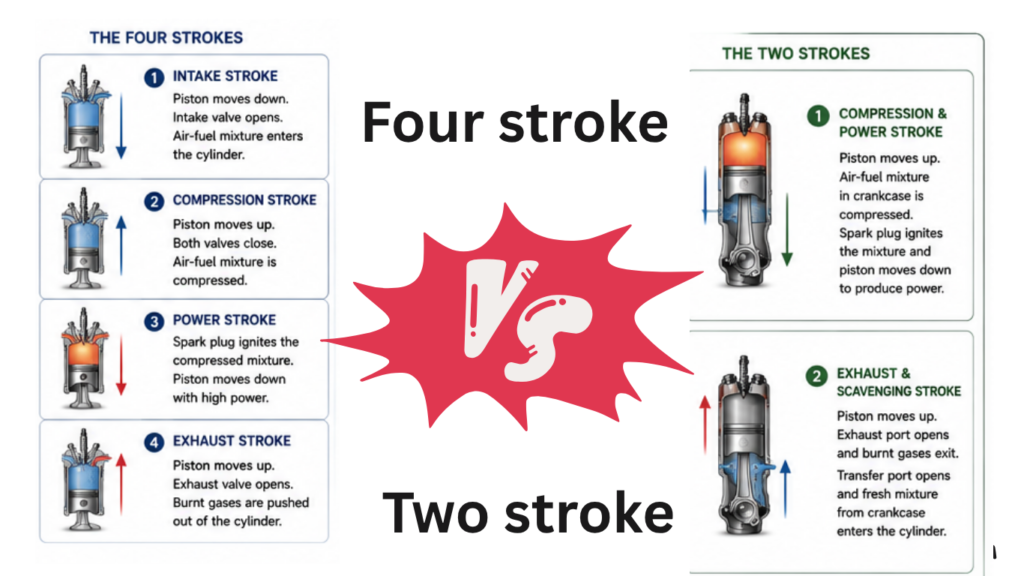
A four-stroke engine completes one cycle in four strokes (intake, compression, power, and exhaust) and is more fuel-efficient.
A two-stroke engine completes one cycle in two strokes, producing more power for its size but with higher fuel consumption.
Four-stroke engines are widely used in cars, while two-stroke engines are common in small motorcycles and portable machines.
In this article:
- Internal Combustion Engine Cycles: Four-Stroke vs. Two-Stroke
- What is an Internal Combustion Engine?
- Main Components of an Internal Combustion Engine
- Engine Cycle
- Four-Stroke Engine
- Working of a Four-Stroke Engine
- Characteristics of Four-Stroke Engines
- Two-Stroke Engine
- Working of a Two-Stroke Engine
- Characteristics of Two-Stroke Engines
- Four-Stroke vs. Two-Stroke Engine Comparison
- Advantages of Four-Stroke Engines
- Disadvantages of Four-Stroke Engines
- Advantages of Two-Stroke Engines
- Disadvantages of Two-Stroke Engines
- Applications of Four-Stroke Engines
- Applications of Two-Stroke Engines
- Performance Comparison
- Environmental Considerations
- Future Trends
- Summary Table
- Frequently Asked Questions (FAQs)
- Conclusion
Internal Combustion Engine Cycles: Four-Stroke vs. Two-Stroke
Introduction
An Internal Combustion Engine (ICE) is a heat engine in which the combustion of fuel takes place inside the engine cylinder. The energy released during combustion is converted into mechanical work by moving the piston, which ultimately drives the crankshaft. Internal combustion engines have been the primary source of power for automobiles, motorcycles, ships, generators, agricultural equipment, and industrial machinery for over a century.
Based on the number of piston strokes required to complete one operating cycle, internal combustion engines are classified into:
- Four-stroke engines
- Two-stroke engines
Both engine types follow the same basic thermodynamic principles but differ significantly in their operating cycles, efficiency, power output, fuel consumption, emissions, lubrication, and applications.
This guide explains the working principles of four-stroke and two-stroke engines, compares their characteristics, and discusses their advantages, disadvantages, and real-world applications.
What is an Internal Combustion Engine?
Definition
An Internal Combustion Engine (ICE) is a machine that converts the chemical energy of fuel into mechanical energy by burning the fuel-air mixture inside a combustion chamber.
The expanding gases produced during combustion push the piston downward, generating useful mechanical work.
Also Read : What is an engine cycle?
Main Components of an Internal Combustion Engine
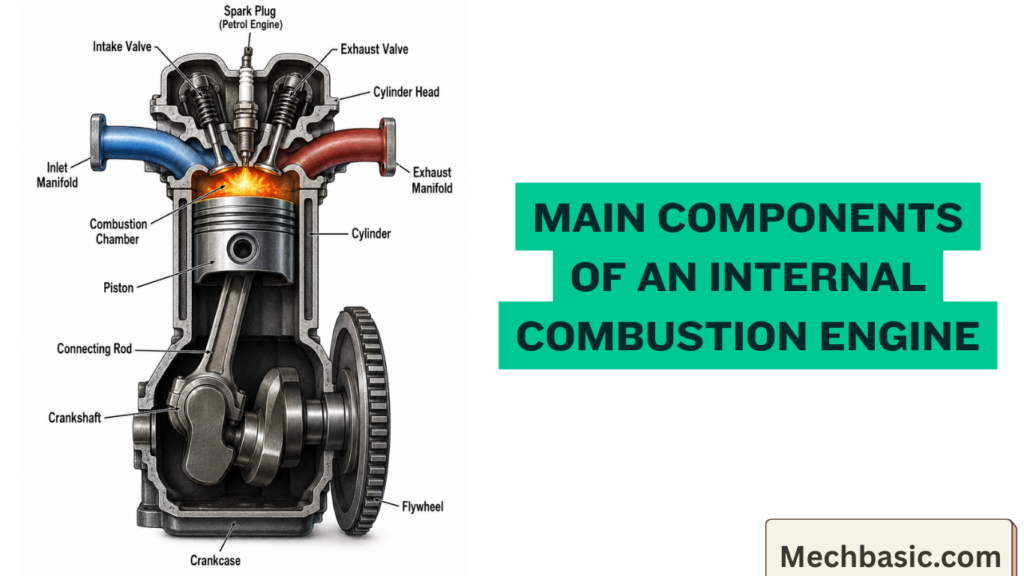
An ICE consists of several essential parts:
- Cylinder
- Piston
- Connecting rod
- Crankshaft
- Cylinder head
- Intake valve
- Exhaust valve
- Spark plug (petrol engines)
- Fuel injector or carburetor
- Camshaft (in four-stroke engines)
- Flywheel
- Crankcase
Each component plays a critical role in the engine’s operation and performance.
Engine Cycle
An engine cycle is the complete sequence of operations required to convert fuel into mechanical work.
A complete cycle includes:
- Intake of the air-fuel mixture (or air in diesel engines)
- Compression
- Combustion and power generation
- Exhaust of combustion gases
The difference between four-stroke and two-stroke engines lies in how these processes are completed.
Four-Stroke Engine
Definition
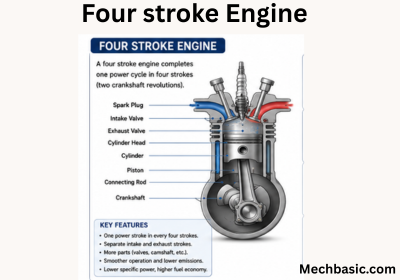
A four-stroke engine completes one operating cycle in four piston strokes and two crankshaft revolutions (720°).
It is the most commonly used engine in passenger cars, trucks, buses, and industrial machinery.
Working of a Four-Stroke Engine
1. Intake Stroke
Process
- The piston moves downward from Top Dead Center (TDC) to Bottom Dead Center (BDC).
- The intake valve opens.
- The exhaust valve remains closed.
- Air-fuel mixture (petrol engine) or air (diesel engine) enters the cylinder.
Result
The cylinder is filled with fresh charge.
2. Compression Stroke
Process
- Both intake and exhaust valves remain closed.
- The piston moves upward from BDC to TDC.
- The charge is compressed.
Result
Compression increases temperature and pressure, improving combustion efficiency.
3. Power (Expansion) Stroke
Process
- Near TDC, combustion occurs.
- In petrol engines, the spark plug ignites the compressed mixture.
- In diesel engines, fuel is injected into the hot compressed air.
Result
High-pressure gases force the piston downward, producing useful mechanical work.
This is the only power-producing stroke in the cycle.
4. Exhaust Stroke
Process
- Exhaust valve opens.
- Intake valve remains closed.
- The piston moves upward.
- Burnt gases are expelled from the cylinder.
Result
The cylinder is ready for the next cycle.
Characteristics of Four-Stroke Engines
- One power stroke every two crankshaft revolutions.
- Uses intake and exhaust valves.
- Separate lubrication system.
- Better fuel economy.
- Lower emissions.
- Longer engine life.
- Smoother operation.
Two-Stroke Engine
Definition
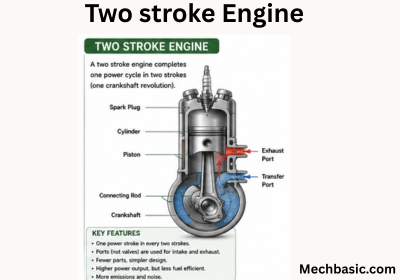
A two-stroke engine completes one operating cycle in two piston strokes and one crankshaft revolution (360°).
It produces one power stroke during every crankshaft revolution.
Working of a Two-Stroke Engine
Unlike a four-stroke engine, intake, compression, power, and exhaust occur through overlapping processes.
First Stroke (Compression)
Process
- The piston moves upward.
- Air-fuel mixture in the cylinder is compressed.
- Simultaneously, a fresh mixture enters the crankcase through the intake port.
Result
Compressed mixture is prepared for ignition.
Second Stroke (Power and Exhaust)
Process
- Ignition occurs near TDC.
- Expanding gases push the piston downward.
- As the piston moves down:
- Exhaust port opens.
- Burnt gases leave the cylinder.
- Transfer port opens.
- Fresh mixture enters the cylinder from the crankcase.
Result
Fresh charge replaces exhaust gases, preparing the cylinder for the next cycle.
Characteristics of Two-Stroke Engines
- One power stroke per crankshaft revolution.
- No intake or exhaust valves (ports are used instead).
- Simpler construction.
- Higher power-to-weight ratio.
- Lower fuel efficiency.
- Higher emissions.
- Requires oil mixed with fuel in many designs.
Four-Stroke vs. Two-Stroke Engine Comparison
| Feature | Four-Stroke Engine | Two-Stroke Engine |
|---|---|---|
| Engine Cycle | Four piston strokes | Two piston strokes |
| Crankshaft Revolutions | Two (720°) | One (360°) |
| Power Stroke | Once every two revolutions | Every revolution |
| Valves | Intake and exhaust valves | Intake, transfer, and exhaust ports |
| Camshaft | Required | Not required |
| Fuel Efficiency | Higher | Lower |
| Power Output | Lower for the same engine size | Higher for the same engine size |
| Lubrication | Separate lubrication system | Oil mixed with fuel or separate oil injection |
| Emissions | Lower | Higher |
| Mechanical Complexity | More complex | Simpler |
| Maintenance | Lower frequency | More frequent |
| Engine Life | Longer | Shorter |
| Noise | Quieter | Louder |
| Weight | Heavier | Lighter |
| Manufacturing Cost | Higher | Lower |
Advantages of Four-Stroke Engines
1. Better Fuel Economy
Consumes less fuel because combustion is more controlled and complete.
2. Lower Emissions
Produces fewer pollutants due to efficient combustion and separate lubrication.
3. Longer Service Life
Reduced wear because lubrication is more effective.
4. Smoother Operation
Power delivery is more refined with less vibration and noise.
5. Better Reliability
Suitable for continuous operation over long periods.
Disadvantages of Four-Stroke Engines
- More moving parts.
- Higher manufacturing cost.
- Heavier construction.
- Lower power-to-weight ratio.
- More complex maintenance.
Advantages of Two-Stroke Engines
1. High Power-to-Weight Ratio
Produces more power for a given engine size because every revolution generates a power stroke.
2. Simpler Construction
No valve train or camshaft is required.
3. Lightweight
Fewer components result in a compact and lightweight design.
4. Lower Manufacturing Cost
Simpler design reduces production costs.
5. Easy Maintenance
Fewer mechanical parts simplify repairs.
Disadvantages of Two-Stroke Engines
- Higher fuel consumption.
- Greater emissions.
- Increased oil consumption.
- Shorter engine life.
- Poor lubrication compared to four-stroke engines.
- Noisier operation.
Applications of Four-Stroke Engines
Four-stroke engines are commonly used in:
- Passenger cars
- Trucks
- Buses
- Tractors
- Power generators
- Construction equipment
- Industrial machinery
- Marine engines
- Locomotives (diesel variants)
Applications of Two-Stroke Engines
Two-stroke engines are commonly found in:
- Chainsaws
- Brush cutters
- Leaf blowers
- Small motorcycles
- Outboard boat motors
- Snowmobiles
- Portable generators
- Some scooters (older models)
Performance Comparison
Fuel Efficiency
Four-stroke engines are significantly more fuel-efficient due to complete combustion and controlled valve timing.
Power Output
Two-stroke engines generally produce more power per unit displacement because they generate a power stroke every crankshaft revolution.
Emissions
Four-stroke engines emit fewer hydrocarbons and particulate matter because they have separate lubrication systems and more complete combustion.
Maintenance
Four-stroke engines require less frequent maintenance, while two-stroke engines need regular attention to lubrication and exhaust deposits.
Environmental Considerations
Modern emission regulations have greatly reduced the use of conventional two-stroke engines in road vehicles. Manufacturers have improved engine technologies through:
- Electronic fuel injection
- Catalytic converters
- Direct fuel injection
- Advanced lubrication systems
- Electronic engine management
These technologies help improve efficiency and reduce emissions in both engine types.
Future Trends
The evolution of internal combustion engines includes:
- Turbocharging and supercharging
- Variable valve timing (VVT)
- Direct fuel injection
- Hybrid powertrains
- Alternative fuels (hydrogen, biofuels, synthetic fuels)
- Advanced engine control systems
- Low-friction materials
- Improved combustion chamber designs
Although electric vehicles are gaining popularity, internal combustion engines continue to play a vital role in transportation, heavy-duty machinery, aviation, and marine applications.
Summary Table
| Aspect | Four-Stroke Engine | Two-Stroke Engine |
|---|---|---|
| Operating Cycle | Four strokes | Two strokes |
| Power Stroke Frequency | Every two crankshaft revolutions | Every crankshaft revolution |
| Fuel Efficiency | High | Moderate to Low |
| Power Density | Moderate | High |
| Lubrication | Separate oil system | Oil mixed with fuel or oil injection |
| Emissions | Lower | Higher |
| Complexity | Higher | Lower |
| Durability | Longer | Shorter |
| Typical Uses | Cars, trucks, generators | Chainsaws, small motorcycles, outboard motors |
Frequently Asked Questions (FAQs)
1. What is the main difference between a four-stroke and a two-stroke engine?
A four-stroke engine completes one operating cycle in four piston strokes (two crankshaft revolutions), while a two-stroke engine completes the cycle in two piston strokes (one crankshaft revolution).
2. Which engine produces more power for the same displacement?
A two-stroke engine generally produces more power for the same engine size because it delivers a power stroke every crankshaft revolution.
3. Which engine is more fuel-efficient?
Four-stroke engines are more fuel-efficient because they have more complete combustion, better valve control, and separate lubrication systems.
4. Why do many two-stroke engines require oil mixed with fuel?
Many two-stroke engines use the fuel-oil mixture to lubricate internal components because they do not have a separate engine oil circulation system like four-stroke engines.
5. Why are four-stroke engines commonly used in automobiles?
They offer better fuel economy, lower emissions, smoother operation, greater durability, and compliance with modern environmental regulations.
6. What are the advantages of two-stroke engines?
Two-stroke engines are lightweight, mechanically simple, have a high power-to-weight ratio, and are well suited for portable equipment and applications where compact size is important.
7. Which engine has lower emissions?
Four-stroke engines generally produce lower emissions because they burn fuel more efficiently and use separate lubrication systems that reduce oil consumption.
8. Can two-stroke engines be environmentally friendly?
Yes. Modern two-stroke engines equipped with technologies such as direct fuel injection, electronic engine management, and improved lubrication systems have significantly lower emissions than older designs.
9. What industries still use internal combustion engines extensively?
Internal combustion engines remain essential in automotive, agriculture, construction, marine, aviation (piston aircraft), mining, power generation, and industrial equipment sectors.
10. What is the future of internal combustion engines?
The future involves cleaner, more efficient engines using hybrid systems, turbocharging, advanced combustion technologies, alternative fuels, hydrogen, synthetic fuels, and improved emission control systems alongside increasing electrification.
Conclusion
Internal combustion engines remain a cornerstone of modern transportation and industrial machinery. Four-stroke engines are preferred for applications requiring high efficiency, durability, low emissions, and smooth operation, making them the standard choice for most automobiles and heavy-duty equipment. Two-stroke engines, with their simpler construction and higher power-to-weight ratio, continue to serve specialized applications such as portable tools, marine outboards, and lightweight recreational vehicles. Understanding the differences between these engine cycles enables engineers and technicians to select the most appropriate engine type based on performance, efficiency, cost, maintenance, and environmental considerations. As engine technology continues to evolve, innovations in fuel systems, combustion control, hybridization, and alternative fuels will further enhance the performance and sustainability of internal combustion engines.
Other courses:





