
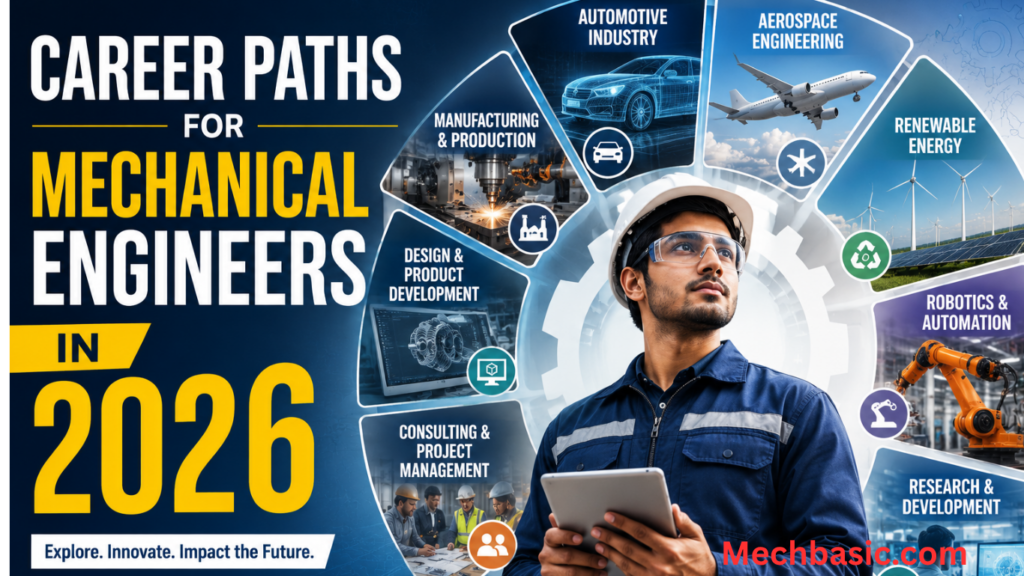
Mechanical engineers have career opportunities in automotive, aerospace, manufacturing, robotics, renewable energy, and HVAC industries.
They also work in product design, automation, maintenance, quality control, and research and development (R&D).
In 2026, skills in CAD, AI-assisted design, automation, and sustainable engineering are expected to be in high demand.
In this article:
- Career Paths for Mechanical Engineers in 2026
- Why Choose Mechanical Engineering?
- Top Career Paths for Mechanical Engineers in 2026
- Emerging Career Opportunities in 2026
- Government Career Opportunities
- Private Sector Opportunities
- Higher Education Options
- Skills Required in 2026
- Certifications That Add Value
- Salary Factors
- Future Trends
- Advantages of a Mechanical Engineering Career
- Challenges
- Frequently Asked Questions (FAQs)
- Conclusion
Career Paths for Mechanical Engineers in 2026
Introduction
Mechanical engineering remains one of the most versatile and in-demand engineering disciplines in 2026. Mechanical engineers design, manufacture, analyze, test, and maintain machines, products, and systems used in industries ranging from automotive and aerospace to renewable energy and robotics.
With the rise of Industry 4.0, artificial intelligence (AI), automation, electric vehicles (EVs), renewable energy, and smart manufacturing, the role of mechanical engineers has expanded significantly. Professionals with skills in CAD, simulation, automation, data analysis, and sustainability have excellent career prospects worldwide.
Why Choose Mechanical Engineering?
Mechanical engineering offers:
- Diverse career opportunities
- Strong demand across industries
- Good salary growth
- Opportunities in research and innovation
- Global career prospects
- Scope for entrepreneurship
- Continuous learning with emerging technologies
Top Career Paths for Mechanical Engineers in 2026
1. Design Engineer
Role
Design engineers create and improve mechanical products, components, and systems.
Responsibilities
- Create 2D and 3D CAD models
- Design machine components
- Prepare engineering drawings
- Perform design calculations
- Select materials
- Coordinate with manufacturing teams
Required Skills
- AutoCAD
- SolidWorks
- CATIA
- Creo
- GD&T
- Engineering drawing
Industries
- Automotive
- Aerospace
- Consumer products
- Heavy machinery
- Industrial equipment
2. Manufacturing Engineer
Role
Manufacturing engineers develop efficient production methods to improve productivity and reduce costs.
Responsibilities
- Production planning
- Process optimization
- CNC programming
- Tool selection
- Lean manufacturing
- Quality improvement
Skills
- CNC machining
- Lean Manufacturing
- Six Sigma
- CAD/CAM
- Production planning
3. CAD Engineer
Role
CAD engineers develop detailed engineering drawings and digital models.
Responsibilities
- Prepare production drawings
- Create assembly drawings
- Design sheet metal parts
- Generate BOMs (Bill of Materials)
- Update engineering documentation
Software
- AutoCAD
- SolidWorks
- Creo
- Inventor
- CATIA
4. CAE/Simulation Engineer
Role
CAE engineers analyze product performance using simulation software before physical manufacturing.
Responsibilities
- Structural analysis
- Thermal analysis
- CFD (Computational Fluid Dynamics)
- Vibration analysis
- Fatigue analysis
Software
- ANSYS
- Abaqus
- HyperWorks
- COMSOL
- LS-DYNA
5. Quality Engineer
Role
Quality engineers ensure products meet customer and industry standards.
Responsibilities
- Inspection
- Root cause analysis
- Process audits
- Statistical quality control
- Documentation
Skills
- ISO 9001
- Six Sigma
- SPC
- FMEA
- Quality tools
6. Production Engineer
Role
Production engineers manage manufacturing operations and improve efficiency.
Responsibilities
- Production scheduling
- Machine utilization
- Workforce management
- Cost reduction
- Productivity improvement
7. Maintenance Engineer
Role
Maintenance engineers ensure machines and equipment operate reliably.
Responsibilities
- Preventive maintenance
- Predictive maintenance
- Equipment troubleshooting
- Spare parts management
- Machine inspections
8. HVAC Engineer
Role
HVAC engineers design heating, ventilation, and air-conditioning systems.
Applications
- Hospitals
- Airports
- Hotels
- Office buildings
- Shopping malls
- Data centers
Skills
- Heat load calculations
- Duct design
- Refrigeration
- Building services
9. Automotive Engineer
Role
Automotive engineers design, develop, and test vehicles and their components.
Emerging Areas
- Electric Vehicles (EVs)
- Battery systems
- Autonomous vehicles
- Hydrogen-powered vehicles
- Advanced driver-assistance systems (ADAS)
10. Aerospace Engineer
Role
Mechanical engineers contribute to aircraft, spacecraft, satellites, and propulsion systems.
Applications
- Aircraft structures
- Jet engines
- Rocket propulsion
- UAVs (drones)
- Satellite mechanisms
11. Robotics Engineer
Role
Robotics engineers design robots for manufacturing, healthcare, logistics, and service industries.
Skills
- Robotics
- Mechatronics
- Sensors
- Actuators
- PLC programming
- Robot simulation
12. Renewable Energy Engineer
Role
Mechanical engineers design systems for clean energy generation.
Areas
- Wind turbines
- Solar thermal plants
- Hydropower
- Biomass systems
- Green hydrogen technologies
13. Industrial Automation Engineer
Role
Automation engineers improve manufacturing through automated systems.
Skills
- PLC
- SCADA
- Industrial robots
- Sensors
- Pneumatics
- Hydraulics
14. Research and Development (R&D) Engineer
Role
Develop new products, materials, and technologies.
Industries
- Automotive
- Aerospace
- Consumer electronics
- Medical devices
- Energy
15. Project Engineer
Responsibilities
- Project planning
- Budget management
- Vendor coordination
- Scheduling
- Technical supervision
16. Field Service Engineer
Responsibilities
- Installation
- Commissioning
- Equipment maintenance
- Customer support
- Troubleshooting
17. Supply Chain Engineer
Responsibilities
- Logistics optimization
- Procurement
- Inventory management
- Warehouse planning
- Vendor management
18. Marine Engineer
Applications
- Ships
- Offshore platforms
- Naval vessels
- Marine engines
19. Energy Engineer
Responsibilities
- Energy audits
- Energy conservation
- Industrial efficiency
- Sustainability projects
20. Mechanical Engineering Consultant
Responsibilities
- Technical consulting
- Design verification
- Feasibility studies
- Engineering analysis
Emerging Career Opportunities in 2026
Electric Vehicle (EV) Engineer
High demand due to the rapid adoption of electric mobility.
Skills
- Battery technology
- Electric motors
- Thermal management
- Charging systems
AI in Mechanical Engineering
Mechanical engineers increasingly work with AI for:
- Predictive maintenance
- Digital twins
- Smart manufacturing
- Quality inspection
- Process optimization
Additive Manufacturing Engineer
Specializes in:
- 3D printing
- Metal additive manufacturing
- Rapid prototyping
- Product development
Digital Twin Engineer
Creates virtual models of machines and processes for monitoring, simulation, and optimization.
Sustainability Engineer
Focuses on:
- Carbon reduction
- Energy efficiency
- Eco-friendly product design
- Circular economy practices
Government Career Opportunities
Mechanical engineers can work in:
- Public sector manufacturing
- Railways
- Defense
- Power generation
- Oil and gas
- Public works
- Research laboratories
Typical roles include design, maintenance, production, inspection, and technical management.
Private Sector Opportunities
Industries include:
- Automobile manufacturing
- Aerospace
- Heavy engineering
- Construction equipment
- Consumer appliances
- Medical devices
- Renewable energy
- Automation
- Robotics
- Electronics manufacturing
Higher Education Options
After graduation, mechanical engineers may pursue:
- M.E./M.Tech.
- M.S.
- MBA
- Ph.D.
- Specialized certifications in CAD, CAE, automation, quality, or project management
Skills Required in 2026
Technical Skills
- AutoCAD
- SolidWorks
- CATIA
- Creo
- ANSYS
- MATLAB
- Python (for engineering applications)
- CNC programming
- GD&T
- PLC and automation
- Basic data analysis
- Additive manufacturing
Soft Skills
- Communication
- Teamwork
- Leadership
- Problem-solving
- Time management
- Critical thinking
- Project management
- Adaptability
Certifications That Add Value
- AutoCAD Professional
- SolidWorks Certification (CSWA/CSWP)
- Six Sigma (Green Belt/Black Belt)
- ISO 9001 Internal Auditor
- Lean Manufacturing
- Project Management
- PLC Programming
- ANSYS Certification
- HVAC Design Certification
Salary Factors
Salary depends on:
- Experience
- Technical skills
- Industry
- Location
- Certifications
- Higher education
- Company size
Specializations such as EV engineering, robotics, AI-assisted manufacturing, CAE simulation, and renewable energy often command higher salaries because of strong demand.
Future Trends
Mechanical engineering continues to evolve with:
- Smart factories
- Industry 4.0
- Artificial intelligence
- Electric vehicles
- Robotics
- Digital twins
- Hydrogen energy
- Green manufacturing
- Advanced materials
- Sustainable product design
Professionals who combine core mechanical knowledge with digital and automation skills are likely to have the best career opportunities.
Advantages of a Mechanical Engineering Career
- Wide range of industries
- Strong global demand
- Opportunities for innovation
- Good career progression
- Potential for entrepreneurship
- International job prospects
- Continuous technological growth
Challenges
- Need for continuous skill development
- Rapid technological changes
- Competitive job market
- Project deadlines
- Balancing technical and business requirements
Frequently Asked Questions (FAQs)
1. Is mechanical engineering a good career in 2026?
Yes. Mechanical engineering remains a strong career choice due to demand in manufacturing, electric vehicles, automation, robotics, renewable energy, aerospace, and industrial design.
2. Which field has the highest demand for mechanical engineers?
High-demand fields include:
- Electric vehicles (EVs)
- Robotics and automation
- CAD/CAE
- Renewable energy
- HVAC
- Aerospace
- Smart manufacturing
3. Can mechanical engineers work in software-related roles?
Yes. Mechanical engineers increasingly use software for CAD, simulation, automation, digital twins, data analysis, and AI-assisted engineering. Learning programming languages such as Python can broaden career opportunities.
4. Which CAD software should a mechanical engineer learn?
Commonly used software includes:
- AutoCAD
- SolidWorks
- CATIA
- Creo
- Autodesk Inventor
5. Is higher education necessary?
Not always. Many engineers build successful careers with industry certifications and practical experience. However, a master’s degree or specialized certification can improve opportunities in research, advanced design, and management.
6. What industries hire mechanical engineers?
Mechanical engineers are employed in:
- Automotive
- Aerospace
- Manufacturing
- Oil and gas
- Renewable energy
- Construction
- Healthcare
- Electronics
- Robotics
- Defense
7. What skills are most valuable in 2026?
A combination of:
- Mechanical fundamentals
- CAD and CAE tools
- Automation
- Data analysis
- Project management
- Communication
- Knowledge of sustainable engineering
8. Can mechanical engineers become entrepreneurs?
Yes. Many start businesses in product design, manufacturing, industrial consulting, CAD services, automation, 3D printing, maintenance services, or renewable energy solutions.
9. What is the future scope of mechanical engineering?
The future is promising, especially in electric mobility, robotics, AI-assisted manufacturing, renewable energy, advanced materials, and smart factories.
10. How can a fresh graduate improve employability?
- Build a strong foundation in engineering fundamentals.
- Learn industry-standard CAD and simulation software.
- Gain internship or project experience.
- Develop communication and teamwork skills.
- Earn relevant technical certifications.
- Stay updated with emerging technologies.
Conclusion
Mechanical engineering continues to be a dynamic and future-ready profession in 2026. While traditional careers in design, manufacturing, quality, and maintenance remain important, the field is rapidly expanding into electric vehicles, automation, robotics, artificial intelligence, additive manufacturing, digital twins, and renewable energy. Graduates who combine strong engineering fundamentals with digital skills, practical experience, and continuous learning will be well positioned for rewarding careers across a wide range of industries worldwide.
Other courses:





