
The vapor compression refrigeration cycle uses a compressor and is the most common system in refrigerators and air conditioners.
The absorption refrigeration cycle uses heat instead of a mechanical compressor to produce cooling.
Both cycles transfer heat from a low-temperature region to a high-temperature region, but they use different operating methods.
In this article:
- Types of Refrigeration Cycles: Vapor Compression and Absorption
- What is a Refrigeration Cycle?
- Basic Principle of Refrigeration
- Types of Refrigeration Cycles
- 1. Vapor Compression Refrigeration Cycle (VCRS)
- 2. Vapor Absorption Refrigeration Cycle (VARS)
- Common Refrigerant–Absorbent Pairs
- Main Components of VARS
- Working of the Vapor Absorption Cycle
- Advantages of VARS
- Disadvantages of VARS
- Applications of VARS
- Comparison Between VCRS and VARS
- Coefficient of Performance (COP)
- Real-World Examples
- Advantages of Refrigeration Systems
- Limitations
- Summary Table
- Frequently Asked Questions (FAQs)
- Conclusion
Types of Refrigeration Cycles: Vapor Compression and Absorption
Introduction
Refrigeration is the process of removing heat from a low-temperature space or substance and transferring it to a higher-temperature environment. This process keeps food fresh, cools buildings, preserves medicines, and supports numerous industrial processes.
A refrigeration cycle is the sequence of thermodynamic processes that a refrigerant undergoes to absorb heat from a cold region and reject it to a warmer region.
The two most widely used refrigeration cycles are:
- Vapor Compression Refrigeration Cycle (VCRS)
- Vapor Absorption Refrigeration Cycle (VARS)
Both cycles achieve the same objective—cooling—but they differ in their working principles, components, energy sources, efficiency, and applications.
What is a Refrigeration Cycle?
A refrigeration cycle is a continuous thermodynamic cycle in which a refrigerant circulates through various components, absorbing heat from a low-temperature region and rejecting it to a high-temperature region.
The refrigerant repeatedly changes between liquid and vapor states, allowing it to transfer heat efficiently.
Basic Principle of Refrigeration
Refrigeration works on the principle that:
- Heat naturally flows from a hot body to a cold body.
- To move heat from a cold region to a hotter region, external energy is required.
This principle follows the Second Law of Thermodynamics.
Types of Refrigeration Cycles
The main refrigeration cycles are:
- Vapor Compression Refrigeration Cycle (VCRS)
- Vapor Absorption Refrigeration Cycle (VARS)
- Air Refrigeration Cycle (Bell–Coleman Cycle)
- Steam Jet Refrigeration Cycle
- Thermoelectric Refrigeration Cycle
- Magnetic Refrigeration Cycle
- Gas Refrigeration Cycle
Among these, VCRS and VARS are the most widely used.
1. Vapor Compression Refrigeration Cycle (VCRS)
Definition
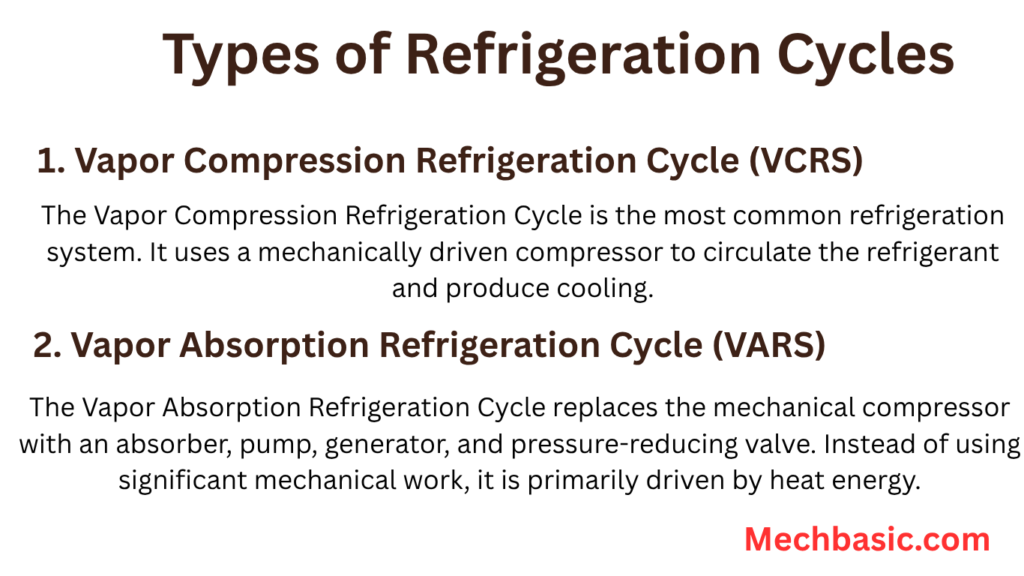
The Vapor Compression Refrigeration Cycle is the most common refrigeration system. It uses a mechanically driven compressor to circulate the refrigerant and produce cooling.
This cycle is used in:
- Domestic refrigerators
- Air conditioners
- Cold storage facilities
- Supermarkets
- Industrial refrigeration systems
Main Components of VCRS
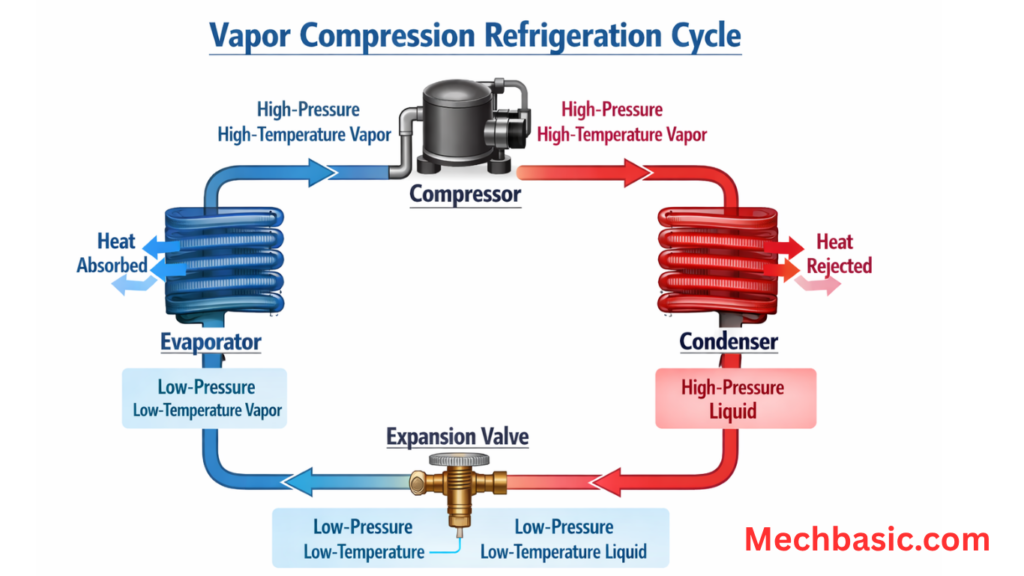
1. Compressor
Function
- Compresses low-pressure refrigerant vapor.
- Increases pressure and temperature.
- Pumps refrigerant throughout the system.
Input
Low-pressure vapor
Output
High-pressure, high-temperature vapor
2. Condenser
Function
- Rejects heat to the surrounding air or water.
- Converts vapor into liquid.
Input
High-pressure hot vapor
Output
High-pressure liquid refrigerant
3. Expansion Valve (Throttle Valve)
Function
- Reduces refrigerant pressure.
- Lowers refrigerant temperature.
- Controls refrigerant flow into the evaporator.
Output
Low-pressure, low-temperature liquid-vapor mixture
4. Evaporator
Function
- Absorbs heat from the refrigerated space.
- Refrigerant evaporates into vapor.
Output
Low-pressure vapor returning to the compressor
Working of the Vapor Compression Cycle
Step 1: Compression
The compressor compresses low-pressure refrigerant vapor into a high-pressure, high-temperature vapor.
Step 2: Condensation
The hot vapor enters the condenser and releases heat to the surroundings, changing into a high-pressure liquid.
Step 3: Expansion
The liquid refrigerant passes through the expansion valve, where its pressure and temperature decrease significantly.
Step 4: Evaporation
The cold refrigerant enters the evaporator and absorbs heat from the refrigerated space. It evaporates into a low-pressure vapor, completing the cycle.
Advantages of VCRS
- High cooling efficiency.
- Compact design.
- Fast cooling.
- Reliable operation.
- Suitable for domestic and commercial use.
- Widely available and easy to service.
Disadvantages of VCRS
- Requires electrical energy to drive the compressor.
- Compressor noise and vibration.
- Higher maintenance than absorption systems.
- Performance depends on electricity supply.
Applications of VCRS
- Household refrigerators
- Split air conditioners
- Window air conditioners
- Water coolers
- Cold storage warehouses
- Food processing industries
- Ice plants
- Supermarket refrigeration
2. Vapor Absorption Refrigeration Cycle (VARS)
Definition
The Vapor Absorption Refrigeration Cycle replaces the mechanical compressor with an absorber, pump, generator, and pressure-reducing valve. Instead of using significant mechanical work, it is primarily driven by heat energy.
Heat sources may include:
- Steam
- Natural gas
- Solar energy
- Waste heat
- Hot water
Common Refrigerant–Absorbent Pairs
Water–Lithium Bromide (H₂O–LiBr)
- Refrigerant: Water
- Absorbent: Lithium bromide
- Commonly used for air conditioning.
Ammonia–Water (NH₃–H₂O)
- Refrigerant: Ammonia
- Absorbent: Water
- Used for refrigeration at temperatures below 0°C.
Main Components of VARS
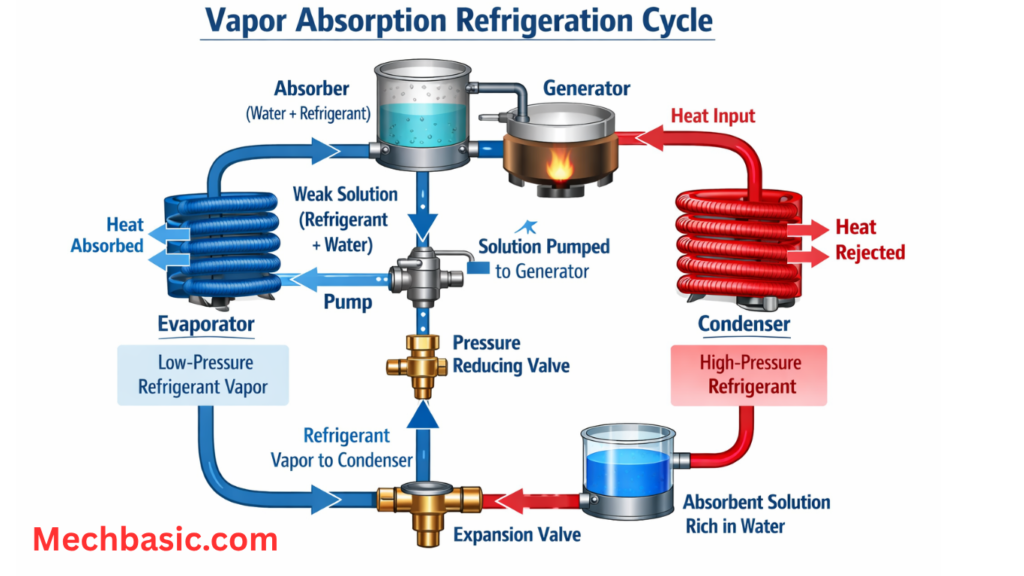
1. Evaporator
Absorbs heat from the refrigerated space.
2. Absorber
Absorbs refrigerant vapor into the absorbent solution, forming a strong solution.
3. Pump
Pumps the strong solution to the generator.
Requires very little mechanical power compared with a compressor.
4. Generator
Heat is supplied to separate the refrigerant vapor from the absorbent.
5. Condenser
Rejects heat and converts refrigerant vapor into liquid.
6. Expansion Valve
Reduces refrigerant pressure before it enters the evaporator.
Working of the Vapor Absorption Cycle
Step 1
The refrigerant evaporates in the evaporator, absorbing heat.
Step 2
The refrigerant vapor is absorbed by the absorbent in the absorber.
Step 3
The solution is pumped to the generator.
Step 4
Heat supplied to the generator separates the refrigerant vapor from the absorbent.
Step 5
The refrigerant vapor condenses into a liquid in the condenser.
Step 6
The liquid passes through the expansion valve and returns to the evaporator.
The cycle then repeats.
Advantages of VARS
- Can operate using waste heat or solar energy.
- Very quiet because there is no large compressor.
- Fewer moving parts.
- Lower vibration.
- Suitable where inexpensive heat is available.
Disadvantages of VARS
- Lower efficiency than VCRS.
- Larger and heavier equipment.
- Slower cooling response.
- Higher initial installation cost.
- More suitable for large-capacity systems than small domestic units.
Applications of VARS
- Large commercial buildings
- Hotels
- Hospitals
- Industrial cooling
- Solar-powered refrigeration
- Waste-heat recovery systems
- District cooling plants
Comparison Between VCRS and VARS
| Feature | Vapor Compression Refrigeration Cycle (VCRS) | Vapor Absorption Refrigeration Cycle (VARS) |
|---|---|---|
| Driving Energy | Mechanical work (compressor) | Heat energy |
| Main Device | Compressor | Absorber, pump, generator |
| Energy Source | Electricity | Steam, gas, solar, waste heat |
| Efficiency (COP) | Higher | Lower |
| Noise | More | Very low |
| Moving Parts | More | Fewer |
| Maintenance | Moderate | Lower mechanical maintenance |
| Cooling Speed | Faster | Slower |
| Initial Cost | Lower | Higher |
| Best Use | Homes, offices, commercial refrigeration | Large buildings and industrial systems |
Coefficient of Performance (COP)
The performance of a refrigeration system is measured by its Coefficient of Performance (COP).
It is defined as:
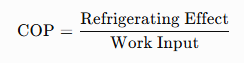
A higher COP indicates a more energy-efficient refrigeration system.
Typically:
- VCRS has a higher COP.
- VARS has a lower COP but can be economical when low-cost or waste heat is available.
Real-World Examples
Vapor Compression
- Home refrigerator
- Split AC
- Window AC
- Car air conditioner
- Supermarket refrigeration
- Ice cream freezer
Vapor Absorption
- Hotel central air conditioning
- Hospital cooling systems
- Solar refrigeration
- Industrial waste-heat cooling
- Large absorption chillers in commercial complexes
Advantages of Refrigeration Systems
- Preserves food and medicines.
- Improves indoor comfort.
- Supports industrial manufacturing.
- Enables cold storage and transportation.
- Increases equipment reliability through cooling.
Limitations
- Electrical refrigeration increases energy consumption.
- Refrigerant leaks may affect the environment if not properly managed.
- Absorption systems require a reliable heat source.
- Initial installation costs can be high for large systems.
Summary Table
| Aspect | Vapor Compression | Vapor Absorption |
|---|---|---|
| Driving Force | Compressor | Heat source |
| Main Energy | Electricity | Thermal energy |
| Efficiency | High | Moderate |
| Noise | Moderate | Low |
| Applications | Domestic and commercial | Industrial and large commercial |
Frequently Asked Questions (FAQs)
1. What is a refrigeration cycle?
A refrigeration cycle is a thermodynamic process in which a refrigerant absorbs heat from a low-temperature space and rejects it to a higher-temperature environment.
2. What are the two main types of refrigeration cycles?
The two main types are:
- Vapor Compression Refrigeration Cycle (VCRS)
- Vapor Absorption Refrigeration Cycle (VARS)
3. What is the main difference between VCRS and VARS?
The Vapor Compression Refrigeration Cycle uses a mechanical compressor powered by electricity, whereas the Vapor Absorption Refrigeration Cycle uses heat energy and replaces the compressor with an absorber, pump, and generator.
4. Which refrigeration cycle is more efficient?
The Vapor Compression Refrigeration Cycle generally has a higher Coefficient of Performance (COP) and is more efficient for most cooling applications.
5. Where is the Vapor Compression Refrigeration Cycle commonly used?
It is used in:
- Domestic refrigerators
- Air conditioners
- Cold storage facilities
- Supermarkets
- Industrial refrigeration plants
6. Where is the Vapor Absorption Refrigeration Cycle commonly used?
It is commonly used in:
- Hotels
- Hospitals
- Large commercial buildings
- Industrial cooling systems
- Solar-powered and waste-heat refrigeration systems
7. What is the role of the evaporator?
The evaporator absorbs heat from the space to be cooled, causing the refrigerant to evaporate into a vapor.
8. Why is an expansion valve needed?
The expansion valve reduces the refrigerant’s pressure and temperature before it enters the evaporator, enabling effective heat absorption.
9. What is COP?
The Coefficient of Performance (COP) is the ratio of the refrigerating effect to the work input. It indicates the energy efficiency of a refrigeration system.
10. Which refrigerants are commonly used in absorption refrigeration systems?
Common refrigerant–absorbent pairs include:
- Water–Lithium Bromide (H₂O–LiBr) for air conditioning.
- Ammonia–Water (NH₃–H₂O) for low-temperature refrigeration.
Conclusion
Refrigeration cycles are essential for transferring heat from a cooler region to a warmer one, making modern cooling and preservation technologies possible. The Vapor Compression Refrigeration Cycle (VCRS) is the most widely used because of its high efficiency, compact size, and fast cooling, making it ideal for homes and commercial applications. The Vapor Absorption Refrigeration Cycle (VARS), while less efficient, is valuable in situations where waste heat, solar energy, or other thermal energy sources are readily available, such as in large commercial and industrial installations. Understanding the operation, components, advantages, and limitations of these cycles helps engineers select the most suitable refrigeration system for a given application.
Other courses:





