
Robotics and automation use intelligent machines and control systems to perform manufacturing tasks efficiently.
They improve productivity, precision, quality, and workplace safety while reducing human error and production time.
These technologies are widely used in automotive, electronics, food processing, and industrial manufacturing.
In this article:
- Robotics and Automation in Modern Manufacturing
- What is Robotics?
- What is Automation?
- Difference Between Robotics and Automation
- Evolution of Manufacturing Automation
- Components of Industrial Robotics
- Types of Industrial Robots
- Types of Automation
- Key Technologies in Modern Manufacturing
- Applications of Robotics and Automation
- Advantages of Robotics and Automation
- Challenges and Limitations
- Future Trends in Robotics and Automation
- Skills Required for Careers in Robotics and Automation
- Career Opportunities
- Summary Table
- Frequently Asked Questions (FAQs)
- Conclusion
Robotics and Automation in Modern Manufacturing
Introduction
Robotics and automation have transformed modern manufacturing by making production processes faster, more accurate, safer, and more efficient. Industries worldwide use robots and automated systems to perform repetitive, complex, and hazardous tasks with high precision. From automobile assembly lines to electronics manufacturing and pharmaceutical production, robotics and automation play a crucial role in increasing productivity and maintaining product quality.
Modern manufacturing is driven by the concepts of Industry 4.0, smart factories, Artificial Intelligence (AI), the Internet of Things (IoT), and digital twins, all of which rely heavily on robotics and automation.
What is Robotics?
Definition
Robotics is the branch of engineering and technology that deals with the design, construction, operation, programming, and maintenance of robots.
A robot is a programmable machine capable of carrying out tasks automatically or with minimal human intervention. Robots can perform operations repeatedly with high accuracy and consistency.
Characteristics of Robots
- Programmable
- Highly accurate
- Repeatable
- Flexible
- Reliable
- Capable of working continuously
- Can operate in hazardous environments
What is Automation?
Definition
Automation is the use of machines, control systems, software, sensors, and computers to perform tasks with little or no human intervention.
The primary goals of automation are to:
- Increase productivity
- Improve product quality
- Reduce production costs
- Enhance workplace safety
- Minimize human errors
Automation may involve mechanical, electrical, electronic, pneumatic, hydraulic, or computer-based systems.
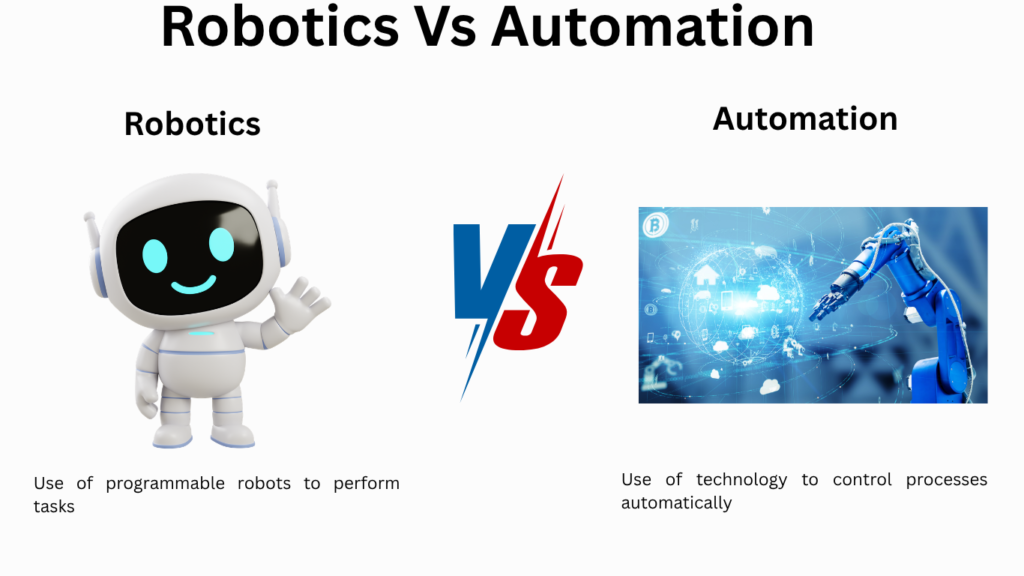
Difference Between Robotics and Automation
| Feature | Robotics | Automation |
|---|---|---|
| Definition | Use of programmable robots to perform tasks | Use of technology to control processes automatically |
| Flexibility | High | Depends on the system |
| Human Involvement | Minimal | Low to moderate |
| Main Components | Robot, controller, sensors, actuators | Sensors, controllers, PLCs, software, machines |
| Applications | Welding, assembly, material handling | Production lines, packaging, process control |
Evolution of Manufacturing Automation
1. Manual Manufacturing
- Human labor performed most tasks.
- Low productivity.
- Higher chances of errors.
2. Mechanized Manufacturing
- Machines assisted workers.
- Increased production capacity.
- Reduced physical effort.
3. Automated Manufacturing
- Machines performed repetitive tasks automatically.
- Higher speed and consistency.
- Lower dependence on manual labor.
4. Smart Manufacturing (Industry 4.0)
- Connected machines
- AI-based decision-making
- IoT-enabled devices
- Cloud computing
- Real-time monitoring
- Predictive maintenance
Components of Industrial Robotics
1. Robot Manipulator
The mechanical structure consisting of links and joints that allows movement.
2. End Effector
The tool attached to the robot arm for performing a specific task.
Examples:
- Grippers
- Welding torches
- Spray guns
- Vacuum cups
- Cutting tools
3. Controller
The robot’s “brain” that processes instructions and controls movements.
4. Sensors
Sensors collect information from the environment.
Examples:
- Vision cameras
- Force sensors
- Proximity sensors
- Temperature sensors
- Position sensors
5. Actuators
Actuators convert energy into mechanical motion.
Types:
- Electric motors
- Hydraulic actuators
- Pneumatic actuators
Types of Industrial Robots
1. Articulated Robots
- Multiple rotating joints
- High flexibility
- Most common industrial robot
Applications:
- Welding
- Painting
- Assembly
2. SCARA Robots
Selective Compliance Assembly Robot Arm
Applications:
- Electronic assembly
- Pick-and-place operations
- Packaging
Advantages:
- High speed
- Excellent accuracy
3. Cartesian Robots
Move along X, Y, and Z axes.
Applications:
- CNC machines
- 3D printing
- Material handling
4. Delta Robots
Lightweight robots designed for very high-speed operations.
Applications:
- Food packaging
- Sorting
- Pharmaceutical industries
5. Collaborative Robots (Cobots)
Designed to safely work alongside humans without extensive physical barriers.
Applications:
- Small assembly tasks
- Inspection
- Machine tending
- Packaging
Advantages:
- Safe
- Easy to program
- Flexible deployment
Types of Automation
1. Fixed Automation
Designed for high-volume production of standardized products.
Examples:
- Automotive assembly lines
- Bottling plants
Advantages:
- High production rate
- Low cost per unit
Limitations:
- Low flexibility
2. Programmable Automation
Equipment can be reprogrammed for different production batches.
Examples:
- CNC machines
- Industrial robots
Advantages:
- Moderate flexibility
3. Flexible Automation
Allows quick changes between different products with minimal downtime.
Examples:
- Flexible manufacturing systems (FMS)
- Smart production lines
Advantages:
- High flexibility
- Efficient for varying product designs
Key Technologies in Modern Manufacturing
Artificial Intelligence (AI)
AI enables machines to:
- Detect defects
- Optimize production schedules
- Predict equipment failures
- Improve quality control
Internet of Things (IoT)
IoT connects machines through networks for:
- Real-time monitoring
- Data collection
- Remote diagnostics
- Process optimization
Digital Twins
A digital twin is a virtual representation of a physical machine or process.
Applications:
- Simulation
- Predictive maintenance
- Performance optimization
Machine Vision
Uses cameras and image processing for:
- Inspection
- Quality control
- Barcode reading
- Object recognition
Additive Manufacturing (3D Printing)
Builds components layer by layer.
Benefits:
- Rapid prototyping
- Customized products
- Reduced material waste
Applications of Robotics and Automation
Automotive Industry
- Welding
- Painting
- Assembly
- Material handling
- Inspection
Electronics Industry
- PCB assembly
- Component placement
- Testing
- Packaging
Food and Beverage Industry
- Packaging
- Sorting
- Palletizing
- Quality inspection
Pharmaceutical Industry
- Medicine packaging
- Sterile handling
- Laboratory automation
Aerospace Industry
- Composite manufacturing
- Drilling
- Riveting
- Inspection
Warehousing and Logistics
- Automated storage systems
- Autonomous mobile robots (AMRs)
- Order picking
- Inventory management
Metal Manufacturing
- CNC machining
- Laser cutting
- Robotic welding
- Surface finishing
Advantages of Robotics and Automation
Increased Productivity
Robots can operate continuously, often 24/7, reducing production time.
Improved Product Quality
Automation minimizes human error and ensures consistent quality.
Higher Precision
Robots perform tasks with excellent accuracy and repeatability.
Enhanced Workplace Safety
Robots can perform hazardous tasks such as:
- Welding
- Chemical handling
- Heavy lifting
- High-temperature operations
Lower Production Costs
Although the initial investment may be high, automation can reduce long-term labor, scrap, and maintenance costs.
Greater Flexibility
Modern robots can be reprogrammed to handle different products and processes.
Challenges and Limitations
- High initial investment
- Skilled workforce required for programming and maintenance
- Cybersecurity risks in connected factories
- Maintenance and software updates
- Potential job displacement for repetitive manual tasks
- Integration challenges with existing systems
Future Trends in Robotics and Automation
Artificial Intelligence Integration
AI-powered robots will make more autonomous decisions and adapt to changing production conditions.
Collaborative Robots (Cobots)
Cobots will become more common in small and medium-sized industries because of their flexibility and ease of use.
Autonomous Mobile Robots (AMRs)
AMRs will increasingly transport materials within factories without fixed guide paths.
Digital Twin Technology
Virtual models will be used to simulate production systems, optimize performance, and reduce downtime.
5G Connectivity
High-speed communication will support real-time control and coordination of robots and machines.
Sustainable Manufacturing
Automation will help reduce:
- Energy consumption
- Material waste
- Carbon emissions
Skills Required for Careers in Robotics and Automation
Technical Skills
- Robotics fundamentals
- PLC programming
- Industrial automation
- CAD software
- Sensors and actuators
- CNC programming
- Mechatronics
- Machine vision
- AI and IoT basics
- Programming (e.g., Python or C++)
Soft Skills
- Problem-solving
- Communication
- Teamwork
- Analytical thinking
- Adaptability
- Continuous learning
Career Opportunities
Professionals can work as:
- Robotics Engineer
- Automation Engineer
- PLC Programmer
- Mechatronics Engineer
- Controls Engineer
- Industrial Automation Specialist
- Manufacturing Engineer
- Maintenance Engineer
- Machine Vision Engineer
- Systems Integration Engineer
Summary Table
| Aspect | Robotics | Automation |
|---|---|---|
| Purpose | Perform physical tasks | Automate processes |
| Main Components | Robots, sensors, controllers | PLCs, sensors, software, machines |
| Flexibility | High | Varies by system |
| Applications | Welding, assembly, packaging | Production lines, process control |
| Benefits | Precision, safety, speed | Efficiency, consistency, cost reduction |
Frequently Asked Questions (FAQs)
1. What is the difference between robotics and automation?
Robotics focuses on programmable machines (robots) that perform physical tasks, while automation is the broader concept of using technology to control and optimize processes with minimal human intervention.
2. What is Industry 4.0?
Industry 4.0 is the fourth industrial revolution, characterized by smart factories that integrate AI, IoT, robotics, cloud computing, and data analytics to create highly connected and efficient manufacturing systems.
3. What are collaborative robots (cobots)?
Collaborative robots are designed to work safely alongside humans, assisting with tasks such as assembly, machine tending, and inspection without requiring extensive safety barriers.
4. Which industries use robotics the most?
Major users include:
- Automotive
- Electronics
- Aerospace
- Food and beverage
- Pharmaceuticals
- Logistics and warehousing
- Metal manufacturing
5. What are the advantages of automation?
Automation improves:
- Productivity
- Product quality
- Precision
- Workplace safety
- Cost efficiency
- Production consistency
6. Do robots replace human workers?
Robots primarily replace repetitive, hazardous, and physically demanding tasks. At the same time, they create new opportunities in robot programming, maintenance, system integration, and process optimization. Human skills remain essential for design, supervision, decision-making, and innovation.
7. What skills are important for a career in robotics?
Important skills include robotics fundamentals, PLC programming, CAD, mechatronics, sensors, automation, machine vision, and basic programming, along with strong problem-solving and communication abilities.
8. What is a digital twin?
A digital twin is a virtual representation of a physical machine or process used for simulation, monitoring, predictive maintenance, and performance optimization.
9. What role does AI play in manufacturing?
AI helps manufacturers by:
- Predicting equipment failures
- Detecting product defects
- Optimizing production schedules
- Improving quality control
- Supporting autonomous decision-making
10. What is the future of robotics and automation?
The future includes greater use of AI-powered robots, collaborative robots, autonomous mobile robots, digital twins, 5G-enabled factories, and sustainable manufacturing, making production systems more intelligent, efficient, and adaptable.
Conclusion
Robotics and automation are at the heart of modern manufacturing, enabling industries to produce high-quality products with greater speed, precision, and efficiency. From industrial robots and collaborative robots to AI, IoT, and digital twins, these technologies are transforming traditional factories into smart, connected production environments. While automation presents challenges such as high initial investment and the need for skilled professionals, its long-term benefits in productivity, safety, quality, and sustainability make it a cornerstone of manufacturing in 2026 and beyond. Engineers who develop expertise in robotics, automation, and digital technologies will be well prepared for the evolving demands of the global manufacturing industry.
Other courses:





