
Thermodynamics is the study of heat, energy, and how they are transferred or transformed.
It is based on four fundamental laws that explain the conservation of energy and the direction of natural processes.
These principles are widely used in physics, engineering, chemistry, and everyday life.
In this article:
- Fundamental Principles of Thermodynamics for Beginners
- What is Thermodynamics?
- Basic Concepts of Thermodynamics
- Forms of Energy
- The Four Laws of Thermodynamics
- Important Thermodynamic Processes
- Applications of Thermodynamics
- Advantages of Studying Thermodynamics
- Limitations
- Real-Life Examples
- Summary Table
- Frequently Asked Questions (FAQs)
- Conclusion
Fundamental Principles of Thermodynamics for Beginners
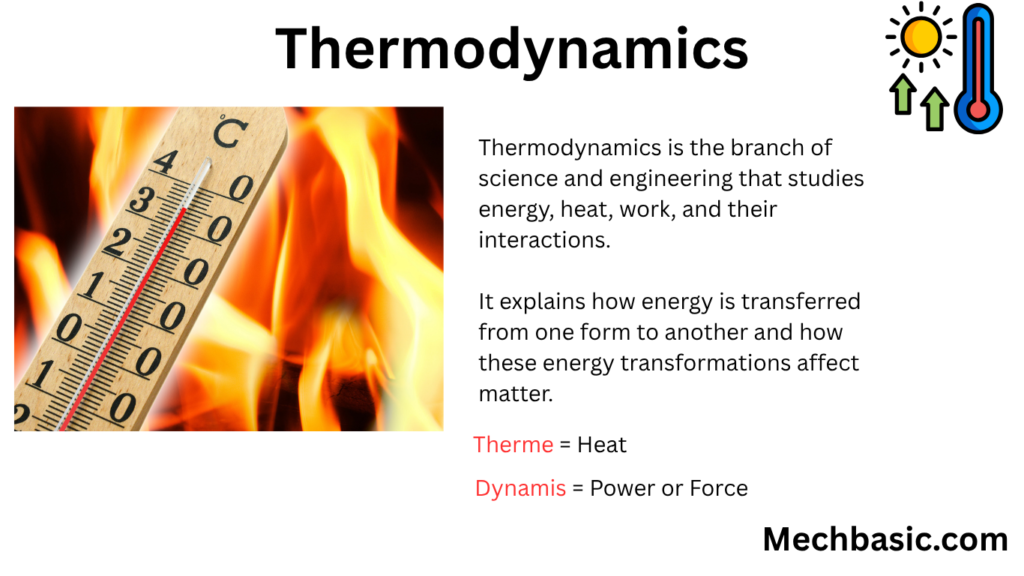
Thermodynamics is the branch of science and engineering that studies energy, heat, work, and their interactions. It explains how energy is transferred from one form to another and how these energy transformations affect matter.
The word thermodynamics comes from two Greek words:
- Therme = Heat
- Dynamis = Power or Force
Thermodynamics is one of the most important subjects in mechanical engineering, chemical engineering, civil engineering, electrical engineering, aerospace engineering, and many other scientific fields.
Everyday Examples
- Boiling water in a kettle
- Refrigerator cooling food
- Air conditioner cooling a room
- Car engine producing power
- Steam turbine generating electricity
- Human body converting food into energy
What is Thermodynamics?
Definition
Thermodynamics is the science that deals with the relationship between heat, work, temperature, and energy, and the laws governing the conversion of one form of energy into another.
It helps engineers answer questions such as:
- How does an engine produce power?
- Why does heat always flow from hot to cold?
- How efficient is a power plant?
- Why can’t energy be created from nothing?
Basic Concepts of Thermodynamics
1. System
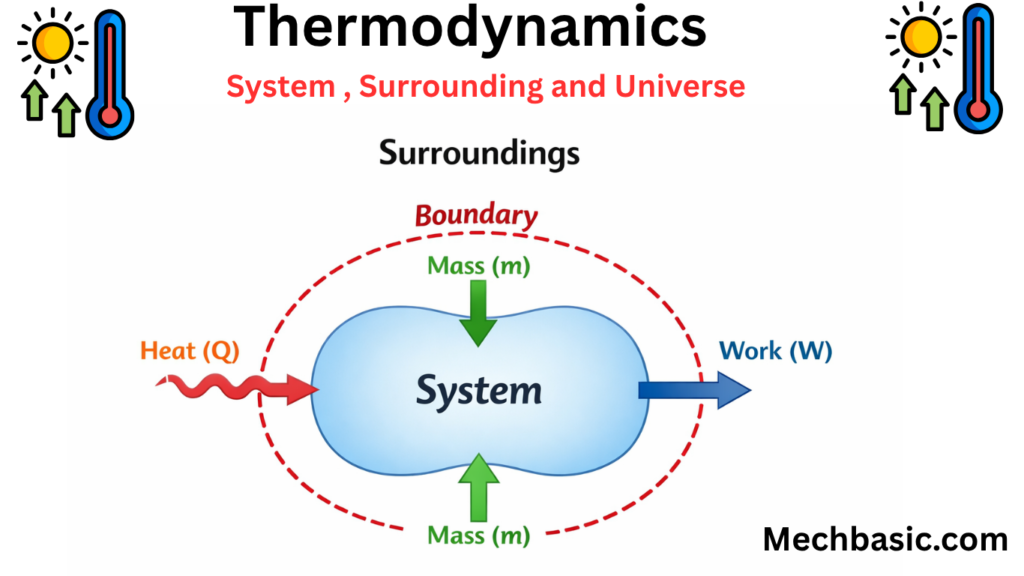
A system is the part of the universe chosen for study.
Everything outside the system is called the surroundings.
Example
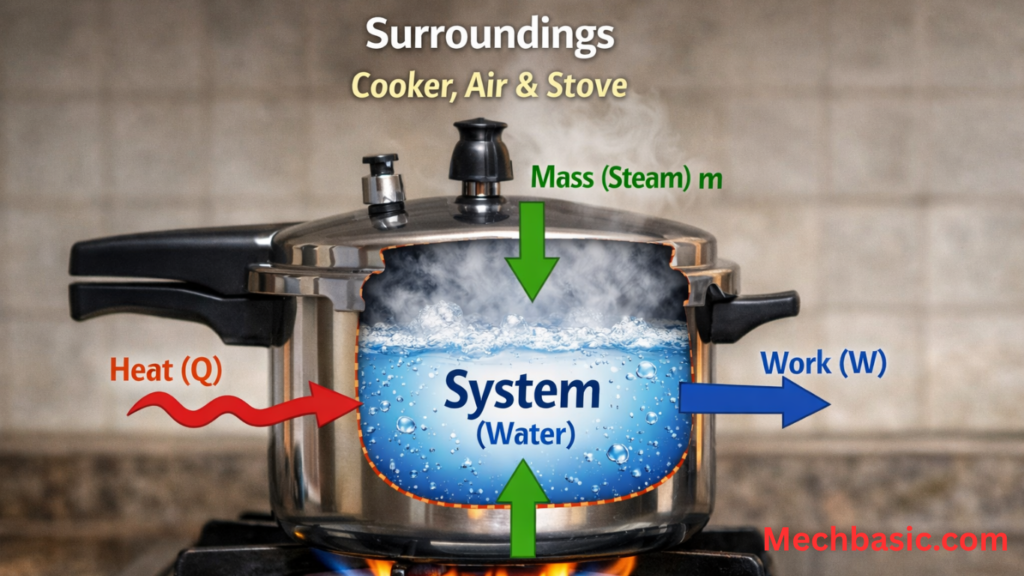
A pressure cooker placed on a stove:
- Water inside = System
- Cooker body, air, and stove = Surroundings
Types of Systems
Open System
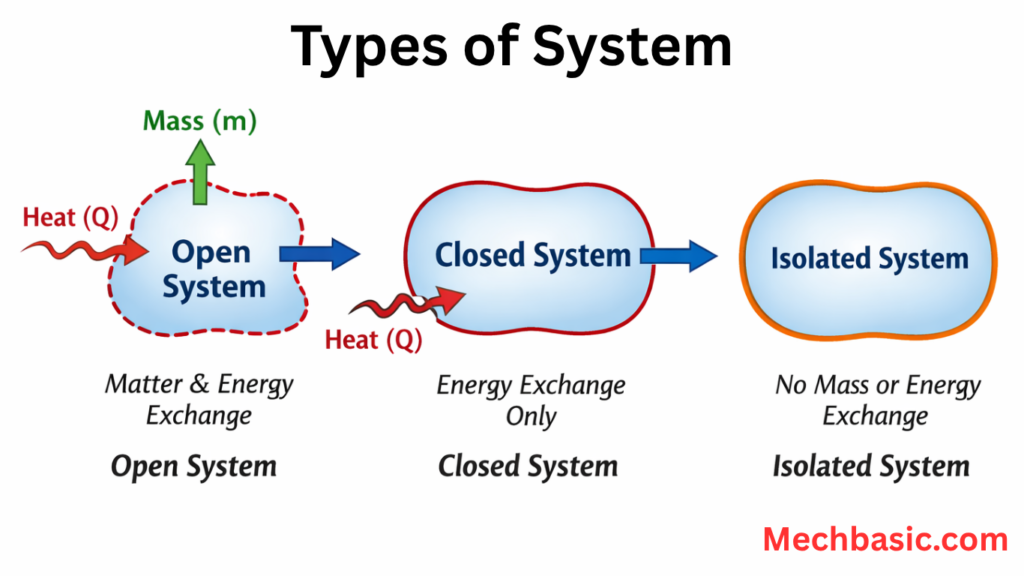
An open system allows both mass and energy to cross its boundary.
Examples
- Steam turbine
- Boiler
- Compressor
- Pump
Closed System
A closed system allows energy transfer but no mass transfer.
Example
Gas enclosed inside a sealed piston-cylinder.
Isolated System
Neither mass nor energy crosses the boundary.
Example
An ideal thermos flask (approximately isolated).
2. Surroundings
Everything outside the system boundary is called the surroundings.
Example:
If a gas inside a cylinder is the system, the cylinder walls, piston, and outside air are the surroundings.
3. Boundary
The boundary separates the system from its surroundings.
It may be:
- Fixed
- Moving
- Real
- Imaginary
4. Property
A property is any measurable characteristic of a system.
Examples:
- Pressure
- Temperature
- Volume
- Density
- Internal energy
- Enthalpy
- Entropy
5. State
The state of a system is its condition at a particular moment.
A system is completely defined when all its properties are known.
Example:
- Pressure = 2 bar
- Temperature = 150°C
- Volume = 0.02 m³
6. Process
A process is any change in the state of a system.
Examples:
- Heating water
- Compressing air
- Cooling steam
7. Cycle
A thermodynamic cycle is a series of processes that returns the system to its original state.
Examples:
- Otto cycle
- Diesel cycle
- Rankine cycle
- Refrigeration cycle
Forms of Energy
Internal Energy (U)
Energy stored within a substance due to the motion and interaction of its molecules.
Example
Hot water has more internal energy than cold water.
Heat (Q)
Heat is energy transferred because of a temperature difference.
Heat always flows from a higher-temperature body to a lower-temperature body until thermal equilibrium is reached.
Units
- Joule (J)
- Kilojoule (kJ)
Work (W)
Work is energy transferred when a force causes displacement.
Examples
- Gas pushing a piston
- Steam rotating a turbine
Units
- Joule (J)
Temperature
Temperature indicates the degree of hotness or coldness of a body.
Common scales:
- Celsius (°C)
- Kelvin (K)
- Fahrenheit (°F)
Conversion
K = °C + 273.15
Pressure
Pressure is the force acting per unit area.
P = F/A
Unit:
- Pascal (Pa)
The Four Laws of Thermodynamics
Zeroth Law of Thermodynamics
Statement
If two systems are each in thermal equilibrium with a third system, they are also in thermal equilibrium with each other.
Significance
- Forms the basis of temperature measurement.
- Explains how thermometers work.
Example
If a thermometer shows the same temperature when placed in two different containers, those containers are at the same temperature.
First Law of Thermodynamics (Law of Energy Conservation)
Statement
Energy can neither be created nor destroyed. It can only be transformed from one form to another.
For a closed system:
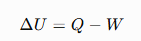
where:
- Delta U= Change in internal energy
- (Q) = Heat added to the system
- (W) = Work done by the system
Example
Heating a gas in a cylinder:
- Some heat increases internal energy.
- The remaining energy performs work by moving the piston.
Applications
- Internal combustion engines
- Boilers
- Turbines
- Compressors
Second Law of Thermodynamics
Statement
Heat naturally flows from a hot body to a cold body and not in the reverse direction without external work.
Key Concepts
- No heat engine is 100% efficient.
- Every energy conversion involves losses.
- Introduces the concept of entropy.
Example
A hot cup of coffee cools to room temperature naturally; it never becomes hotter by absorbing heat from cooler surroundings.
Applications
- Refrigerators
- Air conditioners
- Power plants
- Heat pumps
Third Law of Thermodynamics
Statement
As the temperature of a perfect crystal approaches absolute zero (0 K), its entropy approaches zero.
Importance
- Defines the absolute zero of temperature.
- Useful in cryogenics and low-temperature physics.
Important Thermodynamic Processes
Isothermal Process
- Temperature remains constant.
- Heat transfer occurs to maintain constant temperature.
Example
Slow compression of a gas.
Adiabatic Process
- No heat enters or leaves the system.
Example
Rapid compression in a diesel engine.
Isobaric Process
- Pressure remains constant.
Example
Heating water in an open vessel.
Isochoric Process
- Volume remains constant.
Example
Heating gas in a rigid sealed container.
Applications of Thermodynamics
Mechanical Engineering
- Engines
- Turbines
- Boilers
- Refrigeration
- HVAC systems
Electrical Engineering
- Thermal power plants
- Generators
- Cooling systems
Chemical Engineering
- Chemical reactors
- Distillation
- Heat exchangers
Civil Engineering
- Building energy efficiency
- HVAC design
Aerospace Engineering
- Jet engines
- Rocket propulsion
- Gas turbines
Biomedical Engineering
- Human metabolism
- Medical refrigeration
- Sterilization equipment
Advantages of Studying Thermodynamics
- Helps design efficient engines.
- Improves energy conservation.
- Enhances industrial productivity.
- Reduces fuel consumption.
- Supports renewable energy technologies.
- Improves refrigeration and air conditioning systems.
Limitations
- Thermodynamics predicts equilibrium states but not the speed of a process.
- It deals with macroscopic systems and does not describe individual molecular behavior.
- Practical systems always experience energy losses due to friction and other irreversibilities.
Real-Life Examples
- Cooking food in a pressure cooker.
- Ice melting in a drink.
- Refrigerator removing heat from food.
- Air conditioner cooling a room.
- Steam turbines generating electricity.
- Automobile engines converting fuel into motion.
- Solar water heaters warming water.
Summary Table
| Principle | Description | Example |
|---|---|---|
| Zeroth Law | Defines thermal equilibrium | Thermometer measuring temperature |
| First Law | Energy is conserved | Engine converting fuel energy into work |
| Second Law | Heat flows from hot to cold; entropy increases | Coffee cooling to room temperature |
| Third Law | Entropy approaches zero at 0 K | Cryogenic systems |
Frequently Asked Questions (FAQs)
1. What is thermodynamics?
Thermodynamics is the branch of science that studies heat, work, energy, temperature, and their interactions.
2. Why is thermodynamics important?
It helps engineers design and analyze engines, refrigerators, power plants, air conditioners, turbines, and many other energy-conversion systems.
3. What are the four laws of thermodynamics?
- Zeroth Law – Thermal equilibrium.
- First Law – Conservation of energy.
- Second Law – Heat flows naturally from hot to cold; entropy increases.
- Third Law – Entropy of a perfect crystal approaches zero at absolute zero.
4. What is the difference between heat and temperature?
- Heat is energy transferred due to a temperature difference.
- Temperature measures how hot or cold a body is.
5. What is a thermodynamic system?
A thermodynamic system is the portion of the universe selected for analysis, separated from its surroundings by a boundary.
6. What are the three types of thermodynamic systems?
- Open system: Exchanges both mass and energy.
- Closed system: Exchanges energy but not mass.
- Isolated system: Exchanges neither mass nor energy.
7. What is internal energy?
Internal energy is the total microscopic energy stored within a substance due to the motion and interactions of its molecules.
8. What is entropy?
Entropy is a measure of the disorder or randomness of a system and indicates the direction of natural processes.
9. Can energy be created or destroyed?
No. According to the First Law of Thermodynamics, energy can only be transformed from one form to another.
10. What is an example of thermodynamics in daily life?
Examples include boiling water, cooking in a pressure cooker, refrigeration, air conditioning, automobile engines, and power generation.
Conclusion
Thermodynamics is a fundamental branch of engineering and physics that explains how energy, heat, and work interact. Its four laws govern the behavior of all energy-conversion systems, from simple household appliances to complex industrial power plants. A solid understanding of thermodynamic principles enables engineers and scientists to design more efficient machines, conserve energy, improve industrial processes, and develop sustainable technologies. Mastering these concepts provides a strong foundation for advanced studies in mechanical, chemical, civil, electrical, and aerospace engineering.
Other courses:





