
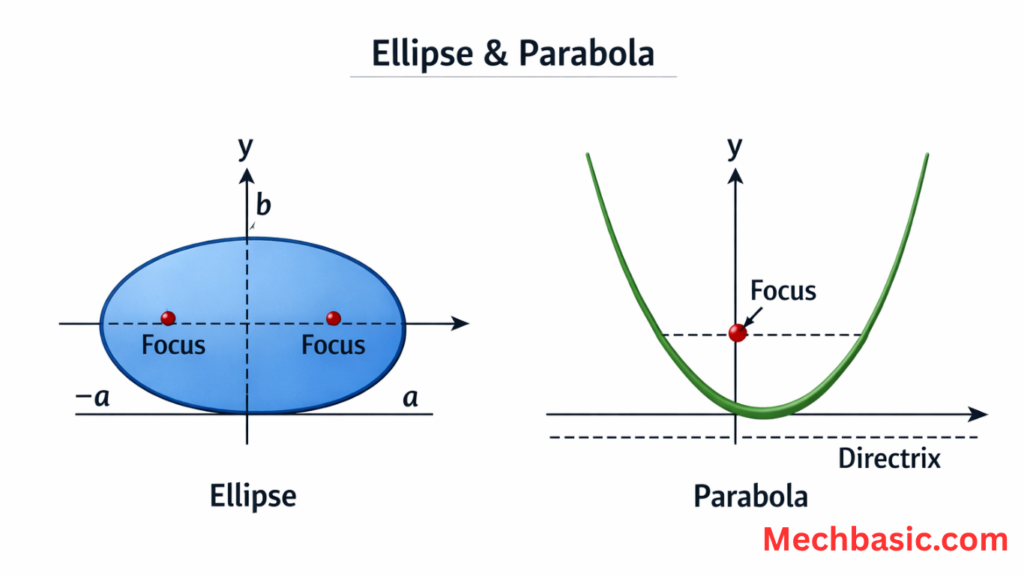
- Ellipse: A closed curve with two foci and eccentricity less than 1.
- Parabola: An open curve with one focus and eccentricity equal to 1.
- An ellipse forms a closed shape, while a parabola extends infinitely in one direction.
In this article:
- Ellipse vs Parabola
- What is an Ellipse?
- What is a Parabola?
- Formation of the Curves
- Shape Comparison
- Comparison of Properties
- Eccentricity
- Focus Comparison
- Directrix Comparison
- Vertex Comparison
- Axis Comparison
- Standard Equations
- Reflection Property
- Engineering Applications
- Advantages
- Similarities
- Key Differences
- Real-Life Examples
- Interview Questions
- Conclusion
Ellipse vs Parabola
An ellipse and a parabola are two important conic sections, formed when a plane intersects a right circular cone at different angles. Although both are smooth curves and have focus-directrix properties, they differ in shape, equation, eccentricity, number of foci, directrices, and practical applications.
What is an Ellipse?
An ellipse is a closed, oval-shaped curve in which the sum of the distances from any point on the curve to two fixed points (called foci) is constant.
Key Characteristics
- Closed curve
- Two foci
- Two directrices
- One major axis and one minor axis
- Eccentricity is less than 1
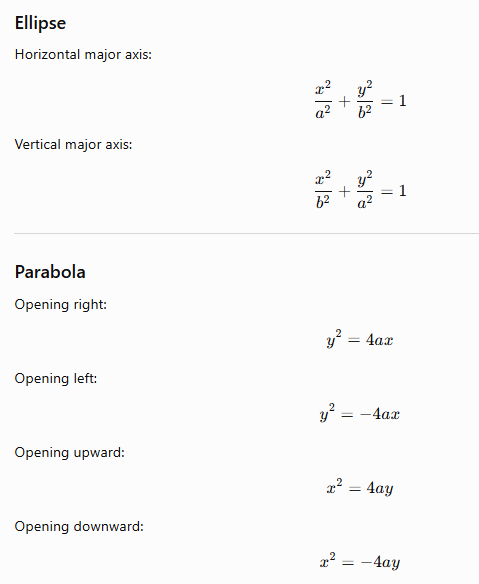
Standard Equation (Horizontal Major Axis)
where (a>b).
What is a Parabola?
A parabola is an open U-shaped curve consisting of all points that are equidistant from a fixed point (focus) and a fixed straight line (directrix).
Key Characteristics
- Open curve
- One focus
- One directrix
- One vertex
- One axis of symmetry
- Eccentricity equals 1
Standard Equation (Opening to the Right)
y2=4ax
Formation of the Curves
Ellipse
An ellipse is formed when a plane cuts a cone at an angle greater than the angle between the side of the cone and its axis, but does not pass through the base.
Result: Closed curve
Parabola
A parabola is formed when a plane cuts a cone parallel to one side (generator) of the cone.
Result: Open curve
Shape Comparison
| Ellipse | Parabola |
|---|---|
| Closed oval curve | Open U-shaped curve |
| Finite boundary | Extends infinitely |
| Resembles a stretched circle | Opens in one direction |
Comparison of Properties
| Property | Ellipse | Parabola |
|---|---|---|
| Nature | Closed | Open |
| Shape | Oval | U-shaped |
| Number of Foci | 2 | 1 |
| Number of Directrices | 2 | 1 |
| Number of Vertices | 2 major vertices and 2 co-vertices | 1 vertex |
| Axes | Major and Minor | Axis of symmetry |
| Eccentricity | (0<e<1) | (e=1) |
| Infinite Curve | No | Yes |
Eccentricity
The eccentricity ((e)) distinguishes the two curves.
Ellipse
0<e<1
- Smaller (e): nearly circular
- Larger (e): more elongated
Parabola
e=1
The distance from any point on the parabola to the focus equals its perpendicular distance to the directrix.
Focus Comparison
Ellipse
- Two foci
- Both lie inside the ellipse
- The sum of the distances from any point on the ellipse to the two foci is constant
Parabola
- One focus
- Every point is equidistant from the focus and the directrix
Directrix Comparison
| Ellipse | Parabola |
|---|---|
| Two directrices | One directrix |
Vertex Comparison
Ellipse
Has:
- Two major vertices
- Two co-vertices
Total important points on the axes: 4
Parabola
Has only one vertex, which is the turning point of the curve.
Axis Comparison
Ellipse
- Major axis
- Minor axis
Parabola
- One axis of symmetry
Standard Equations
Reflection Property
Ellipse
A ray originating from one focus reflects off the ellipse and passes through the other focus.
Applications
- Whispering galleries
- Optical systems
- Elliptical mirrors
Parabola
A ray parallel to the axis reflects through the focus.
Conversely, a ray from the focus reflects parallel to the axis.
Applications
- Satellite dishes
- Car headlights
- Solar cookers
- Reflecting telescopes
Engineering Applications
Ellipse
Used in:
- Planetary orbits
- Elliptical gears
- Machine cams
- Bridges
- Arches
- Domes
- CAD models
- Acoustic chambers
Parabola
Used in:
- Satellite antennas
- Radio telescopes
- Searchlights
- Vehicle headlights
- Solar concentrators
- Suspension bridge cables
Advantages
Ellipse
- Attractive shape
- Efficient load distribution
- Excellent sound and light reflection between the two foci
- Useful in structural engineering
Parabola
- Outstanding focusing ability
- Efficient collection and reflection of light and radio waves
- Ideal for communication systems
Similarities
- Both are conic sections.
- Both are defined using a focus and a directrix.
- Both are symmetric curves.
- Both are widely used in engineering, mathematics, and architecture.
- Both have well-defined mathematical equations.
Key Differences
| Feature | Ellipse | Parabola |
|---|---|---|
| Curve Type | Closed | Open |
| Shape | Oval | U-shaped |
| Number of Foci | 2 | 1 |
| Number of Directrices | 2 | 1 |
| Eccentricity | (0<e<1) | (e=1) |
| Number of Vertices | 2 major vertices and 2 co-vertices | 1 vertex |
| Major and Minor Axes | Present | Not present |
| Reflection Property | Rays from one focus reflect to the other focus | Parallel rays reflect through the focus |
| Typical Applications | Planetary orbits, arches, gears | Satellite dishes, headlights, telescopes |
Real-Life Examples
Ellipse
- Earth’s orbit around the Sun
- Oval athletics tracks
- Elliptical conference tables
- Elliptical arches and domes
- Whispering galleries
Parabola
- Satellite TV dishes
- Car headlight reflectors
- Solar cookers
- Flashlights
- Reflecting telescopes
Interview Questions
1. What is the main difference between an ellipse and a parabola?
An ellipse is a closed curve with two foci and an eccentricity less than 1, while a parabola is an open curve with one focus and an eccentricity equal to 1.
2. Which conic section has one focus?
The parabola.
3. Which conic section has two foci?
The ellipse.
4. Which conic section is used in satellite dishes?
The parabola, because parallel rays are reflected through its focus.
5. Which conic section represents planetary orbits?
The ellipse, as described by Kepler’s First Law of Planetary Motion.
Conclusion
The ellipse and parabola are two important conic sections with distinct geometric properties and applications. An ellipse is a closed oval-shaped curve with two foci, two directrices, and an eccentricity between 0 and 1, making it suitable for planetary orbits, architectural arches, and acoustic systems. A parabola is an open U-shaped curve with one focus, one directrix, and an eccentricity of 1, making it ideal for devices that require accurate focusing or reflection of light, sound, or radio waves, such as satellite dishes, telescopes, and headlights. Understanding these differences is fundamental in engineering drawing, mathematics, physics, and engineering design.
Other courses:





