
A heat engine is a device that converts heat energy into useful mechanical work.
It works by absorbing heat from a hot source, converting part of it into work, and releasing the remaining heat to a cold sink.
Examples : car engines, steam turbines, and power plant turbines.
In this article:
- How Do Heat Engines Work?
- What is a Heat Engine?
- Basic Principle of a Heat Engine
- Main Components of a Heat Engine
- Working of a Heat Engine (Step-by-Step)
- Energy Flow in a Heat Engine
- Why Can't a Heat Engine Be 100% Efficient?
- Thermal Efficiency of a Heat Engine
- Types of Heat Engines
- Real-Life Examples
- Applications of Heat Engines
- Advantages of Heat Engines
- Limitations of Heat Engines
- Comparison: Internal vs External Combustion Engines
- Everyday Examples of Heat Engines
- Frequently Asked Questions (FAQs)
- Conclusion
How Do Heat Engines Work?
Introduction
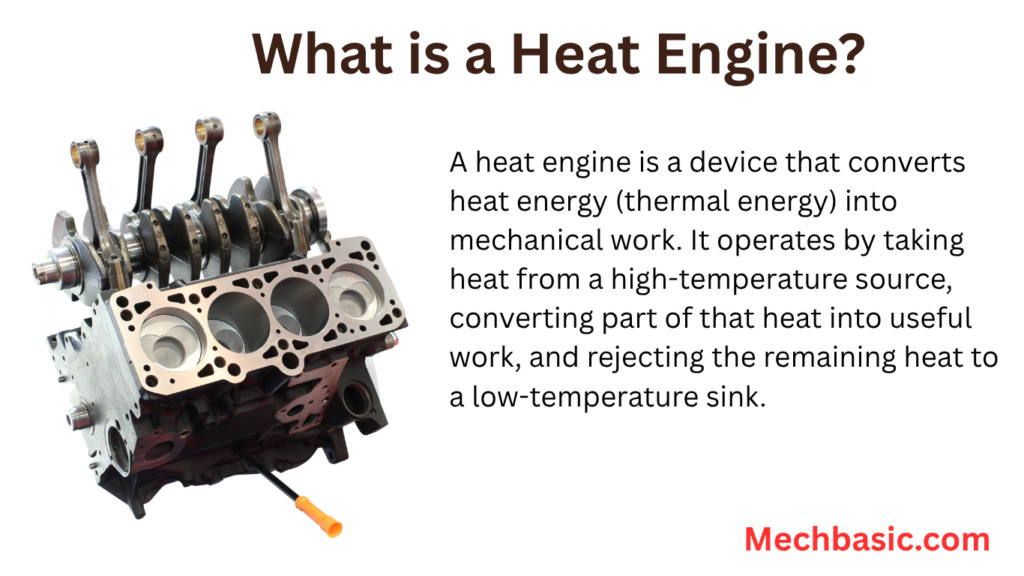
A heat engine is a device that converts heat energy (thermal energy) into mechanical work. It operates by taking heat from a high-temperature source, converting part of that heat into useful work, and rejecting the remaining heat to a low-temperature sink.
Heat engines are the backbone of modern civilization and are found in:
- Automobiles
- Motorcycles
- Steam power plants
- Aircraft engines
- Ships
- Diesel locomotives
- Industrial power generation
The operation of heat engines is based primarily on the First Law of Thermodynamics (Conservation of Energy) and the Second Law of Thermodynamics, which states that no heat engine can convert all absorbed heat into useful work.
What is a Heat Engine?
Definition
A heat engine is a thermodynamic device that:
- Absorbs heat from a high-temperature source.
- Converts part of the absorbed heat into mechanical work.
- Rejects the remaining heat to a low-temperature sink.
- Repeats the process continuously in a cycle.
Basic Principle of a Heat Engine
A heat engine works because heat naturally flows from a hotter body to a colder body. During this transfer, some of the thermal energy is converted into mechanical work.
The engine operates continuously by repeating a thermodynamic cycle.
Main Components of a Heat Engine
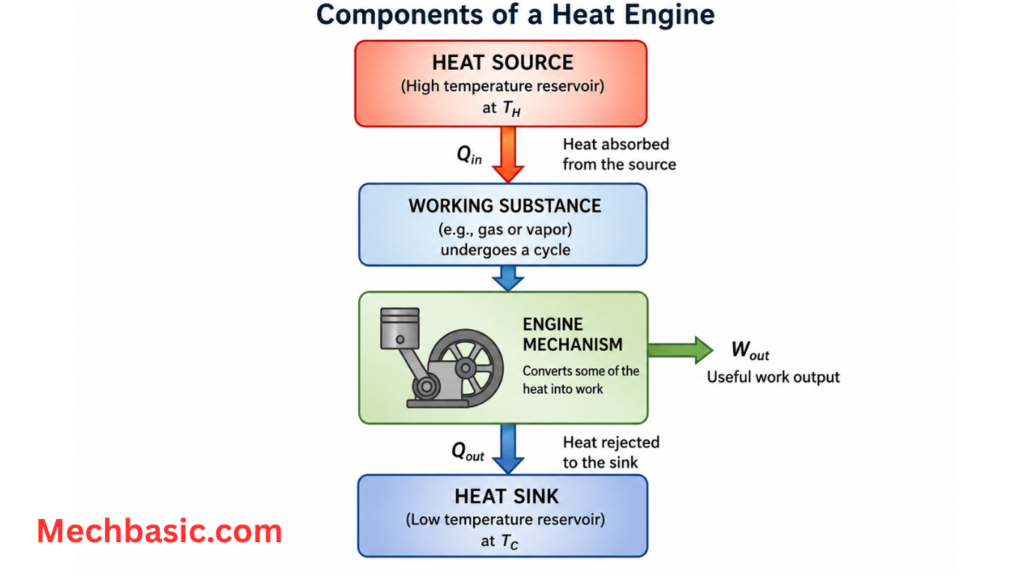
1. Heat Source (High-Temperature Reservoir)
The heat source supplies thermal energy to the engine.
Examples:
- Burning petrol
- Burning diesel
- Coal furnace
- Nuclear reactor
- Solar concentrator
- Biomass combustion
Function
Provides heat energy ((Q_H)).
2. Working Substance
The working substance absorbs heat and performs work.
Examples:
- Steam
- Air
- Combustion gases
- Refrigerant gases (in reverse cycles)
Function
Converts thermal energy into mechanical energy.
3. Engine Mechanism
This converts the energy of the working substance into useful work.
Examples:
- Piston and cylinder
- Turbine blades
- Rotors
Output
Mechanical work ((W))
4. Heat Sink (Low-Temperature Reservoir)
The sink absorbs the unused heat rejected by the engine.
Examples:
- Atmosphere
- Cooling water
- Cooling towers
- Radiators
Function
Receives rejected heat ((Q_C)).
Working of a Heat Engine (Step-by-Step)
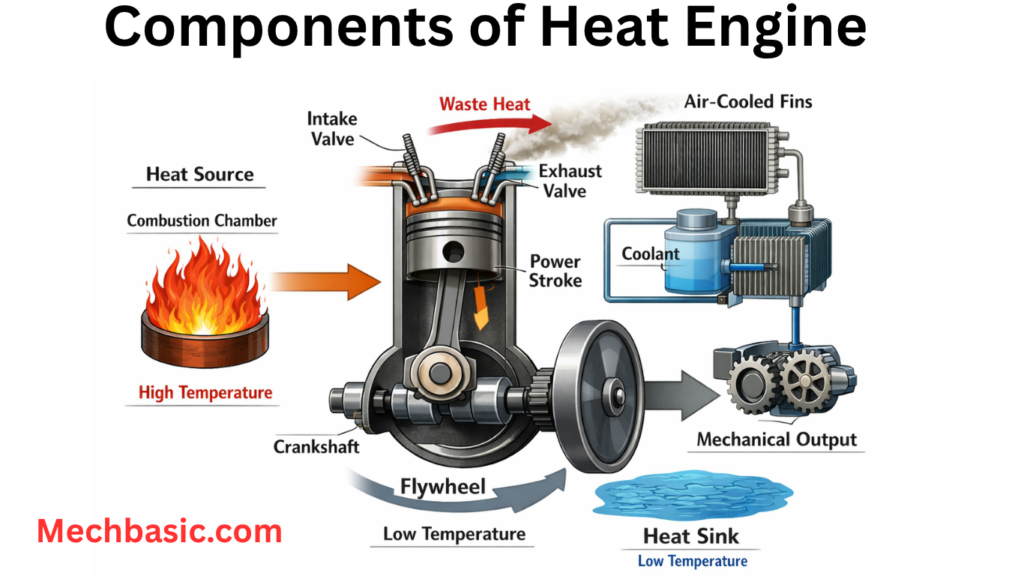
Step 1: Heat is Supplied
Fuel burns in the combustion chamber or boiler.
Examples:
- Petrol burns inside a car engine.
- Coal burns inside a boiler.
The fuel releases heat.
Step 2: Working Substance Absorbs Heat
The working fluid absorbs thermal energy.
Examples:
- Air-fuel mixture in an engine.
- Steam in a steam turbine.
Its:
- Temperature increases.
- Pressure increases.
- Internal energy increases.
Step 3: Expansion Produces Work
The hot, high-pressure fluid expands.
Expansion causes:
- Pistons to move.
- Turbines to rotate.
This produces useful mechanical work.
Examples:
- Car wheels rotate.
- Electric generators rotate.
- Ship propellers rotate.
Step 4: Heat Rejection
After expansion, the working fluid still contains unused heat.
This heat is rejected to:
- Cooling water
- Air
- Radiator
This rejected heat is called waste heat.
Step 5: Cycle Repeats
The working fluid returns to its initial state.
The entire process repeats continuously.
Energy Flow in a Heat Engine
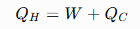
The energy balance for a heat engine is:
where:
- (QH) = Heat supplied by the source
- (W) = Useful work produced
- (QC) = Heat rejected to the sink
This equation follows the First Law of Thermodynamics, showing that the input heat equals the sum of useful work and rejected heat.
Why Can’t a Heat Engine Be 100% Efficient?
According to the Second Law of Thermodynamics:
- Some heat must always be rejected to the surroundings.
- No engine can convert all heat into work.
- Friction, heat losses, and irreversibilities reduce efficiency.
Therefore:
W < QH
Thermal Efficiency of a Heat Engine
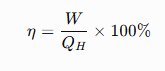
Thermal efficiency measures how effectively a heat engine converts heat into work.
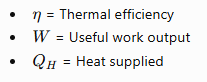
The efficiency is given by:
where:
Example
If an engine receives:
- Heat supplied = 1000 kJ
- Work produced = 400 kJ
Then:
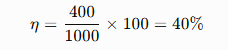
This means 40% of the supplied heat is converted into useful work, while the remaining 60% is rejected as waste heat.
Types of Heat Engines
1. Internal Combustion (IC) Engine
Fuel burns inside the engine cylinder.
Examples
- Petrol engine
- Diesel engine
- Motorcycle engine
- Car engine
Applications
- Cars
- Trucks
- Motorcycles
- Generators
2. External Combustion (EC) Engine
Fuel burns outside the engine.
The generated steam or hot gas drives the engine.
Examples
- Steam engine
- Steam turbine
Applications
- Thermal power plants
- Steam locomotives
- Industrial turbines
3. Gas Turbine Engine
Hot combustion gases rotate turbine blades.
Applications
- Aircraft
- Power plants
- Industrial gas turbines
Real-Life Examples
Automobile Engine
- Petrol burns.
- High-pressure gases push the piston.
- Crankshaft rotates.
- Wheels move.
Steam Power Plant
- Coal burns in a boiler.
- Steam is produced.
- Steam rotates a turbine.
- Generator produces electricity.
Jet Engine
- Fuel burns.
- Hot gases expand.
- Turbine rotates.
- Exhaust gases produce thrust.
Diesel Generator
- Diesel burns.
- Engine rotates.
- Alternator generates electricity.
Applications of Heat Engines
Transportation
- Cars
- Buses
- Trucks
- Ships
- Aircraft
- Trains
Power Generation
- Thermal power plants
- Nuclear power plants
- Diesel generators
- Gas turbine plants
Industrial Applications
- Compressors
- Pumps
- Manufacturing equipment
- Industrial machinery
Agriculture
- Tractors
- Irrigation pumps
- Harvesters
Advantages of Heat Engines
- Convert heat into useful mechanical work.
- Provide reliable power for transportation.
- Essential for electricity generation.
- Can use various fuels such as petrol, diesel, natural gas, coal, biomass, and nuclear energy (indirectly through steam generation).
- Well-established and widely available technology.
Limitations of Heat Engines
- Cannot achieve 100% efficiency.
- Produce waste heat.
- Fossil-fuel engines emit pollutants and greenhouse gases.
- Require regular maintenance due to moving parts.
- Efficiency decreases because of friction and other losses.
Comparison: Internal vs External Combustion Engines
| Feature | Internal Combustion Engine | External Combustion Engine |
|---|---|---|
| Fuel Burning | Inside the engine | Outside the engine |
| Working Fluid | Combustion gases | Steam or another fluid |
| Efficiency | Generally higher | Generally lower |
| Start-up Time | Fast | Slower |
| Examples | Petrol engine, Diesel engine | Steam engine, Steam turbine |
Everyday Examples of Heat Engines
- Car engine
- Motorcycle engine
- Truck engine
- Steam locomotive
- Diesel generator
- Thermal power plant
- Aircraft jet engine
- Marine diesel engine
Frequently Asked Questions (FAQs)
1. What is a heat engine?
A heat engine is a machine that converts heat energy into mechanical work by operating in a thermodynamic cycle.
2. What are the main parts of a heat engine?
- Heat source
- Working substance
- Engine mechanism (piston or turbine)
- Heat sink
3. Why is a heat sink necessary?
A heat sink absorbs the unused heat rejected by the engine. Without rejecting heat, a heat engine cannot complete its cycle or continue operating.
4. Why can’t a heat engine be 100% efficient?
According to the Second Law of Thermodynamics, some heat must always be rejected to a cooler reservoir, making complete conversion of heat into work impossible.
5. What is the difference between an internal and external combustion engine?
- Internal combustion engine: Fuel burns inside the engine cylinder (e.g., petrol and diesel engines).
- External combustion engine: Fuel burns outside the engine, and the generated steam or hot fluid drives the engine (e.g., steam engine).
6. What is the working fluid in a heat engine?
The working fluid is the substance that absorbs heat and performs work. Examples include steam, air, and combustion gases.
7. What fuels are used in heat engines?
Common fuels include:
- Petrol
- Diesel
- Natural gas
- Coal
- Biomass
- Hydrogen (in some engines)
8. What are common applications of heat engines?
Heat engines are used in:
- Automobiles
- Aircraft
- Ships
- Power plants
- Industrial machinery
- Agricultural equipment
9. What is thermal efficiency?
Thermal efficiency is the ratio of useful work produced to the heat supplied, expressed as a percentage.
10. Which law of thermodynamics is most important for heat engines?
Heat engines are governed by both:
- First Law of Thermodynamics (conservation of energy), and
- Second Law of Thermodynamics (limits on heat-to-work conversion and the need to reject waste heat).
Conclusion
A heat engine converts thermal energy into mechanical work by absorbing heat from a high-temperature source, using part of that energy to perform useful work, and rejecting the remaining heat to a low-temperature sink. This process repeats continuously through a thermodynamic cycle. Heat engines power automobiles, aircraft, ships, power plants, and countless industrial systems. Although no heat engine can be perfectly efficient due to the Second Law of Thermodynamics, they remain among the most important technologies for transportation, electricity generation, and industrial development.
Other courses:





