
The directrix of an ellipse is a fixed straight line used to define the ellipse. Every point on the ellipse has a constant ratio of its distance from the focus to its distance from the directrix, called the eccentricity (e), where e < 1. Each ellipse has two directrices, one corresponding to each focus.
In this article:
- Directrix of an Ellipse
- What is a Directrix?
- Definition of the Directrix of an Ellipse
- Terms Associated with the Directrix
- Mathematical Relation
- Why Does an Ellipse Have Two Directrices?
- Location of the Directrix
- Directrix and Eccentricity
- Formula for the Directrix
- Construction of an Ellipse Using the Directrix-Focus Method
- Importance of the Directrix in Engineering Drawing
- Applications of the Directrix of an Ellipse
- Difference Between Focus and Directrix
- Difference Between Ellipse and Other Conic Sections
- Advantages of the Directrix Method
- Limitations
- Interview Questions
- Conclusion
Directrix of an Ellipse
In engineering drawing, geometry, and mathematics, an ellipse is a closed curve formed by a point moving in a plane such that the sum of its distances from two fixed points (called foci) is constant.
Another important way to define an ellipse is by using a focus and a directrix. This definition is widely used in engineering graphics, conic sections, and coordinate geometry.
What is a Directrix?
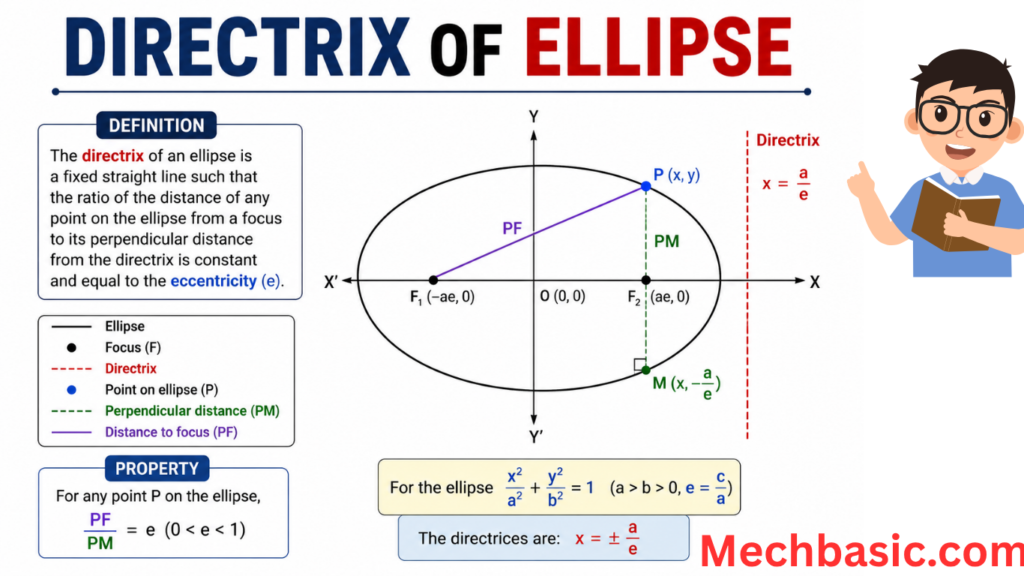
A directrix is a fixed straight line used to define and construct conic sections (ellipse, parabola, and hyperbola).
For an ellipse, every point on the curve has a special relationship with:
- A fixed point called the focus (F).
- A fixed straight line called the directrix (D).
The ratio of the distance from any point on the ellipse to the focus and its distance to the directrix is constant.
Definition of the Directrix of an Ellipse
The directrix of an ellipse is a fixed straight line such that for any point (P) on the ellipse:

where:
- e = Eccentricity of the ellipse
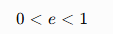
- e < 1 for an ellipse
This constant ratio is the defining property of the ellipse.
Terms Associated with the Directrix
1. Focus (F)
A fixed point inside the ellipse.
An ellipse has two foci.
2. Directrix (D)
A fixed straight line outside the ellipse.
An ellipse has two directrices, one corresponding to each focus.
3. Eccentricity (e)
The constant ratio between:
- Distance to the focus
- Perpendicular distance to the directrix
For an ellipse:
Mathematical Relation
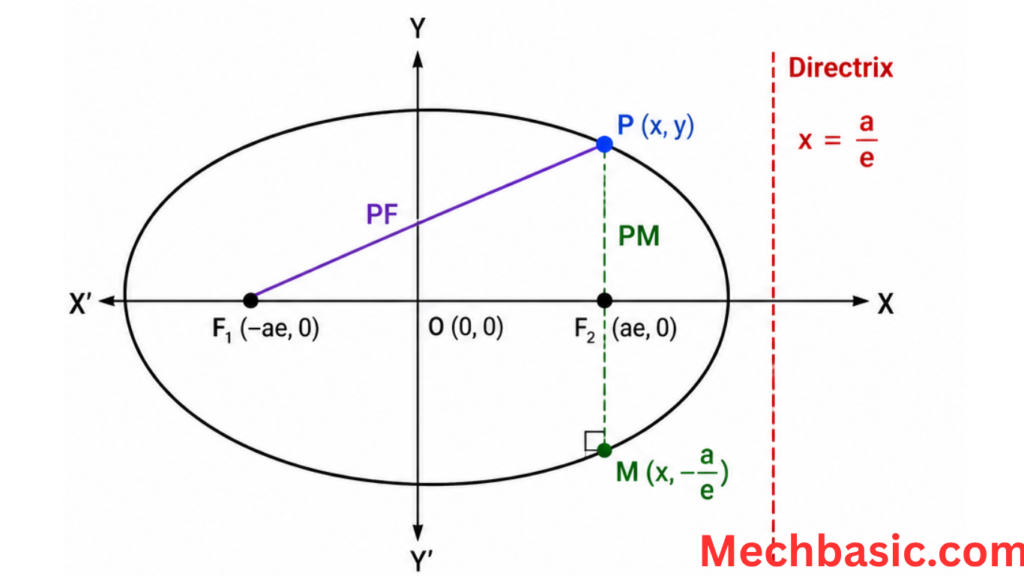
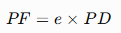
For any point (P) on the ellipse:
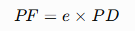
where:
- (PF) = Distance from point (P) to the focus.
- (PD) = Perpendicular distance from point (P) to the directrix.
- (e) = Eccentricity.
Since (e<1):
- Distance to the focus is always less than the distance to the directrix.
Why Does an Ellipse Have Two Directrices?
An ellipse has:
- Two foci
- Two directrices
Each focus has its corresponding directrix.
The ellipse is symmetrical about:
- Major axis
- Minor axis
Therefore, two directrices are required to maintain symmetry.
Location of the Directrix
The directrix is:
- Outside the ellipse
- Perpendicular to the major axis
- Parallel to the minor axis
It never touches the ellipse.
Directrix and Eccentricity
The value of eccentricity determines the shape of the ellipse.
| Eccentricity (e) | Shape |
|---|---|
| 0 | Circle |
| 0 < e < 1 | Ellipse |
| e = 1 | Parabola |
| e > 1 | Hyperbola |
As e approaches 0, the ellipse becomes more circular.
As e approaches 1, the ellipse becomes more elongated.
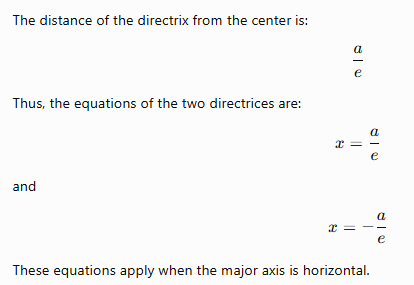
Formula for the Directrix
For an ellipse centered at the origin with:
- Semi-major axis = (a)
- Semi-minor axis = (b)
- Eccentricity = (e)
Construction of an Ellipse Using the Directrix-Focus Method
The directrix-focus method is commonly taught in engineering drawing.
Step 1
Draw the directrix as a vertical straight line.
Step 2
Mark the focus at a specified distance from the directrix.
Step 3
Choose the given eccentricity ((e<1)).
Step 4
Locate points satisfying:
Step 5
Repeat for many points.
Step 6
Join the points smoothly to obtain the ellipse.
Importance of the Directrix in Engineering Drawing
The directrix is useful for:
- Constructing ellipses accurately
- Understanding conic sections
- Solving geometrical problems
- Designing engineering components
- Teaching descriptive geometry
Applications of the Directrix of an Ellipse
Mechanical Engineering
Used in designing:
- Elliptical gears
- Cam profiles
- Machine components
Civil Engineering
Used in:
- Arch design
- Bridges
- Decorative structures
Architecture
Used for:
- Elliptical domes
- Arches
- Windows
Astronomy
Planetary orbits are elliptical.
The concept of focus and directrix helps explain the geometry of these paths.
Computer-Aided Design (CAD)
CAD software uses mathematical definitions of ellipses, including focus-directrix relationships, to create accurate curves.
Difference Between Focus and Directrix
| Focus | Directrix |
|---|---|
| Fixed point | Fixed straight line |
| Lies inside the ellipse | Lies outside the ellipse |
| Two foci | Two directrices |
| Used to define the ellipse | Used with the focus to define the ellipse |
Difference Between Ellipse and Other Conic Sections
| Conic Section | Eccentricity | Directrix |
|---|---|---|
| Circle | 0 | Not used |
| Ellipse | Less than 1 | Two directrices |
| Parabola | 1 | One directrix |
| Hyperbola | Greater than 1 | Two directrices |
Advantages of the Directrix Method
- Simple geometric construction
- High accuracy
- Suitable for engineering drawing
- Demonstrates the definition of conic sections
- Easy to understand the role of eccentricity
Limitations
- More time-consuming than some other construction methods.
- Requires accurate measurement of distances.
- Less commonly used in CAD, where ellipses are generated automatically.
Interview Questions
What is the directrix of an ellipse?
The directrix is a fixed straight line used with a focus to define an ellipse. For every point on the ellipse, the ratio of its distance from the focus to its perpendicular distance from the directrix is a constant (the eccentricity).
How many directrices does an ellipse have?
An ellipse has two directrices, one corresponding to each focus.
What is the eccentricity of an ellipse?
The eccentricity of an ellipse is always:
0<e<1
Is the directrix inside or outside the ellipse?
The directrix is always outside the ellipse.
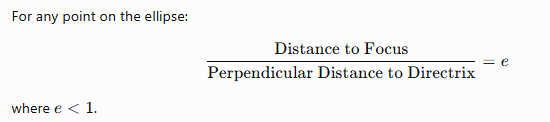
What is the focus-directrix property of an ellipse?
For any point on the ellipse:
Conclusion
The directrix of an ellipse is a fixed straight line that, together with a focus, defines the ellipse through the focus-directrix property. Every point on the ellipse maintains a constant ratio (called the eccentricity) between its distance from the focus and its perpendicular distance to the directrix. Since an ellipse has two foci, it also has two directrices. The directrix concept is fundamental in engineering drawing, geometry, CAD, and the study of conic sections, providing both a mathematical definition and a practical method for constructing ellipses.
Other courses:





