
The standard equation of an ellipse centered at the origin is x2/a2+b2/y2=1, where (a>b).
It represents an ellipse with its major axis along the x-axis.
Here, (a) is the semi-major axis and (b) is the semi-minor axis.
In this article:
- Ellipse Equation
- Standard Equation of an Ellipse
- Ellipse with Center at ((h,k))
- Definition of the Variables
- Relationship Between (a), (b), and (c)
- Eccentricity of an Ellipse
- Vertices of the Ellipse
- Foci of the Ellipse
- Major and Minor Axes
- Example
- How to Identify the Equation of an Ellipse
- Applications of the Ellipse Equation
- Summary Table
- Interview Questions
- Conclusion
Ellipse Equation
An ellipse is a closed curve formed by all points in a plane such that the sum of the distances from any point on the curve to two fixed points (called foci) is constant.
The equation of an ellipse depends on:
- The position of its center
- The orientation of its major axis (horizontal or vertical)
- The lengths of its major and minor axes
Standard Equation of an Ellipse
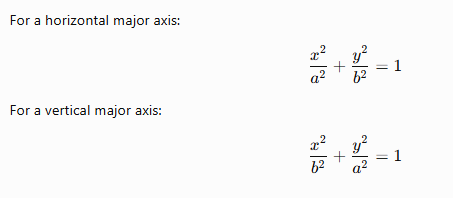
1. Ellipse with Horizontal Major Axis
When the ellipse is centered at the origin and its major axis lies along the x-axis, the standard equation is:
where:
- (a>b)
- (a) = Semi-major axis
- (b) = Semi-minor axis
Features
- Center = ((0,0))
- Major axis is horizontal.
- Major axis length = (2a)
- Minor axis length = (2b)
2. Ellipse with Vertical Major Axis
When the major axis lies along the y-axis, the equation becomes:
where:
- (a>b)
Features
- Center = ((0,0))
- Major axis is vertical.
- Major axis length = (2a)
- Minor axis length = (2b)
Ellipse with Center at ((h,k))
Horizontal Major Axis
If the center is shifted to ((h,k)), the equation becomes:
Vertical Major Axis
If the major axis is vertical:
Definition of the Variables
| Symbol | Meaning |
|---|---|
| (x,y) | Coordinates of any point on the ellipse |
| (h,k) | Coordinates of the center |
| (a) | Semi-major axis |
| (b) | Semi-minor axis |
| (c) | Distance from the center to each focus |
| (e) | Eccentricity |
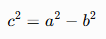
Relationship Between (a), (b), and (c)
The distance from the center to each focus is:
where:
- (a>b)
Eccentricity of an Ellipse
The eccentricity is:
For every ellipse:
0<e<1
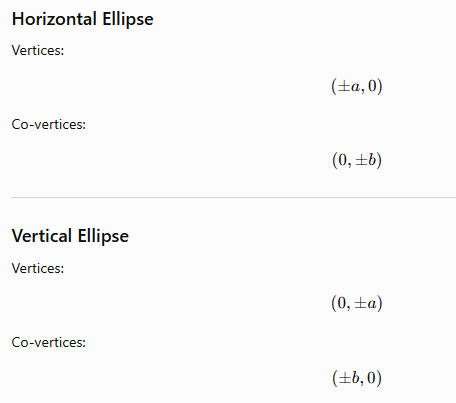
Vertices of the Ellipse
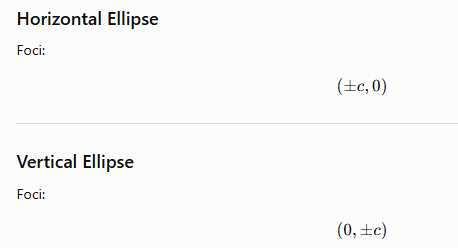
Foci of the Ellipse
Major and Minor Axes
| Axis | Length |
|---|---|
| Major Axis | (2a) |
| Minor Axis | (2b) |
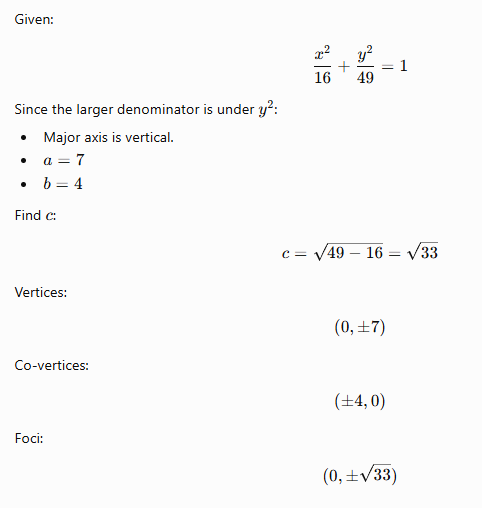
Example
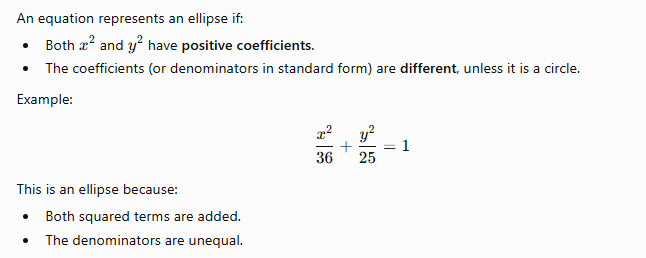
How to Identify the Equation of an Ellipse
Applications of the Ellipse Equation
The ellipse equation is used in:
Engineering Drawing
- Construction of ellipses
- Machine component design
Civil Engineering
- Arch and bridge design
Mechanical Engineering
- Elliptical gears
- Cam profiles
Astronomy
- Planetary and satellite orbits
Architecture
- Domes
- Windows
- Decorative structures
CAD Software
- AutoCAD
- SolidWorks
- CATIA
- Creo
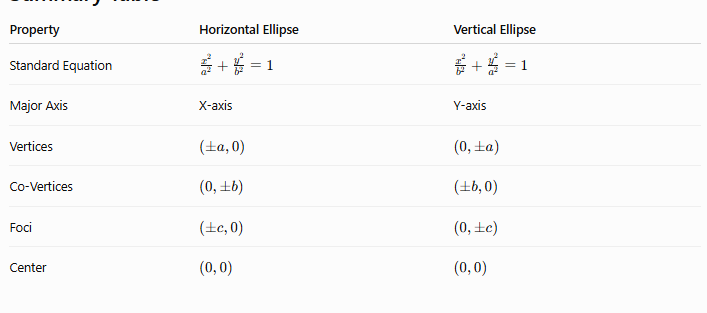
Summary Table
Interview Questions
1. What is the standard equation of an ellipse?
2. What does (a) represent?
The semi-major axis, which is half the length of the major axis.
3. How are the foci related to (a) and (b)?
They are determined using:
4. How do you know if the major axis is horizontal or vertical?
- If the larger denominator is under (x^2), the major axis is horizontal.
- If the larger denominator is under (y^2), the major axis is vertical.
Conclusion
The equation of an ellipse describes the relationship between the coordinates of all points on the ellipse. The standard equation depends on the orientation of the major axis and the location of the center. By using the parameters (a), (b), and (c), engineers and mathematicians can determine the ellipse’s center, vertices, co-vertices, foci, major axis, minor axis, and eccentricity. These equations are fundamental in engineering drawing, coordinate geometry, CAD, architecture, astronomy, and mechanical design.
Other courses:





