
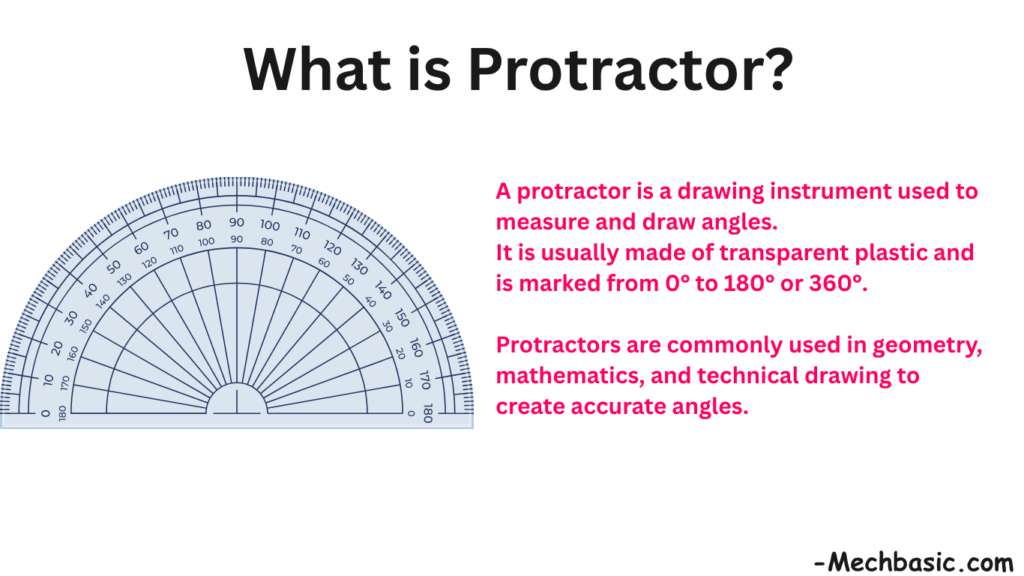
A protractor is a drawing instrument used to measure and draw angles.
It is usually made of plastic, metal, or transparent material and marked in degrees.
Protractors are commonly used in engineering drawing, geometry, and drafting.
In this article:
- Protractor
- Units of Angle Measurement
- Types of Protractors
- Functions of a Protractor
- How to Measure an Angle
- How to Draw an Angle
- Common Angles in Engineering
- Bevel Protractor in Engineering
- Applications of Protractors
- Advantages of Protractors
- Limitations
- Care and Maintenance
- Protractor vs Divider
- Protractor vs Compass
- Conclusion
Protractor
What is a Protractor?
A protractor is a measuring and drawing instrument used to measure, construct, and transfer angles. It is one of the most important tools in engineering drawing, geometry, drafting, surveying, and mechanical layout work.
A protractor is usually marked in degrees (°) from 0° to 180° or 0° to 360°.
In simple terms, a protractor helps determine how much one line is inclined relative to another.
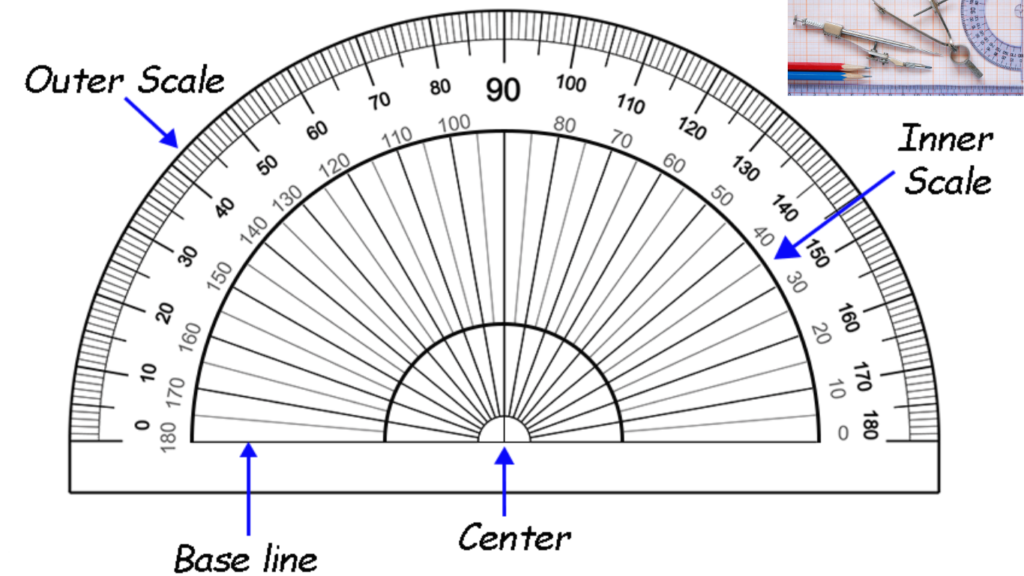
Structure of a Protractor
Main Parts
1. Base Line
- Straight edge at the bottom.
- Used as the reference line.
2. Center Point (Origin)
- Located at the midpoint of the base line.
- Placed at the vertex of the angle.
3. Degree Scale
- Graduated markings in degrees.
- Usually marked from:
- 0° to 180° (semi-circular)
- 0° to 360° (circular)
4. Inner and Outer Scales
- Allow angle measurement in both directions.
Units of Angle Measurement
Degrees
The most common unit.
Examples
- Right angle = 90°
- Straight angle = 180°
- Full circle = 360°
Types of Protractors
1. Semi-Circular Protractor
Most common type.
Features
- Half-circle shape
- Measures 0° to 180°
Uses
- School geometry
- Basic engineering drawing
2. Circular Protractor
Features
- Full circle
- Measures 0° to 360°
Uses
- Surveying
- Advanced drafting
3. Bevel Protractor
Used in mechanical engineering.
Features
- Adjustable blade
- Precision scale
Accuracy
Often up to:
- 5 minutes of arc
- 1 minute of arc (precision models)
Uses
- Tool room inspection
- Machining
- Quality control
4. Digital Protractor
Electronic angle-measuring device.
Features
- LCD display
- High precision
Uses
- Manufacturing
- Fabrication
- CNC setup
Functions of a Protractor
1. Measuring Angles
The primary purpose.
2. Drawing Angles
Used to construct angles accurately.
3. Transferring Angles
Copy an angle from one drawing to another.
4. Inspection and Quality Control
Used to verify angles on manufactured parts.
How to Measure an Angle
Step 1
Place the center point on the vertex.
Step 2
Align the base line with one side of the angle.
Step 3
Read the degree where the second line crosses the scale.
How to Draw an Angle
Example: Draw a 45° Angle
Step 1
Draw a horizontal reference line.
Step 2
Place the protractor center at the endpoint.
Step 3
Mark the 45° graduation.
Step 4
Connect the endpoint to the mark.
Result:
A 45° angle is created.
Common Angles in Engineering
| Angle | Application |
|---|---|
| 30° | Drafting and geometry |
| 45° | Chamfers and layouts |
| 60° | Hexagons and triangles |
| 90° | Perpendicular features |
| 120° | Hexagonal constructions |
| 180° | Straight line |
Bevel Protractor in Engineering
The bevel protractor is widely used in manufacturing.
Measures
- Internal angles
- External angles
- Tool angles
- Machine component angles
Components
Blade
Contacts the workpiece.
Dial
Shows angular measurement.
Vernier Scale
Provides higher accuracy.
Applications of Protractors
Engineering Drawing
- Geometric constructions
- Angular layouts
Mechanical Engineering
- Tool inspection
- Component measurement
Civil Engineering
- Road design
- Surveying layouts
Architecture
- Roof angles
- Building layouts
Carpentry
- Miter cuts
- Joint construction
Advantages of Protractors
Easy to Use
Simple measurement process.
Portable
Lightweight and compact.
Accurate
Provides reliable angle measurements.
Versatile
Useful in many fields.
Limitations
Manual Reading Errors
Incorrect reading may occur.
Limited Precision
Basic protractors are less accurate than advanced instruments.
Wear and Damage
Scratched scales can reduce accuracy.
Care and Maintenance
Keep Clean
Dust can obscure markings.
Avoid Scratches
Protect graduated scales.
Store Flat
Prevents warping.
Handle Carefully
Especially precision bevel protractors.
Protractor vs Divider
| Feature | Protractor | Divider |
|---|---|---|
| Measures Angles | Yes | No |
| Measures Distances | No | Yes |
| Draws Angles | Yes | No |
| Transfers Measurements | Limited | Excellent |
| Geometric Construction | Yes | Yes |
Protractor vs Compass
| Feature | Protractor | Compass |
|---|---|---|
| Measures Angles | Yes | No |
| Draws Circles | No | Yes |
| Draws Arcs | No | Yes |
| Measures Degrees | Yes | No |
Conclusion
A protractor is a precision instrument used to measure, draw, and transfer angles. It is widely used in engineering drawing, manufacturing, architecture, surveying, and education. Common types include semi-circular, circular, bevel, and digital protractors. Among these, the bevel protractor is especially important in mechanical engineering and quality control because it provides highly accurate angular measurements for machined components and tools.
Other courses:





