
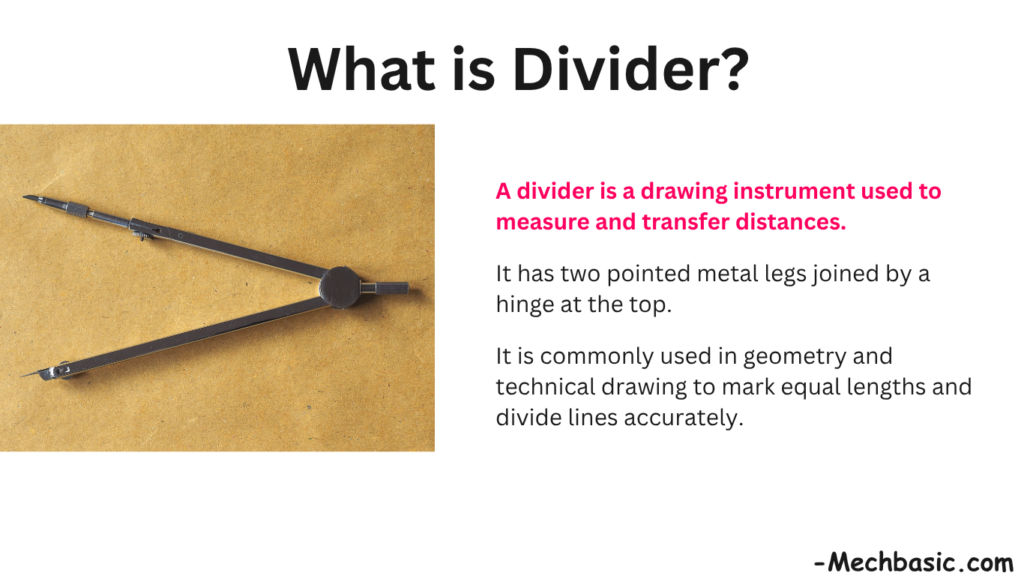
A divider is a drawing instrument used to measure and transfer distances on drawings.
It consists of two pointed legs joined by a pivot.
Dividers are commonly used for marking equal divisions and drawing arcs or circles.
In this article:
Divider Drawing Instrument
What is a Divider?
A divider is a drafting and measuring instrument used to measure distances, transfer measurements, divide lines into equal parts, and mark arcs or circles on a drawing or workpiece.
It consists of two pointed metal legs joined by a pivot (hinge) at the top.
Unlike a compass, a divider has two sharp points, while a compass has one point and one pencil lead.
Structure of a Divider
Main Parts
1. Pivot Joint (Hinge)
- Located at the top.
- Allows the legs to open and close.
2. Two Pointed Legs
- Made of hardened steel.
- Used for marking and measuring.
3. Adjustment Mechanism (in some dividers)
- Fine adjustment screw for precise spacing.
4. Spring (Spring Divider)
- Maintains consistent pressure and accuracy.
Types of Dividers
1. Plain Divider
The simplest type.
Features
- Two pointed legs
- Manual adjustment
Applications
- Basic measurement transfer
- Simple drafting work
2. Spring Divider
Contains a spring and adjusting screw.
Features
- Higher accuracy
- Fine adjustment
Applications
- Precision engineering drawings
- Tool room work
3. Wing Divider
Has a wing nut for precise setting.
Features
- Excellent measurement control
- Maintains spacing accurately
Applications
- Mechanical drafting
- Inspection work
Functions of a Divider
1. Measuring Distances
Used to measure distances on:
- Drawings
- Maps
- Blueprints
Example
Measure the distance between two holes on a drawing and transfer it elsewhere.
2. Transferring Measurements
A divider can transfer a dimension from one location to another without using a ruler.
Example
Transfer a 50 mm spacing repeatedly across a layout.
3. Dividing Lines into Equal Parts
One of the most common uses.
Example
Divide a 100 mm line into:
- 2 equal parts
- 4 equal parts
- 10 equal parts
without calculations.
4. Marking Arcs
Used to scribe arcs on:
- Paper
- Metal surfaces
- Wood surfaces
5. Constructing Geometric Shapes
Useful for:
- Triangles
- Hexagons
- Polygons
- Geometric constructions
How a Divider Works
Step 1
Adjust the opening between the two points.
Step 2
Place one point at the starting location.
Step 3
Swing the other point to mark the distance.
Step 4
Repeat as needed.
Use of Divider in Engineering Drawing
Engineering students commonly use dividers for:
Geometric Construction
- Bisecting lines
- Bisecting angles
- Constructing polygons
Scaling
Transfer dimensions from scale to drawing.
Repetitive Spacing
Mark equal intervals accurately.
Example: Dividing a Line into Equal Parts
Suppose a line is 120 mm long.
You need six equal divisions.
Procedure
- Open divider approximately.
- Step off six equal spaces along the line.
- Adjust spacing slightly until the sixth step reaches the endpoint.
- Mark division points.
Result:
Each division = 20 mm.
Divider vs Compass
| Feature | Divider | Compass |
|---|---|---|
| Points | Two sharp points | One point and one pencil |
| Purpose | Measure and transfer distances | Draw circles and arcs |
| Drawing Circles | No | Yes |
| Measurement Transfer | Yes | Limited |
Advantages of a Divider
High Accuracy
Provides precise distance transfer.
Simple Construction
Easy to use and maintain.
No Scale Reading Required
Transfers measurements directly.
Useful in Geometry
Ideal for geometric constructions.
Applications of Dividers
Engineering Drawing
- Geometric constructions
- Layout work
Mechanical Engineering
- Marking measurements
- Tool room operations
Surveying
- Measuring distances on maps
Carpentry
- Equal spacing layouts
Metal Fabrication
- Marking hole centers
- Transferring dimensions
Care and Maintenance
Keep Points Sharp
Sharp points improve accuracy.
Avoid Dropping
May affect alignment.
Store Properly
Keep in a protective case.
Prevent Rust
Light oil coating may be used on metal parts.
Limitations
❌ Cannot directly draw circles like a compass
❌ Requires careful handling
❌ Less suitable for large measurements
❌ Accuracy depends on proper adjustment
Real-Life Example
A machinist needs to mark six equally spaced holes on a circular flange.
Using a divider:
- Set the required spacing.
- Step off equal distances around the circumference.
- Mark hole locations.
This method is fast and highly accurate.
Conclusion
A divider is a precision drafting and measuring instrument consisting of two pointed legs connected by a pivot. It is used to measure distances, transfer dimensions, divide lines into equal parts, and perform geometric constructions. Dividers are widely used in engineering drawing, machining, surveying, metal fabrication, and technical drafting because of their simplicity, accuracy, and ability to transfer measurements directly without reading a scale.
Other courses:





