
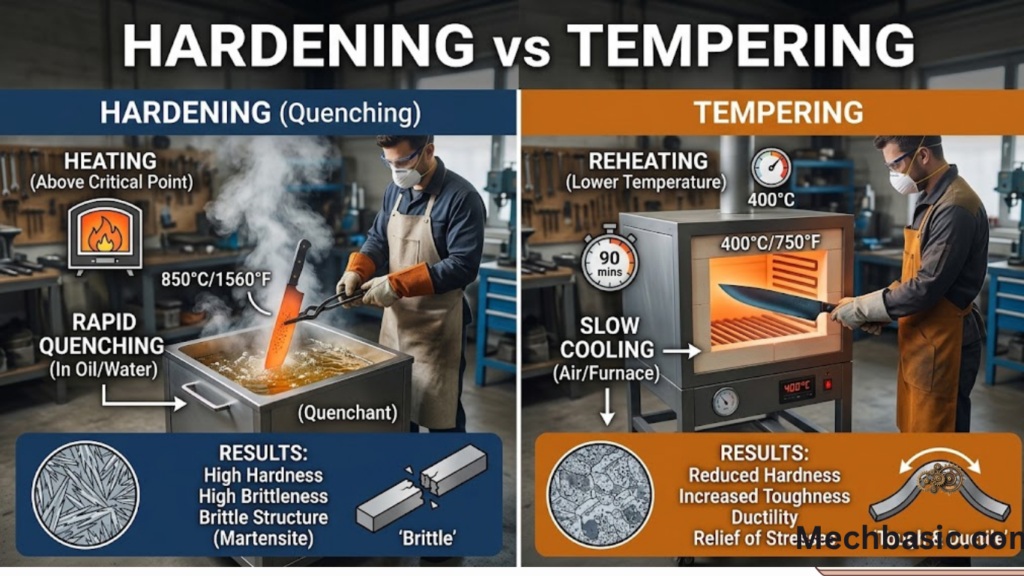
Hardening increases the hardness and strength of metal by heating and rapid cooling.
Tempering is done after hardening to reduce brittleness and improve toughness.
Hardening makes metal harder, while tempering balances hardness with durability.
In this article:
- Difference Between Hardening and Tempering
- Quick Comparison
- What Is Hardening?
- What Is Tempering?
- Why Hardening Alone Is Not Enough
- Effect on Mechanical Properties
- Temperature Difference
- Example: Hardening and Tempering a Gear
- Microstructural Comparison
- Industrial Examples
- Real-Life Analogy
- Advantages of Hardening
- Advantages of Tempering
- Conclusion
Difference Between Hardening and Tempering
Hardening and tempering are two important heat-treatment processes used for steel. They are often performed together, but they serve different purposes.
- Hardening increases hardness and strength.
- Tempering reduces brittleness and improves toughness after hardening.
A common sequence is:
Hardening → Quenching → Tempering
Without tempering, hardened steel can be too brittle for practical use.
Quick Comparison
| Feature | Hardening | Tempering |
|---|---|---|
| Purpose | Increase hardness and strength | Reduce brittleness and improve toughness |
| Performed When | First | After hardening |
| Heating Temperature | Above critical temperature (Ac3 or Ac1 depending on steel) | Below Ac1 |
| Cooling Method | Rapid quenching | Usually air cooling |
| Main Result | Martensite formation | Tempered martensite formation |
| Hardness | Increases greatly | Decreases slightly |
| Toughness | Decreases | Increases |
| Internal Stresses | Increase | Decrease |
What Is Hardening?
Hardening is a process that makes steel harder and stronger.
Process
Step 1: Heat
Steel is heated above its critical temperature.
For many steels:
- Approximately 800–900°C
At this temperature, the structure becomes austenite.
Step 2: Soak
The steel is held at temperature to ensure uniform heating.
Step 3: Quench
The steel is rapidly cooled in:
- Water
- Oil
- Brine
- Polymer solution
What Happens Metallurgically?
During quenching:
Austenite transforms into martensite.
Martensite is:
- Very hard
- Very strong
- Very brittle
Purpose of Hardening
- Increase wear resistance
- Increase strength
- Improve cutting ability
- Improve surface durability
Applications
- Cutting tools
- Gears
- Dies
- Punches
- Bearings
What Is Tempering?
Tempering is performed after hardening.
Its purpose is to improve toughness and reduce brittleness.
Process
Step 1
Take the hardened steel.
Step 2
Reheat it below the critical temperature.
Typically:
150–650°C
Step 3
Hold for a specified time.
Step 4
Cool in air.
What Happens Metallurgically?
The martensite partially decomposes into a more stable structure.
This:
- Relieves stresses
- Reduces brittleness
- Increases toughness
Purpose of Tempering
- Improve toughness
- Reduce cracking risk
- Improve ductility
- Increase reliability
Applications
- Gears
- Springs
- Shafts
- Automotive parts
- Machine components
Why Hardening Alone Is Not Enough
Imagine a steel chisel.
After hardening:
- Extremely hard
- Can hold a sharp edge
But:
- May crack when struck
After tempering:
- Slightly softer
- Much tougher
- More durable
Therefore, tempering makes the hardened steel usable.
Effect on Mechanical Properties
Hardening
Increases
- ✓ Hardness
- ✓ Strength
- ✓ Wear resistance
Decreases
- ✗ Toughness
- ✗ Ductility
Tempering
Increases
- ✓ Toughness
- ✓ Ductility
- ✓ Impact resistance
Decreases Slightly
- ✗ Hardness
- ✗ Strength
Temperature Difference
Hardening and tempering use very different temperatures.
Hardening
Steel is heated above critical temperatures.
The critical transformation concept is:
A_c1 < A_c3
For most steels:
- Heating is above Ac1 and often above Ac3.
Tempering
Steel is reheated below Ac1.
Typical range:
150–650°C
No austenite forms during tempering.
Example: Hardening and Tempering a Gear
Hardening
- Heat gear to approximately 850°C.
- Quench in oil.
Result:
- Very hard martensitic structure
Tempering
- Reheat to approximately 500°C.
- Hold for one hour.
- Air cool.
Result:
- Hard gear teeth
- Improved toughness
- Lower cracking risk
Microstructural Comparison
Before Hardening
Steel contains:
- Ferrite
- Pearlite
These structures are relatively soft.
After Hardening
Steel contains:
- Martensite
Properties:
- Very hard
- Brittle
After Tempering
Steel contains:
- Tempered martensite
Properties:
- Hard
- Tough
- More stable
Industrial Examples
Hardening Is Used For
- Drill bits
- Knives
- Cutting tools
- Dies
Tempering Is Used For
- Springs
- Gears
- Crankshafts
- Shafts
- Bearings
In practice, most hardened parts are also tempered.
Real-Life Analogy
Think of glass and plastic.
Hardened Steel
Like glass:
- Strong
- Hard
- Can break suddenly
Tempered Steel
Like tough plastic:
- Slightly less hard
- More resistant to impact
This is why tempering is so important.
Advantages of Hardening
- Maximum hardness
- Excellent wear resistance
- Improved cutting performance
Advantages of Tempering
- Increased toughness
- Reduced brittleness
- Improved fatigue life
- Better dimensional stability
Conclusion
Hardening and tempering are complementary heat-treatment processes. Hardening involves heating steel above its critical temperature and rapidly quenching it to form hard martensite, greatly increasing hardness and strength. However, the steel becomes brittle.
Tempering is then performed by reheating the hardened steel below the critical temperature to reduce brittleness, relieve internal stresses, and improve toughness while retaining much of the hardness. In most engineering applications, steel is hardened first and tempered afterward to achieve the best combination of strength, hardness, and durability.
Other courses:





