
The three types of tempering are low-temperature, medium-temperature, and high-temperature tempering.
They are selected based on the required hardness, strength, and toughness.
Higher tempering temperatures generally increase toughness and reduce hardness.
In this article:
Three Types of Tempering in Heat Treatment
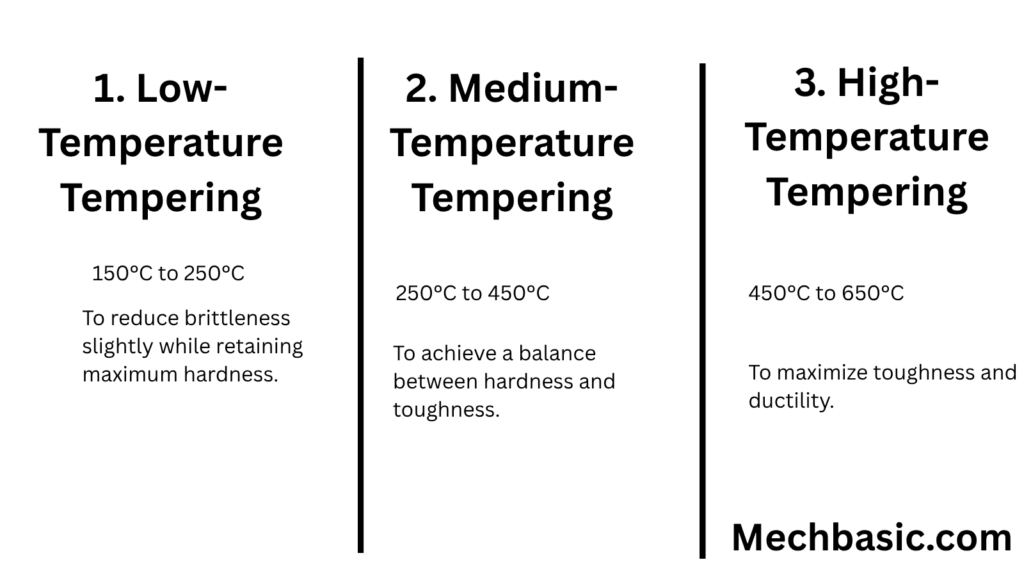
Tempering is commonly classified into three types based on the tempering temperature range:
- Low-Temperature Tempering
- Medium-Temperature Tempering
- High-Temperature Tempering
Each type produces a different balance of hardness, strength, toughness, and ductility.
Overview
After quenching, steel becomes:
- Very hard
- Very strong
- Brittle
Tempering modifies the quenched structure (martensite) to obtain the desired properties.
The higher the tempering temperature:
- The lower the hardness
- The higher the toughness
1. Low-Temperature Tempering
Temperature Range
Typically:
150°C to 250°C
Purpose
To reduce brittleness slightly while retaining maximum hardness.
What Happens?
The steel still remains very hard.
Only a small amount of internal stress is relieved.
The martensitic structure changes only slightly.
Properties Obtained
- Very high hardness
- Excellent wear resistance
- Limited toughness
- High strength
Advantages
- ✓ Retains maximum hardness
- ✓ Improves wear resistance
- ✓ Reduces some residual stresses
Disadvantages
- ✗ Toughness remains relatively low
- ✗ Can still be brittle under impact loads
Applications
Used for:
- Cutting tools
- Files
- Drills
- Reamers
- Measuring instruments
- Knives
Example
A hardened drill bit may be tempered at around 200°C to maintain a sharp, wear-resistant cutting edge.
2. Medium-Temperature Tempering
Temperature Range
Typically:
250°C to 450°C
Purpose
To achieve a balance between hardness and toughness.
What Happens?
More martensite decomposes.
Internal stresses decrease significantly.
The steel becomes tougher while still retaining useful hardness.
Properties Obtained
- Moderate hardness
- Good strength
- Improved toughness
- Better elasticity
Advantages
- ✓ Good combination of hardness and toughness
- ✓ Improved shock resistance
- ✓ Better fatigue resistance
Disadvantages
✗ Hardness is lower than low-temperature tempered steel
Applications
Used for:
- Springs
- Hammers
- Dies
- Punches
- Machine components
Example
A spring tempered at approximately 350°C develops the elasticity and toughness needed for repeated loading.
3. High-Temperature Tempering
Temperature Range
Typically:
450°C to 650°C
Purpose
To maximize toughness and ductility.
What Happens?
A larger portion of martensite transforms into tempered structures.
Residual stresses are largely removed.
Hardness decreases, but toughness increases substantially.
Properties Obtained
- High toughness
- Good ductility
- Improved impact resistance
- Lower hardness
Advantages
- ✓ Excellent toughness
- ✓ Reduced cracking risk
- ✓ Better dimensional stability
- ✓ Improved fatigue life
Disadvantages
- ✗ Lower hardness
- ✗ Reduced wear resistance compared with lower-temperature tempering
Applications
Used for:
- Gears
- Shafts
- Crankshafts
- Connecting rods
- Structural machine parts
Example
A gear may be tempered at approximately 500°C after oil quenching to obtain a combination of wear resistance and toughness.
Comparison of the Three Types
| Property | Low-Temperature | Medium-Temperature | High-Temperature |
|---|---|---|---|
| Temperature Range | 150–250°C | 250–450°C | 450–650°C |
| Hardness | Very High | Moderate–High | Moderate |
| Toughness | Low | Medium | High |
| Ductility | Low | Medium | High |
| Wear Resistance | Excellent | Good | Moderate |
| Impact Resistance | Low | Moderate | High |
| Typical Uses | Cutting tools | Springs | Gears & shafts |
Effect of Temperature on Properties
As tempering temperature increases:
- Hardness decreases ↓
- Toughness increases ↑
- Ductility increases ↑
- Residual stress decreases ↓
This relationship is why engineers carefully select the tempering temperature based on the application.
Example: Same Steel, Different Tempering Temperatures
Suppose a steel component is quenched and then tempered:
At 200°C
- Very hard
- Excellent wear resistance
- Limited toughness
At 400°C
- Balanced hardness and toughness
At 600°C
- Lower hardness
- Excellent toughness and impact resistance
The steel is the same; only the tempering temperature changes the final properties.
Why Different Types Are Needed
Different engineering components require different properties:
Cutting Tool
Needs:
- Maximum hardness
Use:
Low-temperature tempering
Spring
Needs:
- Elasticity and toughness
Use:
Medium-temperature tempering
Gear or Shaft
Needs:
- Toughness and fatigue resistance
Use:
High-temperature tempering
Conclusion
The three types of tempering are low-temperature tempering (150–250°C), medium-temperature tempering (250–450°C), and high-temperature tempering (450–650°C). Low-temperature tempering preserves maximum hardness, medium-temperature tempering provides a balance of hardness and toughness, and high-temperature tempering produces maximum toughness and ductility. The appropriate type is selected based on the performance requirements of the component.
Other courses:





