
Tempering is performed after hardening to reduce brittleness and improve toughness.
Annealing softens metal by heating and slow cooling to relieve internal stresses.
Tempering maintains strength, while annealing increases ductility and machinability.
In this article:
- Tempering vs Annealing
- Quick Comparison
- What Is Tempering?
- What Is Annealing?
- Purpose Comparison
- Temperature Difference
- Cooling Difference
- Microstructural Changes
- Effect on Mechanical Properties
- Example: Steel Chisel
- Advantages of Tempering
- Advantages of Annealing
- Disadvantages
- Real-Life Analogy
- Summary Table
- Conclusion
Tempering vs Annealing
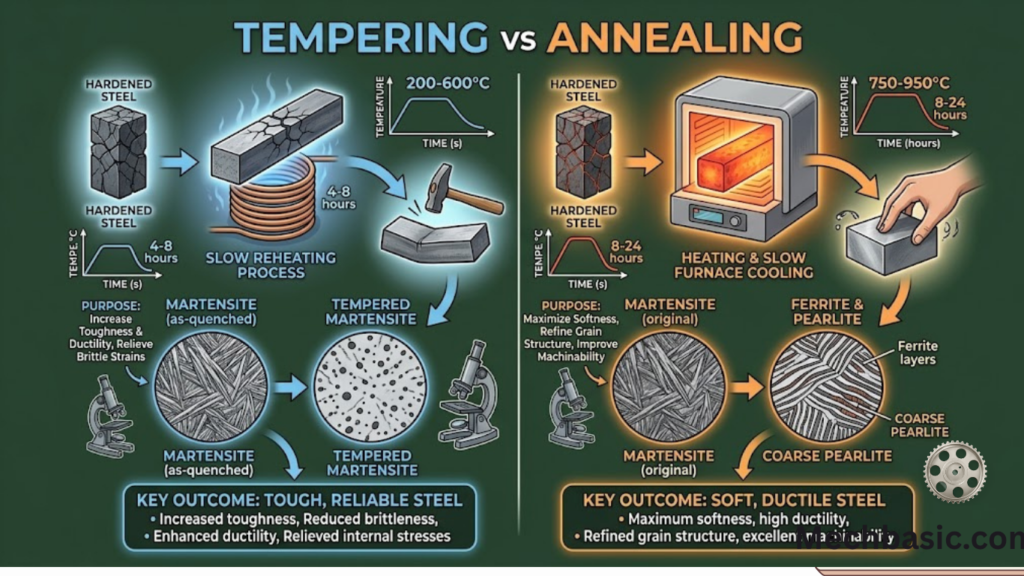
Tempering and annealing are both heat-treatment processes, but they have very different purposes and produce different mechanical properties.
- Tempering is used to reduce brittleness and improve toughness in previously hardened steel.
- Annealing is used to soften metal, improve ductility, and relieve internal stresses.
In simple terms:
Tempering makes hardened steel tougher, while annealing makes steel softer and easier to work with.
Quick Comparison
| Feature | Tempering | Annealing |
|---|---|---|
| Main Purpose | Reduce brittleness | Soften metal |
| Performed After Quenching? | Yes | No |
| Heating Temperature | Below Ac1 | Above Ac3 or Ac1 (depending on steel) |
| Cooling Method | Usually air cooling | Very slow furnace cooling |
| Hardness | Slightly reduced | Significantly reduced |
| Toughness | Increased | Increased |
| Ductility | Increased moderately | Increased greatly |
| Machinability | Improved slightly | Improved significantly |
| Typical Use | Hardened components | Manufacturing and forming operations |
What Is Tempering?
Tempering is performed after hardening and quenching.
Its purpose is to reduce brittleness while retaining useful hardness.
Tempering Process
Step 1
Harden the steel by heating and quenching.
Result:
- Martensite forms
- Steel becomes very hard
Step 2
Reheat the hardened steel.
Typical range:
150°C–650°C
The temperature remains below the critical temperature.
Step 3
Hold at temperature.
Step 4
Cool, usually in air.
Result of Tempering
The steel becomes:
- ✓ Tougher
- ✓ Less brittle
- ✓ More reliable
While still retaining much of its hardness.
What Is Annealing?
Annealing is primarily used to soften steel and improve workability.
Annealing Process
Step 1
Heat steel above its critical temperature.
For many steels:
Approximately 750–950°C.
Step 2
Hold at temperature.
This allows the structure to become uniform.
Step 3
Cool very slowly inside the furnace.
This slow cooling is the key feature of annealing.
Result of Annealing
The steel becomes:
- ✓ Softer
- ✓ More ductile
- ✓ Easier to machine
- ✓ Easier to form
Purpose Comparison
Purpose of Tempering
- Reduce brittleness
- Improve toughness
- Relieve stresses after quenching
- Improve fatigue resistance
Purpose of Annealing
- Soften steel
- Improve machinability
- Improve ductility
- Prepare metal for further processing
Temperature Difference
The critical temperatures of steel are often described by Ac1 and Ac3.
Tempering
Occurs below Ac1.
Annealing
Occurs above Ac1 and often above Ac3.
Cooling Difference
Tempering
Cooling is generally:
- Air cooling
- Moderate cooling
Cooling rate is not highly critical.
Annealing
Cooling is extremely slow.
Often:
- Furnace cooling
This slow cooling produces a soft structure.
Microstructural Changes
Tempering
Starting structure:
- Martensite
Result:
- Tempered martensite
- Reduced internal stress
Annealing
Starting structure:
- Work-hardened or untreated steel
Result:
- Ferrite and pearlite
- Soft, stable structure
Effect on Mechanical Properties
Tempering
Hardness
Decreases slightly.
Toughness
Increases significantly.
Strength
Remains relatively high.
Annealing
Hardness
Drops considerably.
Toughness
Improves.
Ductility
Improves greatly.
Example: Steel Chisel
After Hardening
- Extremely hard
- Brittle
After Tempering
- Hard cutting edge
- Better toughness
- Less likely to chip
Example: Steel Sheet for Forming
Suppose a steel sheet must be bent into shape.
If it is too hard:
- Cracking may occur
Annealing softens the sheet.
Result:
- Easier forming
- Reduced cracking
Industrial Applications
Tempering Applications
- Gears
- Springs
- Shafts
- Bearings
- Cutting tools
- Automotive parts
Annealing Applications
- Wire drawing
- Sheet metal forming
- Forgings
- Castings
- Machined components
Advantages of Tempering
- ✓ Improves toughness
- ✓ Reduces brittleness
- ✓ Relieves stresses
- ✓ Improves fatigue life
Advantages of Annealing
- ✓ Softens metal
- ✓ Improves machinability
- ✓ Improves ductility
- ✓ Relieves residual stress
- ✓ Refines grain structure
Disadvantages
Tempering
- Slight reduction in hardness
- Requires prior hardening
Annealing
- Long processing time
- Lower final strength
- Higher energy consumption due to slow cooling
Real-Life Analogy
Imagine a steel knife.
Tempering
The knife remains hard enough to cut but becomes less likely to chip.
Annealing
The knife becomes much softer and easier to shape, but it would not hold a sharp edge well.
Summary Table
| Property | Tempering | Annealing |
|---|---|---|
| Objective | Toughen hardened steel | Soften steel |
| Applied After Quenching | Yes | No |
| Heating Temperature | Below Ac1 | Above Ac1/Ac3 |
| Cooling Rate | Air cooling | Very slow furnace cooling |
| Hardness | Slightly reduced | Greatly reduced |
| Ductility | Moderate increase | Large increase |
| Toughness | Increased | Increased |
| Machinability | Improved | Greatly improved |
Conclusion
Tempering and annealing are both heat-treatment processes, but they serve different purposes. Tempering is performed on hardened steel to reduce brittleness and improve toughness while maintaining useful hardness. Annealing is performed to soften steel, improve ductility, relieve stresses, and make the material easier to machine or form. In manufacturing, tempering is commonly used for gears, springs, and tools, whereas annealing is widely used for sheet metal, forgings, castings, and components that require extensive machining or forming.
Other courses:





