
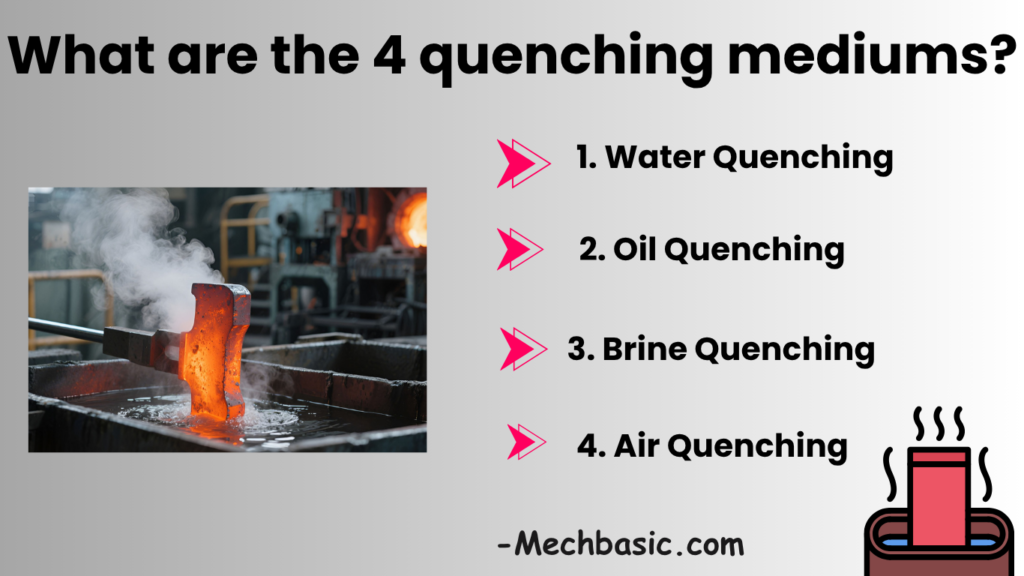
The four common quenching mediums are water, oil, air, and brine (salt water).
These cooling media remove heat from heated metals at different rates.
The choice depends on the required hardness and material properties.
In this article:
What are the 4 quenching mediums?
Quenching media (or quenching mediums) are substances used to rapidly cool a heated metal during the quenching process. The choice of quenching medium strongly affects the cooling rate, and therefore the final hardness, strength, distortion, residual stresses, and cracking tendency of the material.
Although several media exist, the four commonly used quenching media are:
- Water
- Oil
- Brine (salt water)
- Air
Each medium cools at a different rate and is selected according to material type and required properties.
1. Water Quenching
Water is one of the most widely used quenching media because it removes heat quickly.
Working principle
The heated metal is immersed in water, which rapidly extracts heat from the surface.
Cooling characteristics
- Fast cooling rate
- More severe quench
- Produces high hardness
Advantages
- Low cost
- Easily available
- High cooling efficiency
- Suitable for many carbon steels
Disadvantages
- High internal stress formation
- Distortion may occur
- Increased cracking risk
- Cooling can be uneven
Applications
- Carbon steel components
- Tools
- General machine parts
Example
Steel chisels and hand tools are commonly water quenched.
2. Oil Quenching
Oil provides slower and more controlled cooling than water.
Common oils:
- Mineral oils
- Vegetable oils
- Specialized quenching oils
Cooling characteristics
- Moderate cooling rate
- Less severe than water
Advantages
- Reduced cracking risk
- Less distortion
- More uniform cooling
- Better surface quality
Disadvantages
- More expensive than water
- Smoke generation possible
- Fire hazard exists
- Requires maintenance
Applications
- Alloy steels
- Precision machine parts
- Gears
- Springs
Example
High-strength alloy steel gears are often oil quenched.
3. Brine Quenching
Brine is a solution of water mixed with salt.
The addition of salt changes cooling behavior.
Cooling characteristics
- Faster cooling than water
- Removes vapor films effectively
Why faster than water?
During quenching, plain water forms a vapor layer around the hot metal.
Salt helps break this vapor layer, improving heat transfer.
Advantages
- Very rapid cooling
- Produces high hardness
- Better cooling uniformity than water
Disadvantages
- Greater cracking risk
- Higher thermal shock
- Corrosive nature
- Can damage equipment
Applications
- Simple carbon steels
- Components needing very high hardness
4. Air Quenching
Air quenching cools the metal using still air or forced air circulation.
Cooling characteristics
- Slowest cooling among common media
- Gentle cooling
Advantages
- Minimal distortion
- Lower residual stresses
- Reduced cracking risk
- Clean process
Disadvantages
- Limited hardness increase
- Not suitable for many plain carbon steels
Applications
- High alloy steels
- Air-hardening steels
- Precision tools
Example
Some tool steels are designed specifically for air hardening.
Comparison of the four quenching media
| Quenching medium | Cooling rate | Hardness achieved | Cracking risk | Distortion |
|---|---|---|---|---|
| Brine | Very high | Very high | Very high | High |
| Water | High | High | High | Moderate to high |
| Oil | Medium | Moderate to high | Lower | Lower |
| Air | Low | Lower | Very low | Minimal |
Cooling severity order:
Brine > Water > Oil > Air
Factors affecting selection of quenching medium
Engineers choose a medium based on:
- Steel composition
- Size of component
- Desired hardness
- Shape of part
- Cracking sensitivity
- Distortion tolerance
Importance of proper medium selection
Wrong selection may cause:
- Cracks
- Distortion
- Insufficient hardness
- Residual stresses
- Reduced component life
Example
For a precision gear:
- Water may cool too rapidly and create cracks.
- Oil may provide enough hardness with less distortion.
Thus oil becomes a better choice.
Conclusion
The four major quenching media—water, oil, brine, and air—provide different cooling rates and produce different material properties. Selecting the proper quenching medium is essential because it directly influences hardness, strength, residual stress, distortion, and overall component performance.
Other courses:





