
SLA (Stereolithography) gives higher detail, smoother surfaces, and better accuracy than FDM.
FDM is cheaper, faster for large parts, and easier to use for basic prototypes.
The choice depends on whether you need precision (SLA) or cost-efficiency (FDM).
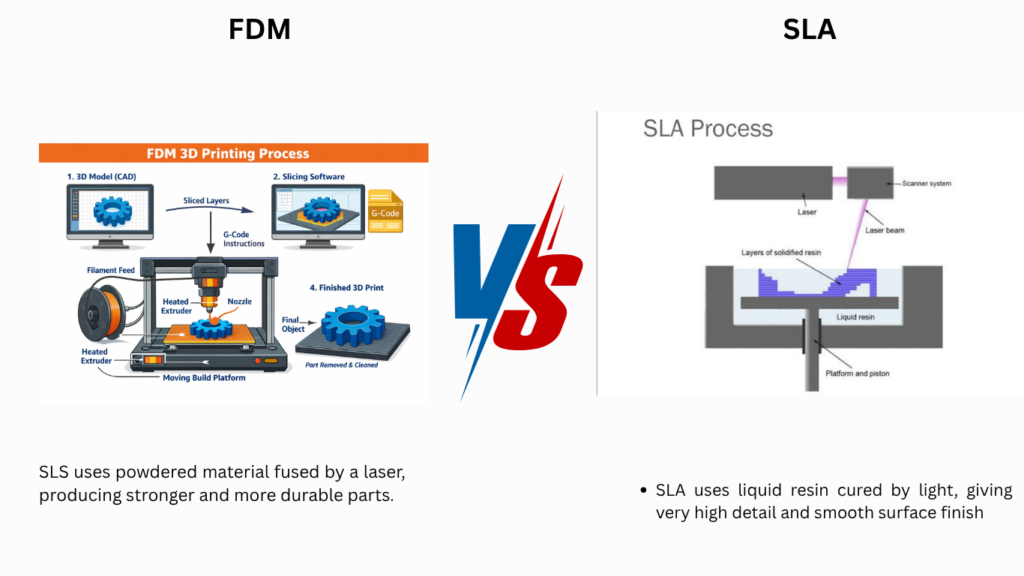
In this article:
Is SLA or FDM Better?
There is no single “best” between SLA (Stereolithography) and FDM (Fused Deposition Modeling). The better choice depends on application, cost, accuracy, strength, and material needs.
Definition
FDM (Fused Deposition Modeling)
- Melts and extrudes plastic filament layer by layer
- Most common and low-cost 3D printing method
SLA (Stereolithography)
- Uses UV laser/light to cure liquid resin layer by layer
- High precision and smooth finish
SLA vs FDM
1. Print Quality & Accuracy
SLA
- Very high accuracy
- Smooth surface finish
- Fine details possible
👉 Best for: intricate models, dental parts, jewelry
FDM
- Lower resolution
- Visible layer lines
- Moderate accuracy
👉 Best for: functional prototypes, simple parts
2. Strength of Parts
FDM
- Stronger in many structural uses
- Thermoplastic materials like ABS, Nylon
👉 Better for mechanical parts
SLA
- Brittle resin material
- Can crack under stress
👉 Not ideal for load-bearing parts
3. Cost
FDM
- Very cheap printers
- Low material cost
👉 Best for beginners and industry prototyping
SLA
- More expensive machines
- Resin is costly
👉 Used in specialized industries
4. Material Types
FDM
- PLA
- ABS
- PETG
- Nylon
👉 Wide variety of thermoplastics
SLA
- Photopolymer resins only
- Limited mechanical variety
5. Surface Finish
SLA
- Very smooth
- Almost injection-mold quality
FDM
- Rough surface
- Needs sanding/post-processing
6. Printing Speed
FDM
- Faster for large parts
SLA
- Slower for large objects
- Better for small detailed prints
7. Applications
FDM Applications
- Engineering prototypes
- Jigs & fixtures
- Household items
- Educational models
SLA Applications
- Dental models 🦷
- Jewelry 💍
- Miniature models
- Medical prototypes
Summary Table
| Feature | FDM | SLA |
|---|---|---|
| Accuracy | Medium | Very high |
| Surface finish | Rough | Smooth |
| Strength | High | Low–medium |
| Cost | Low | High |
| Speed | Medium–fast | Slow (large parts) |
| Material range | Wide | Limited (resins) |
Summary:
👉 FDM = Strong, cheap, practical
👉 SLA = Precise, smooth, detailed
- Choose FDM if you need:
- Strong parts
- Low cost
- Functional prototypes
- Choose SLA if you need:
- High precision
- Smooth finish
- Fine details
Conclusion:
SLA provides higher accuracy and better surface finish but produces brittle parts and is expensive. FDM is cheaper, stronger, and more suitable for functional prototypes but has lower accuracy and rough surface finish. Therefore, neither is universally better; the choice depends on application requirements.
Other courses:





