
FDM uses melted thermoplastic filament to build parts layer by layer and is low-cost but less precise.
SLA uses liquid resin cured by light, giving very high detail and smooth surface finish.
SLS uses powdered material fused by a laser, producing strong, complex parts without support structures.
In this article:
FDM vs SLA vs SLS
FDM, SLA, and SLS are three major Additive Manufacturing (3D printing) technologies, but they differ in material type, process, accuracy, strength, and applications.
1. Basic Definitions
FDM (Fused Deposition Modeling)
- Melts and extrudes thermoplastic filament
- Builds part layer by layer using a nozzle
👉 Most common and low-cost 3D printing method
SLA (Stereolithography)
- Uses UV laser/light to cure liquid resin
- Builds parts by hardening liquid layer by layer
👉 High precision and smooth surface finish
SLS (Selective Laser Sintering)
- Uses a laser to sinter powder particles
- No support structures needed (powder supports part)
👉 Strong functional parts, especially for engineering use
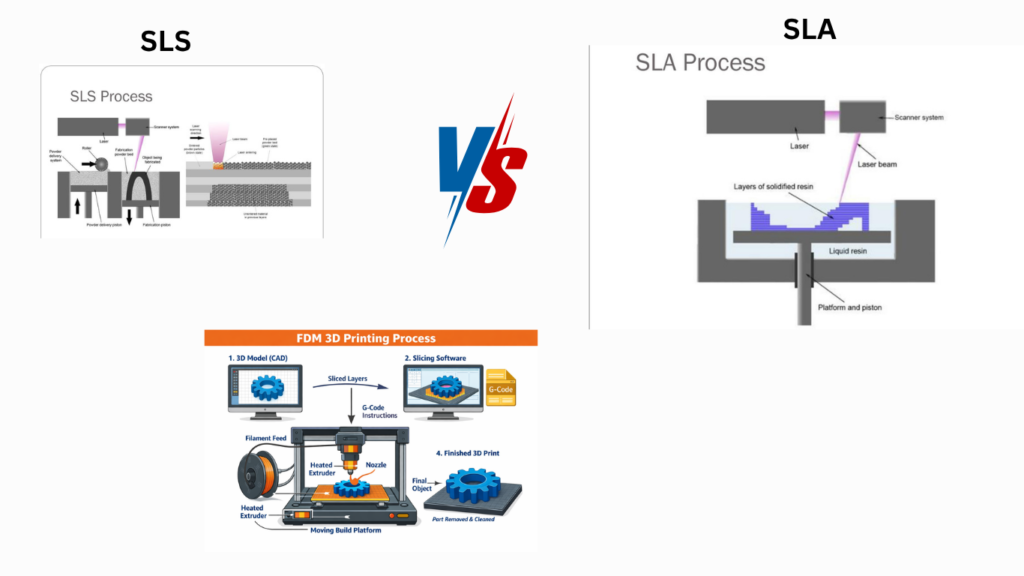
2. Working Principle Comparison
FDM
- Plastic filament is melted
- Deposited through nozzle
- Cools and solidifies layer by layer
SLA
- Liquid resin in vat
- UV laser cures each layer
- Build platform lifts gradually
SLS
- Powder bed spread
- Laser fuses selected areas
- New powder layer added repeatedly
3. Materials Used
| Technology | Material Type |
|---|---|
| FDM | Thermoplastic filaments (PLA, ABS, PETG) |
| SLA | Photopolymer resins |
| SLS | Powdered polymers (nylon), sometimes metals |
4. Accuracy & Surface Finish
SLA (Best)
- Very high accuracy
- Smooth, glossy surface
SLS (Good)
- Good accuracy
- Slightly rough powder texture
FDM (Lowest)
- Visible layer lines
- Moderate accuracy
5. Strength of Parts
SLS (Strongest)
- Uniform strength in all directions
- Good for functional parts
FDM
- Moderate strength
- Weak between layers (Z-axis)
SLA
- Brittle material
- Can crack under load
6. Cost Comparison
| Technology | Cost Level |
|---|---|
| FDM | ⭐ Low |
| SLA | ⭐⭐ Medium–High |
| SLS | ⭐⭐⭐ Very High |
7. Speed Comparison
| Type | Speed |
|---|---|
| FDM | Medium (slow for detail) |
| SLA | Fast for small parts |
| SLS | Fast for batch production |
8. Support Structures
| Technology | Supports Needed |
|---|---|
| FDM | Yes |
| SLA | Yes (in most cases) |
| SLS | ❌ No (powder acts as support) |
9. Applications
FDM Applications
- Prototypes
- Educational models
- Household items
- Jigs and fixtures
SLA Applications
- Dental models 🦷
- Jewelry 💍
- Medical prototypes
- High-detail miniatures
SLS Applications
- Aerospace components ✈️
- Automotive parts 🚗
- Functional engineering parts
- Complex geometries
10. Summary Table
| Feature | FDM | SLA | SLS |
|---|---|---|---|
| Material | Plastic filament | Resin | Powder |
| Accuracy | Medium | Very high | High |
| Strength | Medium | Low | High |
| Surface finish | Rough | Smooth | Medium |
| Cost | Low | Medium–High | Very high |
| Supports | Required | Required | Not required |
| Best use | Prototypes | Detailed models | Functional parts |
Summary:
👉 Each technology has a different strength:
- 🟡 FDM = Cheapest & simplest
- 🟣 SLA = Most precise & smooth
- 🔵 SLS = Strongest & industrial-grade
Conclusion:
FDM uses thermoplastic filaments and is low-cost but has lower accuracy. SLA uses UV light to cure resin and provides high accuracy and smooth finish but produces brittle parts. SLS uses a laser to sinter powder, producing strong functional parts without support structures, but it is expensive.
Other courses:





